Navigation
Install the app
How to install the app on iOS
Follow along with the video below to see how to install our site as a web app on your home screen.
Note: This feature may not be available in some browsers.
More options
Style variation
You are using an out of date browser. It may not display this or other websites correctly.
You should upgrade or use an alternative browser.
You should upgrade or use an alternative browser.
Go to lake fly?
- Thread starter Scudley Do Right
- Start date


Ha, yeah, could probably rename this the confirmation bias thread. It’s fun to see what the various go-to flies are, though. Olive and red seem to be a theme.Semi-seal leeches, pumpkin head in the spring and brown or black the rest of the time.
Full disclosure: I catch 95% of my fish on this, because I fish it 95% of the time.

Semi-seal leeches, pumpkin head in the spring and brown or black the rest of the time.
Full disclosure: I catch 95% of my fish on this, because I fish it 95% of the time.
I too am a 95%er.
When I try a different fly, it is always in tandem: my 'go to' fly and a new pattern or colored one. I switch them between first and last position to see if that makes a difference too...
If it ain't broke don't fix it. Why I am a 95%er...

Mike Bacca
Steelhead
Those are simi-seal leeches.


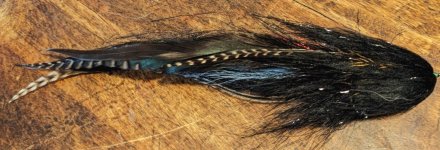

If it's stocked trout it's the stupid stocker leech under a float. Anything else an olive Simi seal leech with red glass bead on a type 6 seems to do the trick.
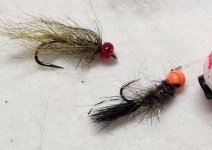

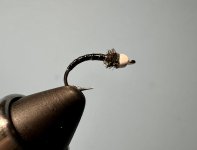
I had to go back and read @Scudley Do Right's "rule(s)" - so I'm gonna cheat and say there's never just one "go to lake" fly (for me). I'm moody, so are trout, so are carp, so are smallmouth. And my "fav" changes from time to time, just like the bite (or lack of bite). I absolutely LOVE indicator fishing - when I get lucky enough to be on a lake with a chironomid hatch, I will fish midges and if I'm lucky enough to get it dialed in then it might be this chronie:
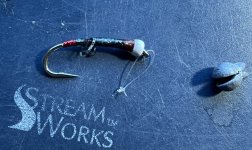
What's left of a zucchini midge (lucky size 13) - this worked unbelievably well on Leighton Lake last June (for two hours and not at all the next day).
More recently I've been fishing jigs under an indicator, the water has been cold and quite cloudy.
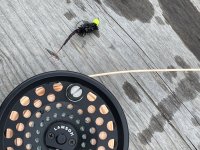
Vampire!
Like @Billy, I also like jig craws but mine look like crud compared to his so no pic.
What's left of a zucchini midge (lucky size 13) - this worked unbelievably well on Leighton Lake last June (for two hours and not at all the next day).
More recently I've been fishing jigs under an indicator, the water has been cold and quite cloudy.
Vampire!
Like @Billy, I also like jig craws but mine look like crud compared to his so no pic.

If I had to choose a favorite all-around lake fly, it would be Rickards Stillwater Bug.
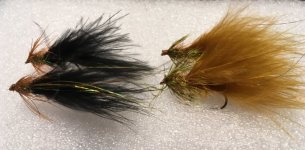
But I can’t pick just one. Sometimes a micro bugger works better, like this Jay Fair pattern.
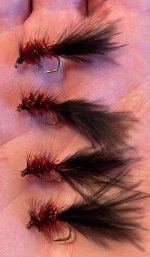
And sometimes I like to present my leeches and nymphs under an indicator.
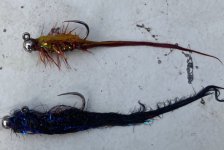
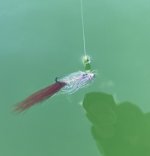
Or lately I’ve been getting more confident with oddball stuff like this that could be taken as a baitfish, but who knows?
But I can’t pick just one. Sometimes a micro bugger works better, like this Jay Fair pattern.
And sometimes I like to present my leeches and nymphs under an indicator.
Or lately I’ve been getting more confident with oddball stuff like this that could be taken as a baitfish, but who knows?
I'm beginning to really like that chartreuse bead so far. I copied that and am eager to see how it does closer to home.I had to go back and read @Scudley Do Right's "rule(s)" - so I'm gonna cheat and say there's never just one "go to lake" fly (for me). I'm moody, so are trout, so are carp, so are smallmouth. And my "fav" changes from time to time, just like the bite (or lack of bite). I absolutely LOVE indicator fishing - when I get lucky enough to be on a lake with a chironomid hatch, I will fish midges and if I'm lucky enough to get it dialed in then it might be this chronie:
View attachment 110250
What's left of a zucchini midge (lucky size 13) - this worked unbelievably well on Leighton Lake last June (for two hours and not at all the next day).
More recently I've been fishing jigs under an indicator, the water has been cold and quite cloudy.
View attachment 110251
Vampire!
Like @Billy, I also like jig craws but mine look like crud compared to his so no pic.

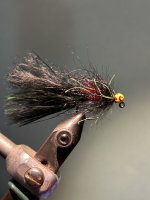

These work well for me.

Dustin Chromers
Legend
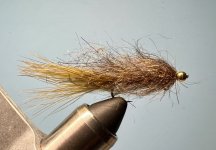
What's the material on this guy? It looks like it would move really nicely on a slow retrieve.View attachment 110003
Brahma buggers include endless variaiton possibilities. They are slowly replacing regular buggers in my lake boxes.

Flymph
Life of the Party
Chickabou feathers tied tip first from rear to front. No need for body material unless you want to experiment. You can purchase the more expensive "Brahma" hen from Whiting at the "Feather Emporium" ($23). Or, cheapskate it like I have from Amazon. Color schemes are unlimited. And yes, the body undulates and quivers much like the marabou tail!
Last edited:

The 95% idea is really interesting. Probably my most productive fly is a black bunny leach (moving or stillwater). It is simple, one of the first flies I learned to tie, caught my first fish on a fly i tied (6lb broodstock, which ruined me for a long time) and catching fish on it early was exciting, fun, productive, and so I have probably started with that fly or reverted back to it more than any other fly. @troutpocket your favorite flies are Denny Rickards or Jay Fair patterns/materials, which I guess are people or patterns your learned to tie somewhat early (correct me if I am wrong), so they were an impressionable part of your fly fishing growth and development. Hence they have stayed some of your favorites. Success also clearly plays a role as well. My only legit 50+ fish day was on chironomids, so of course I now think that is possible every time I go out. I think it is pretty funny that I have hundreds of flies every time I go out, yet I could probably get away with 3-5 different ones in different sizes and be just as successful. I know that I have many flies I tie that never actually get used. Oh well, that is part of the fun I guess.

Your comment on taking 100+ flies and only using a few is spot on. I use to carry a boat bag loaded with different stuff and several fly boxes. Now, especially if I’m fishing familiar water, I take one fly box and sometimes I just take the foam fly patch on my dashboard from the last trip.The 95% idea is really interesting. Probably my most productive fly is a black bunny leach (moving or stillwater). It is simple, one of the first flies I learned to tie, caught my first fish on a fly i tied (6lb broodstock, which ruined me for a long time) and catching fish on it early was exciting, fun, productive, and so I have probably started with that fly or reverted back to it more than any other fly. @troutpocket your favorite flies are Denny Rickards or Jay Fair patterns/materials, which I guess are people or patterns your learned to tie somewhat early (correct me if I am wrong), so they were an impressionable part of your fly fishing growth and development. Hence they have stayed some of your favorites. Success also clearly plays a role as well. My only legit 50+ fish day was on chironomids, so of course I now think that is possible every time I go out. I think it is pretty funny that I have hundreds of flies every time I go out, yet I could probably get away with 3-5 different ones in different sizes and be just as successful. I know that I have many flies I tie that never actually get used. Oh well, that is part of the fun I guess.

For sure we hang on to “confidence flies” from formative experience. Another reason I like Jay Fair/Rickards patterns and materials is that the materials are excellent and the patterns are satisfying to tie. I fish simiseal leeches too, but I don’t really enjoy tying them. Top quality feathers are rewarding for me to handle and I appreciate how the flies come out.The 95% idea is really interesting. Probably my most productive fly is a black bunny leach (moving or stillwater). It is simple, one of the first flies I learned to tie, caught my first fish on a fly i tied (6lb broodstock, which ruined me for a long time) and catching fish on it early was exciting, fun, productive, and so I have probably started with that fly or reverted back to it more than any other fly. @troutpocket your favorite flies are Denny Rickards or Jay Fair patterns/materials, which I guess are people or patterns your learned to tie somewhat early (correct me if I am wrong), so they were an impressionable part of your fly fishing growth and development. Hence they have stayed some of your favorites. Success also clearly plays a role as well. My only legit 50+ fish day was on chironomids, so of course I now think that is possible every time I go out. I think it is pretty funny that I have hundreds of flies every time I go out, yet I could probably get away with 3-5 different ones in different sizes and be just as successful. I know that I have many flies I tie that never actually get used. Oh well, that is part of the fun I guess.
A factor in favor of simiseal is durability. I’ve had one leech last through dozens of fish. I don’t tie or fish seal buggers much because the hackle stems break easily. I’ve played with techniques to protect the hackle but either haven’t been successful or the fly ends up spinning on the retrieve.
I agree that we can all simplify our fly selections and continue to catch plenty. The skills of consistently finding fish and presentation of whatever we choose to fish makes up for a basic fly box.
I keep debating the merit of doing like you suggest; one box for a lake I know well (it could work, it should work, and it would work - if only I took the time to assemble one box). I recall @Tim L sharing a photograph of his "box" (one of those round containers from a fly shop you put your purchase into) with perhaps a dozen bugs. I just can't quite get there.........Your comment on taking 100+ flies and only using a few is spot on. I use to carry a boat bag loaded with different stuff and several fly boxes. Now, especially if I’m fishing familiar water, I take one fly box and sometimes I just take the foam fly patch on my dashboard from the last trip.
It's funny, I hike into a local lake about eight or nine months a year to fish - on days when I can't seem to buy a strike, I might change up nine or ten times.... and always the same flies. (Buzzy: isn't there a lesson to learn?)

If you haven't yet, try this for durable, nonspinning buggers.I don’t tie or fish seal buggers much because the hackle stems break easily. I’ve played with techniques to protect the hackle but either haven’t been successful or the fly ends up spinning on the retrieve.
After tying in tail, lash wire (I use brassie sized wire) to the hook shank with about 7" of wire hanging off the rear of the hook. Build the body with whatever (if making the body from fragile peacock herl, I wrap the herl "towards me" in the opposite direction of everything else, so that the wire will counterwrap it later). Tie in your hackle feather by the base, at the head of the bugger.
Take 2 touching wraps of the hackle feather at the head of the fly. Taking these two wraps before palmering the feather back makes a flat face, rather than the start of a spiral, to push against oncoming water.
Palmer the feather back to the wire, catch it with two touching turns of the wire, then wrap the wire forward to the head and tie off. The wire will bind the hackle feather at every turn. Both the feather and the wire are wrapped "away from me," but because one was wrapped to the rear and one was wrapped to the head, they counterwrap.
Hit the finished fly with some velcro on a stick to randomize and break up the spiral effect of the hackle.