
Fishing the Last Mile First – Part III -Fundamentals
The Fishing the Last Mile First concept was first published in the Spring 2014 issue of Kayak Angler Magazine.
Mike Cline, Bozeman, Montana
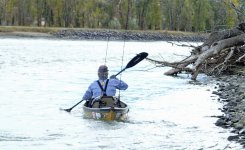
Paddling upstream around obstacles is easy in a light kayak.
Fishing the Last Mile First is based on the premise that everyone else is either fishing the last mile last or can’t get to all the last mile waters. If you take a look at most medium to large sized rivers in SW Montana, there are access points that range from a few miles to upwards of 20 miles apart. Anglers that float these rivers launch at an upstream access and float/fish down to a take-out access. They start in the morning and takeout in the afternoon. They are using drift boats or large rafts to cover a lot of water over a long period of time. Shore bound anglers may access the river at any legal access point but can be stifled by waters too deep to wade or impassible obstructions. The basic scenario is rather simple. Enter the river with your tethered kayak at a legal access point and begin wading (and fishing) upstream. When you encounter water too deep to wade, enter the kayak and paddle through to wadable water. This might be straight upstream through the lower end of a pool or across a pool or run to a shallower side of the river. No part of the river that is wadable is out of play as the kayak has the maneuverability and upstream motive power to access just about any part of the river. During pre and post runoff flows, there is rarely any section of most rivers that can’t either be waded or paddled through. Once you decide to return, enter the kayak and float back to the access point—no shuttle required.
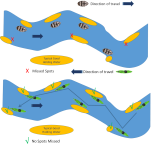
Kayak fishing upstream has a significant advantage over boats floating downstream
This fundamental process provides the Fishing the Last Mile First angler some significant advantages over traditional floaters or shore bound anglers. In medium and large rivers there is generally two to three lanes of productive water—both shorelines and often mid-channel obstructions and pools—three rivers in one in any given section. Any given floater—drift boat or raft--can only attack one of these lanes at a time as they move down the river. Their lack of fast maneuverability, particularly upstream in swift current, prevents them from fishing one shoreline then moving across the river to fish the opposite shoreline in the same river section. As they move down stream, they really only get to fish one of the three rivers. A lot of productive water is by-passed by any given boat. In rivers with moderate to significant pressure, unless you are the first boat down in the morning, every subsequent floater is probably fishing water another angler has already fished. This adds up significantly as the day moves on. Additionally, the floating angler generally doesn’t get more than one shot at productive water in swift current. Anyone who has ever fished from a drift boat knows how fast that deep riffle corner flies by in swift current.
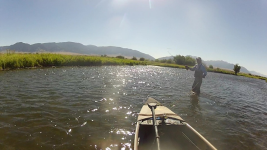
Covering water not available to the floating angler
The Last Mile (metaphorically) of any given point A to B float generally doesn’t get any attention until mid-day or afternoon depending on the distance the float must take. If the upstream access is 10 miles away, there’s a lot of river for the floater to cover before getting to the Last Mile. The Fishing the Last Mile First angler has unfettered and lonely access to all the productive water of the three rivers in one for most of the morning. While the shore-bound angler can certainly fish some parts of the Last Mile water, on medium to large rivers deep and/or swift water and obstructions generally limit angler access to only one of those three rivers in one. In all the years I’ve been in SW Montana I’ve only seen one angler wade across the Yellowstone River in Paradise Valley and that was in the early Spring when the flows were at their annual lows and a wide, shallow riffle stretched from shoreline to shoreline. But the Fishing the Last Mile First strategy has another advantage over the traditional wading angler—access to waters surrounded by private land. While the Montana Stream Access Law allows wading anglers to access rivers below the ordinary high-water mark, there are plenty of rivers where there are long distances of shoreline that just don’t have wadable water below the high water mark. These become obstacles that essentially block upstream travel for the wading angler without having to trespass. When the Fishing the Last Mile First angler encounters un-wadable water, the kayak is easily paddled upstream until suitable wading water is found.
Some Typical Scenarios
Drift Boats Get One Shot
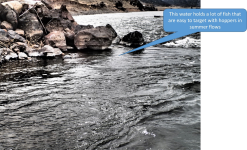
There are lots of productive places on a typical river that just can’t be fished effectively from a drift boat or raft. In the image below the riffle corner behind the rocky point is protected by an extremely swift chute in which a typical floater will fly by. Maybe the angler will get one good shot. However the same riffle corner is approachable by a wading angler from below. Multiple casts can be made to fully explore the hole behind the rocks.
Escaping Deep Water
As the Fishing the Last Mile First angler fishes up a deep bank and eventually encounters water too deep to safely wade, the kayak allows the angler to move across the river to shallow, safer water.
Navigating Difficult Waters
Sometimes the Fishing the Last Mile First angler encounters river sections that are just unpassable by a wading angler without trespassing on private land. In those cases, the kayak provides upstream motive capability to paddle through the impassible water.
Access To Water Unavailable To a Shore Bound Angler
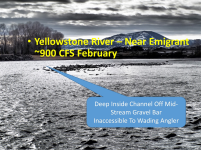
On many rivers mid-stream bars create angling opportunities that are just unreachable by the shore bound angler. These bars essentially create mid-stream banks, ledges and riffle corners/buckets that hold fish. The Fishing the Last Mile First angler can access and safely wade these bar when flows are optimal.
Fundamentally This is Wade Fishing WITH a Kayak, Not From a Kayak.
These Fishing the Last Mile First fundamentals can be applied coast to coast in just about any type of river that will safely float a kayak and has wadable water. Possibly limited to Montana is an angling regulation on certain waters where “Fishing from a boat” is prohibited. This doesn’t limit access to the water by boat and thus makes the Fishing the Last Mile First strategically very valuable on these waters. Fishing the Last Mile First may seem simple in concept, but there are some tips and advice that will make the process easier and more productive. Fishing the Last Mile First – Part IV – Tips and Advice
Fishing the Last Mile First – Part I – An Angling Strategy
Fishing the Last Mile First – Part II – Boats and Gear
Fishing the Last Mile First – Part III – Fundamentals
Fishing the Last Mile First – Part IV – Tips and Advice
The Fishing the Last Mile First concept was first published in the Spring 2014 issue of Kayak Angler Magazine.
Mike Cline, Bozeman, Montana
Paddling upstream around obstacles is easy in a light kayak.
Fishing the Last Mile First is based on the premise that everyone else is either fishing the last mile last or can’t get to all the last mile waters. If you take a look at most medium to large sized rivers in SW Montana, there are access points that range from a few miles to upwards of 20 miles apart. Anglers that float these rivers launch at an upstream access and float/fish down to a take-out access. They start in the morning and takeout in the afternoon. They are using drift boats or large rafts to cover a lot of water over a long period of time. Shore bound anglers may access the river at any legal access point but can be stifled by waters too deep to wade or impassible obstructions. The basic scenario is rather simple. Enter the river with your tethered kayak at a legal access point and begin wading (and fishing) upstream. When you encounter water too deep to wade, enter the kayak and paddle through to wadable water. This might be straight upstream through the lower end of a pool or across a pool or run to a shallower side of the river. No part of the river that is wadable is out of play as the kayak has the maneuverability and upstream motive power to access just about any part of the river. During pre and post runoff flows, there is rarely any section of most rivers that can’t either be waded or paddled through. Once you decide to return, enter the kayak and float back to the access point—no shuttle required.
Kayak fishing upstream has a significant advantage over boats floating downstream
This fundamental process provides the Fishing the Last Mile First angler some significant advantages over traditional floaters or shore bound anglers. In medium and large rivers there is generally two to three lanes of productive water—both shorelines and often mid-channel obstructions and pools—three rivers in one in any given section. Any given floater—drift boat or raft--can only attack one of these lanes at a time as they move down the river. Their lack of fast maneuverability, particularly upstream in swift current, prevents them from fishing one shoreline then moving across the river to fish the opposite shoreline in the same river section. As they move down stream, they really only get to fish one of the three rivers. A lot of productive water is by-passed by any given boat. In rivers with moderate to significant pressure, unless you are the first boat down in the morning, every subsequent floater is probably fishing water another angler has already fished. This adds up significantly as the day moves on. Additionally, the floating angler generally doesn’t get more than one shot at productive water in swift current. Anyone who has ever fished from a drift boat knows how fast that deep riffle corner flies by in swift current.
Covering water not available to the floating angler
The Last Mile (metaphorically) of any given point A to B float generally doesn’t get any attention until mid-day or afternoon depending on the distance the float must take. If the upstream access is 10 miles away, there’s a lot of river for the floater to cover before getting to the Last Mile. The Fishing the Last Mile First angler has unfettered and lonely access to all the productive water of the three rivers in one for most of the morning. While the shore-bound angler can certainly fish some parts of the Last Mile water, on medium to large rivers deep and/or swift water and obstructions generally limit angler access to only one of those three rivers in one. In all the years I’ve been in SW Montana I’ve only seen one angler wade across the Yellowstone River in Paradise Valley and that was in the early Spring when the flows were at their annual lows and a wide, shallow riffle stretched from shoreline to shoreline. But the Fishing the Last Mile First strategy has another advantage over the traditional wading angler—access to waters surrounded by private land. While the Montana Stream Access Law allows wading anglers to access rivers below the ordinary high-water mark, there are plenty of rivers where there are long distances of shoreline that just don’t have wadable water below the high water mark. These become obstacles that essentially block upstream travel for the wading angler without having to trespass. When the Fishing the Last Mile First angler encounters un-wadable water, the kayak is easily paddled upstream until suitable wading water is found.
Some Typical Scenarios
Drift Boats Get One Shot
There are lots of productive places on a typical river that just can’t be fished effectively from a drift boat or raft. In the image below the riffle corner behind the rocky point is protected by an extremely swift chute in which a typical floater will fly by. Maybe the angler will get one good shot. However the same riffle corner is approachable by a wading angler from below. Multiple casts can be made to fully explore the hole behind the rocks.
Escaping Deep Water
As the Fishing the Last Mile First angler fishes up a deep bank and eventually encounters water too deep to safely wade, the kayak allows the angler to move across the river to shallow, safer water.
Navigating Difficult Waters
Sometimes the Fishing the Last Mile First angler encounters river sections that are just unpassable by a wading angler without trespassing on private land. In those cases, the kayak provides upstream motive capability to paddle through the impassible water.
Access To Water Unavailable To a Shore Bound Angler
On many rivers mid-stream bars create angling opportunities that are just unreachable by the shore bound angler. These bars essentially create mid-stream banks, ledges and riffle corners/buckets that hold fish. The Fishing the Last Mile First angler can access and safely wade these bar when flows are optimal.
Fundamentally This is Wade Fishing WITH a Kayak, Not From a Kayak.
These Fishing the Last Mile First fundamentals can be applied coast to coast in just about any type of river that will safely float a kayak and has wadable water. Possibly limited to Montana is an angling regulation on certain waters where “Fishing from a boat” is prohibited. This doesn’t limit access to the water by boat and thus makes the Fishing the Last Mile First strategically very valuable on these waters. Fishing the Last Mile First may seem simple in concept, but there are some tips and advice that will make the process easier and more productive. Fishing the Last Mile First – Part IV – Tips and Advice
Fishing the Last Mile First – Part I – An Angling Strategy
Fishing the Last Mile First – Part II – Boats and Gear
Fishing the Last Mile First – Part III – Fundamentals
Fishing the Last Mile First – Part IV – Tips and Advice
Last edited: