Fish Science Geek Out

Hi @Cabezon ,
Just to be clear, these walleye do not have blue flesh. The protein/biliverdin complexes found in lingcod, cottids, etc., plus some lizards, and many frog species are, I believe, mostly known to involve serpins, and are not fluorescent, and seem to permeate blood, flesh, bone, etc.
Sandercyanin is a secretory protein, as evidenced both by its physical location on the fish, and the fact that the AA sequence contains a secretory signal peptide.
As a free monomer, sandercyanin is colorless, only becoming bright blue when, in the presence of biliverdin, it forms tetrameric complexes, with each sandercyanin molecule cradling a molecule of biliverdin. Under exposure to UV around the 375nm wavelength, that complex fluoresces brilliant red.

I cannot believe that the researchers never took photos of the whole fish under 375nm UV. I may buy a UV dive light and try to do this, just because glowing red walleye 😃🤓😈
Hi Northern,
Yes, you did indicate that the blue was in the slime. Some fish can see in the UV. I wonder if the visual pigments of walleye have been examined. And birds, potentially their predators, can also see in the UV.
 
Hi Northern,
Yes, you did indicate that the blue was in the slime. Some fish can see in the UV. I wonder if the visual pigments of walleye have been examined. And birds, potentially their predators, can also see in the UV.
From one of the papers on sandercyanin:

Blue colors in animals are often expected to have a signaling
function (Umbers 2013). Walleye possess both single and twin
cones in their retina. The single cones in walleye contain a greensensitive
photopigment that absorbs maximally at 533 nm. The
twin cones of the walleye retina absorb maximally at 605 nm. No
blue-sensitive cones have been found (Burkhardt et al. 1980), so
the function of sandercyanin in intraspecific signaling would be
limited in walleye.
 
From one of the papers on sandercyanin:

Blue colors in animals are often expected to have a signaling
function (Umbers 2013). Walleye possess both single and twin
cones in their retina. The single cones in walleye contain a greensensitive
photopigment that absorbs maximally at 533 nm. The
twin cones of the walleye retina absorb maximally at 605 nm. No
blue-sensitive cones have been found (Burkhardt et al. 1980), so
the function of sandercyanin in intraspecific signaling would be
limited in walleye.

Haven't done any reading, so this is just right off there top of a very uninformed head regarding this topic - two ideas cone to mind:
  1. Blue coloration in the slime is for camouflage?
  2. Blue coloration in the slime attracts potential prey?
These things just do not evolve and stay for the halibut (see what I did there - fish pun), there is a purpose. Thoughts? Am I way off?

cheers
 
Haven't done any reading, so this is just right off there top of a very uninformed head regarding this topic - two ideas cone to mind:
  1. Blue coloration in the slime is for camouflage?
  2. Blue coloration in the slime attracts potential prey?
These things just do not evolve and stay for the halibut (see what I did there - fish pun), there is a purpose. Thoughts? Am I way off?

cheers
A paper with some theories; click on the pdf link to read it. And yes, camo is one!
 
Wasn't sure where to post this, but I feel like there might be at least a couple folks on here that find this as cool as I do...serious nerd warning!

In the art forum, I recently posted a couple pics of fins:
View attachment 3967
View attachment 3968
Those are not color manipulated, and they're not tropical. Those are of walleye fins in NW Ontario!
We were on a 2017 fly-in trip, the only cabin on the lake, so there was no one to ask if this was normal. My sibs and I have fished ON for decades - but this was the farthest north we've been. About 10% of the 'eyes we were catching had these brilliant blue fins, and this blue goo came off on your hands and on the cleaning table.
(Of course, after discussing how bizarre that was, and that we had no idea what it could be, we ate them anyway 😜)

Now, there used to be such a thing as Blue Walleye, but they apparently went extinct or almost extinct decades ago, and were more an all-over bluish gray phase, not this bright indigo. We knew that, and these were definitely not that.

When I got home, I did some internet research, and found some very recent articles about a newly discovered protein isolated from - you guessed it - walleye (Sander vitreus) fins!

Turns out that sandercyanin is a fluorescent protein with some super cool unique properties. As a molecular biologist, protein engineer, and walleye enthusiast myself, I was smitten! 🤓

If you're interested, here's a paper to start with: https://www.pnas.org/content/113/41/11513

A very brief summary, though: Sandercyanin is a very small protein secreted in the mucous layer of some walleye. Four of these molecules will non-covalently bind to a ligand called biliverdin, which is a product of UV radiation-induced breakdown of heme in the blood. The protein complex formed by that binding is not only bright blue, but under UV light will undergo a huge spectral shift to fluoresce as red!
(I won't bore you with all the other interesting properties of this molecule, you can read the papers if you like.) There's a theory that this is a recent adaptation to the increased UV exposure of a thinning ozone layer up north; that the sandercyanin absorbs UV and acts as a natural sunscreen. 😎

We're headed back up that way in August, after having our trip canceled for the last 2 years due to Covid. I'm planning to bring a strong UV lamp in the appropriate wavelength, and I really want to try to get photos of a glowing red walleye! How cool would that be??

I'm not a scientist but this is kind of up my alley with regard to light and optical effects. What I'd like to know is the blue color also a result of the protein fluorescing, or preferentially absorbing longer wavelengths? I suppose a third option (depending on the dimension and spatial arrangement of the protein molecules) might be diffraction of blue light. I doubt that's the case however since the proteins are embedded in the skin and mucus (additional/denser mediums light would pass through) which should prohibit any iridescence (diffraction). Same reason peacock is iridescent in air but not water.
 
I'm not a scientist but this is kind of up my alley with regard to light and optical effects. What I'd like to know is the blue color also a result of the protein fluorescing, or preferentially absorbing longer wavelengths? I suppose a third option (depending on the dimension and spatial arrangement of the protein molecules) might be diffraction of blue light. I doubt that's the case however since the proteins are embedded in the skin and mucus (additional/denser mediums light would pass through) which should prohibit any iridescence (diffraction). Same reason peacock is iridescent in air but not water.
Your answer might be in here:
 
Same reason peacock is iridescent in air but not water.
Thanks for putting the image in my head of someone throwing a peacock in tub and seeing if the feathers change.
 
I have long been super interested in blue lingcod. Mostly just because I think they are super cool! I've read as much as this non scientist can, and from what I've gathered the scientists know what causes the blue flesh, but nobody has totally established why it happens.

Personally the diet theory never really seemed solid to me because it would seem that if one lingcod in a particular area had access to, and was eating a lot of squid/crab then I would think a higher percentage of other lings in the same area would also be blue, but at least IME I've never found that to be the case. I've never encountered a high density of blue lings in any particular area. More common is to catch 12 lingcod from an area on any particular day, and maybe one of them is blue. I dunno, just my un scientific thoughts lol.

Again anecdotal, but as Steve mentioned regarding depth, I've caught very few blue lingcod deeper than about 250', with the bulk of them coming in 180' or less.

I've heard a lot of people claim that they prefer the taste of the blue lings over the standard flesh, but never really believed it. Always assumed there was a placebo affect going on. Last season we did a blind taste test with our crew in Westport and not one of us was able to notice a difference. Not that that proves anything at all but it was interesting. Always thought it was neat the way the blue flesh turns white when put on heat.

Lingcod are probably my favorite fish. Just love those things.


View attachment 5524


A friend at work fishes of the coast a bit north of you and said all his lings a blue, he catches as many plain Jane's a yr as I get blues in a yr, very few.
 
To continue this excellent thread.

In the late 1980s while snorkeling to find bull trout we noticed that with a pod of bulls holding in a pool prior to the spawning that the largest males had the brightest spawning colors. We speculated that the maybe the largest males matured first. In the same reaches I was capturing individual fish and using meristic counts identifying the fish as a bull trout or Dolly Varden and applied difference color floy tags to each "species". Later that fall as the char began spawning I came upon an active spawning female attended by 3 males: two equal size males and the third much smaller. Oner of the large male was a tagged bull trout which had the vivid coloration typically associated with a male in spawning coloration while the other two were much paler. Of course, I immediately thought that those bright colors were associated with that male being a bull trout and the other Dollies. Since it was mid-day, I found a soft rock to water the fish going through their spawning rituals while eating my lunch. After a few minutes a bird flying by spooked the fish which darted under a large log. The female quickly returned to her redd and was quickly joined by the two larger males which took up position. However now the untagged fish had taken the dominate spawning position (next to the female) and the other now in a secondary position below the other two. The real news here was that after the switch in spawning position the untagged fish now had that vivid spawning coloration while the coloration of the previously brightly colored male faded dramatically.

Having witness that color change in actively spawning char a number of times it is clear that dominate male (usually the larger fish) was always that most brightly color with the secondary have much more muted colors. Further if the dominance changes the fish switch their color intensity within minutes. Clearly at least in the case of the bull trout what we normal thinking of spawning colorations as static conditions related to maturity of the fish the social status (dominant or subdominant) of the fish controls the intensity of that coloration and the fish can change that intensity quickly as its status changes.

As often the case it turns out fish are much more complex than we often think and are more than willing to jump out of any boxes we may want to put them in!

curt
 
To continue this excellent thread.

In the late 1980s while snorkeling to find bull trout we noticed that with a pod of bulls holding in a pool prior to the spawning that the largest males had the brightest spawning colors. We speculated that the maybe the largest males matured first. In the same reaches I was capturing individual fish and using meristic counts identifying the fish as a bull trout or Dolly Varden and applied difference color floy tags to each "species". Later that fall as the char began spawning I came upon an active spawning female attended by 3 males: two equal size males and the third much smaller. Oner of the large male was a tagged bull trout which had the vivid coloration typically associated with a male in spawning coloration while the other two were much paler. Of course, I immediately thought that those bright colors were associated with that male being a bull trout and the other Dollies. Since it was mid-day, I found a soft rock to water the fish going through their spawning rituals while eating my lunch. After a few minutes a bird flying by spooked the fish which darted under a large log. The female quickly returned to her redd and was quickly joined by the two larger males which took up position. However now the untagged fish had taken the dominate spawning position (next to the female) and the other now in a secondary position below the other two. The real news here was that after the switch in spawning position the untagged fish now had that vivid spawning coloration while the coloration of the previously brightly colored male faded dramatically.

Having witness that color change in actively spawning char a number of times it is clear that dominate male (usually the larger fish) was always that most brightly color with the secondary have much more muted colors. Further if the dominance changes the fish switch their color intensity within minutes. Clearly at least in the case of the bull trout what we normal thinking of spawning colorations as static conditions related to maturity of the fish the social status (dominant or subdominant) of the fish controls the intensity of that coloration and the fish can change that intensity quickly as its status changes.

As often the case it turns out fish are much more complex than we often think and are more than willing to jump out of any boxes we may want to put them in!

curt
Well that's interesting and timely!
My daughter is working in a fish biology lab this quarter down at Cal Poly, helping with a study on colorations and breeding behaviors in some guppylike species. She was just describing it to me yesterday, but when I asked if the prof knew if the color differences were genetic or environmental, she wasn't sure.

Do you mind if I send her this anecdote?
 
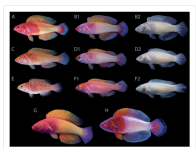
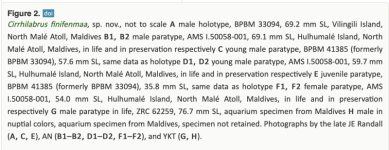
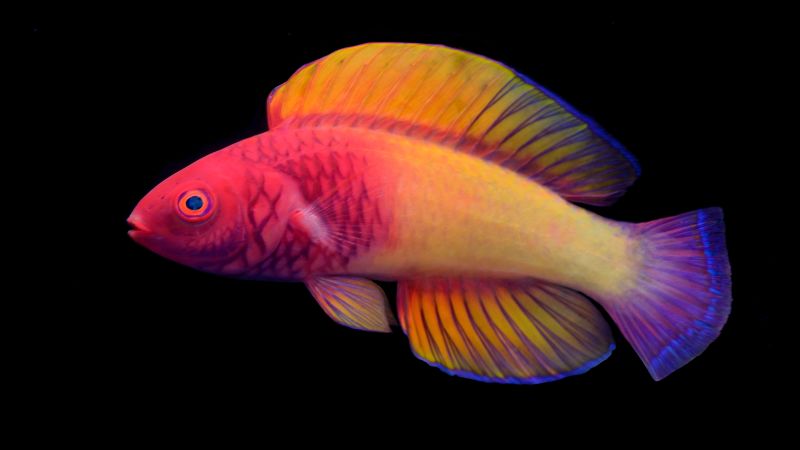
Meet the newly discovered Cirrhilabrus finifenmaa (rose-veiled fairy wrasse):
Screen Shot 2022-03-10 at 4.43.54 AM.png

Screen Shot 2022-03-10 at 4.45.17 AM.png


cheers
 
Meet the newly discovered Cirrhilabrus finifenmaa (rose-veiled fairy wrasse):
View attachment 8231

View attachment 8232


cheers
Easy to see why it's been overlooked.
 
Back
Top