
Back from a trip over the mountains and the time when a special bug, loaded with protein, comes crawling out to meet others, engage in a little hanky panky, and seeks to repopulate their species. Larger trout, hungry from not having much to eat in the winter, muscle smaller trout away from the prime feeding lanes and gorge themselves on the hatching Skwalla. I am an old guy and don't have too many more years to get on the water and enjoy our amazing pastime. This is one time in the year when old guys like me, who are not especially skillful, have a shot at larger trout.
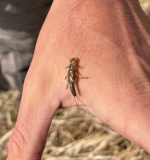
The bug life in a river continues to fascinate me and I learn much from good guides who understand the life on their waters and the changing seasons. Here is a photo of the pupa. This one is missing a leg for some reason.
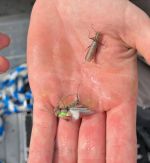
And here is a photo of the adult (after they crawl out of the water and shed their casing on a tree branch). In this same photo is the fly we used to imitate the adult on the water, laying eggs. Skwallas do not usually fly very far to lay their legs. They seem to just fall off of branches and grass, near the waters edge, and float close to the bank downstream, in a clearly defined feeding lane.
I attach a link to a short video, taken by my friend, that shows me trying to strip in line, as fast as an old man can strip line in, because the trout who took my fly is racing towards me. Ryder, my friend's dog, was helping me all the way: https://www.youtube.com/watch?v=xU75rrb-fkE Ryder, by the way, gives me "The Look of Shame" whenever I lose a fish. I was trying my darnedest to avoid that look.
You will note that both my friend and I (and I suspect Ryder) were laughing at the old guy trying to relive his youth. We have such a good time together and he is so skillful and knowledgeable. It is a special treat to spend time on the water with him.
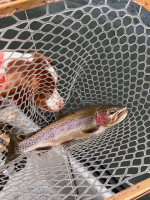
This trip will be a memory to keep me company in the later stages of my life. I attach a photo of one of the nearly a dozen, 20-inch trout that I caught on a simply incredible day. Many of the trout on this trip showed the result of the winter, with thinner bodies than they will have later in the year, and proportionately larger heads. I hope you enjoy these images and that spring is also coming to your part of the world, too.
The bug life in a river continues to fascinate me and I learn much from good guides who understand the life on their waters and the changing seasons. Here is a photo of the pupa. This one is missing a leg for some reason.
And here is a photo of the adult (after they crawl out of the water and shed their casing on a tree branch). In this same photo is the fly we used to imitate the adult on the water, laying eggs. Skwallas do not usually fly very far to lay their legs. They seem to just fall off of branches and grass, near the waters edge, and float close to the bank downstream, in a clearly defined feeding lane.
I attach a link to a short video, taken by my friend, that shows me trying to strip in line, as fast as an old man can strip line in, because the trout who took my fly is racing towards me. Ryder, my friend's dog, was helping me all the way: https://www.youtube.com/watch?v=xU75rrb-fkE Ryder, by the way, gives me "The Look of Shame" whenever I lose a fish. I was trying my darnedest to avoid that look.
You will note that both my friend and I (and I suspect Ryder) were laughing at the old guy trying to relive his youth. We have such a good time together and he is so skillful and knowledgeable. It is a special treat to spend time on the water with him.
This trip will be a memory to keep me company in the later stages of my life. I attach a photo of one of the nearly a dozen, 20-inch trout that I caught on a simply incredible day. Many of the trout on this trip showed the result of the winter, with thinner bodies than they will have later in the year, and proportionately larger heads. I hope you enjoy these images and that spring is also coming to your part of the world, too.