Dozens of Carp at a lake near Spokane

I've never weighed a carp but two years ago I was fishing with Chief and caught a carp, I guessed the weight and was pretty close at just over 6 pounds. He has a scale and weighs fish in his net. I'd guess that the biggest carp I've caught were less than 20 pounds but probably pushing 20. Here's @Engee with a pretty good sized carp:View attachment 118418

No offense to @mcswny, I don't wait three seconds. If a carp eats, I set the hook. Quickly. But he's spot on with rod weight.
No offense taken!!
 
I've never weighed a carp but two years ago I was fishing with Chief and caught a carp, I guessed the weight and was pretty close at just over 6 pounds. He has a scale and weighs fish in his net. I'd guess that the biggest carp I've caught were less than 20 pounds but probably pushing 20. Here's @Engee with a pretty good sized carp:View attachment 118418

No offense to @mcswny, I don't wait three seconds. If a carp eats, I set the hook. Quickly. But he's spot on with rod weight.
In his defense, it was a special scenario where fish were kind of suspended in 4-5' of water. So you can see the fish dip, but not the actual eat. I wait for the dip, count, then strip set.
 
Remember the old commercials that said "When E. F Hutten talks, people listen"?...that is were I am here in this thread. Already my odds of success have increased immensely. So,, say I have a fly on the bottom near a fish and I am attempting to place right in front of his nose. Once that has been accomplished,,,should the fly stay motionless? Or twitch?
 
So many questions.. I have never considered using any kind of "scent" on any fly...however I have found that the use of a "scent" to be very effective in other fisheries. I wonder if Carp fly fisherman have explored the possibilities of using scent to increase catch rate. If any fish "sniffs" the bottom it would be the Carp. Cheating? Possibly ..Interesting notion? Yes IMHO
 
So many questions.. I have never considered using any kind of "scent" on any fly...however I have found that the use of a "scent" to be very effective in other fisheries. I wonder if Carp fly fisherman have explored the possibilities of using scent to increase catch rate. If any fish "sniffs" the bottom it would be the Carp. Cheating? Possibly ..Interesting notion? Yes IMHO
Shouldn't be necessary. If they see it, they'll grab it. Ideally you catch their attention while the fly falls. They see it hit the bottom, then slurp.
 
That is pure gold information Evan B. I am way out of my wheelhouse in this fishery and you (and the other folks) are seriously clueing me in. Question.....the fly hits the bottom..do you leave it there, twitch it or bring it back for another attempt at falling in front of the fish? I humbly ask this, Jim
 
That is pure gold information Evan B. I am way out of my wheelhouse in this fishery and you (and the other folks) are seriously clueing me in. Question.....the fly hits the bottom..do you leave it there, twitch it or bring it back for another attempt at falling in front of the fish? I humbly ask this, Jim
It depends and that's something you will have to get a feel for as every fish is different. If he didn't see it, then try to pull it back without spooking him and reset. Typically, I only move the fly on the bottom if the placement wasn't quite right and I'm making one last effort for him to see it before I reset.

But like I said, I have most my success when they see it drop.
 
Heck, I'll ask another question...How fast should the fly be sinking to ultimately get a strike on the sink? I can tie a fly to sink fast or slow.
 
Evan B Are you saying that you leave your fly completely motionless once it has hit bottom and in front of the fish? Completely motionless?
Pretty much yeah. Ideally it won't sit there for more than a few seconds though. If you don't have their attention within a few seconds, it's time to reset.

Sink is a few inches per second. Typical barbell eyes get the job done. No need for anything crazy like tungsten. Bead chain eyes tend to not be enough for most flies except for really shallow stuff.
 
I agree with Evan that if a carp sees the fly sinking and it hasn't spooked him*, then there's a good chance the fish will move to the sunk fly and eat it. Be ready.

Scent: I won't use it on carp flies (or trout flies or bass flies) that's just me. But I have no qualms about others doing so and I do enjoy fastening a nightcrawler to a slow death hook and fishing for walleye.

I'm a fly twitcher if I've cast out of a fishes sight line but they're coming towards the fly. Sometimes I think twitching a fly gets a fishes attention.

* Sink rate - I'm moving out of big lead dumbell eyes for the most part, they make a lot of noise hitting the water and I think spook more fish than not. That's just me, others mileage may vary.

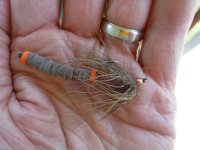
This is a fun fly as the "tail" keeps the hook from fouling bottom:


Trouser worm.JPG

The Trouser Worm ---^

Check out John Montana's stuff.
 
I am so thankful for so much information. Just think how clueless I would be without this forum..... A simple, innocent afternoon kayak trip with my sister and it leads me down a "rabbit hole" of trying to rip a lip of a huge fish.... It's not my fault..those big Carp were laughing at me... I think one of them flipped me the bird. I will net one.
 
I finally broke down and gave carp a try a few years ago when it was so hot and everything else was shut down. It’s a blast, sight fishing to strong, selective fish. There are times I think about trading my drift boat for something I can use for carp.
 
I finally broke down and gave carp a try a few years ago when it was so hot and everything else was shut down. It’s a blast, sight fishing to strong, selective fish. There are times I think about trading my drift boat for something I can use for carp.
The opinion I've kind of formed on carp: They are the most "fair play" fish we have to target around here. As in, if you do things right, they will play almost every time. So it's very much a test of skill, and when you mess it up, you'll know it, they'll know it, and you typically know what to do different next time. It's a fun game to play, and I find it the most rewarding freshwater fly fishery available to us in the PNW.
 
One thing to consider is the forage that is available in the body of water you are fishing. Most of the input here so far is from guys who fish the Columbia or lakes formed from the Columbia. Carp in that system eat a lot of clams and don't move very far for a fly. Thus, the drag and drop presentation has become the go to and is definitely the most effective.

You go to a place like Lake Michigan, where the primary forage is Goby's, and carp will chase streamers several feet for a meal. I fished Lake Las Vegas one time and caught carp on swimming nymphs. Some places in Montana they catch them on dry flies in the foam lines in back eddies of rivers. During the Cicada hatch in the Midwest and southwest they catch them on big floating bugs, and there are other places where they will hang out under mulberry trees and wait for the ripened berries to plop into the water and can be caught on mulberry imitations. Other places crayfish imitations can be what they are looking for.

My point is that your lake near Spokane may or may not have fish that eat the same forage and/or respond the same way as carp near me. But the advice given so far is a great place to start. The more you target carp, the more you learn. They have a lot of dimensions to them and are a very satisfying fish to pursue.
 
One thing to consider is the forage that is available in the body of water you are fishing. Most of the input here so far is from guys who fish the Columbia or lakes formed from the Columbia. Carp in that system eat a lot of clams and don't move very far for a fly. Thus, the drag and drop presentation has become the go to and is definitely the most effective.

You go to a place like Lake Michigan, where the primary forage is Goby's, and carp will chase streamers several feet for a meal. I fished Lake Las Vegas one time and caught carp on swimming nymphs. Some places in Montana they catch them on dry flies in the foam lines in back eddies of rivers. During the Cicada hatch in the Midwest and southwest they catch them on big floating bugs, and there are other places where they will hang out under mulberry trees and wait for the ripened berries to plop into the water and can be caught on mulberry imitations. Other places crayfish imitations can be what they are looking for.

My point is that your lake near Spokane may or may not have fish that eat the same forage and/or respond the same way as carp near me. But the advice given so far is a great place to start. The more you target carp, the more you learn. They have a lot of dimensions to them and are a very satisfying fish to pursue.
It can even vary here in the lower Columbia where I primarily fish. The methods described so far in this thread should be a good place to start for most folks, though.

One variance is a particular back eddy type spot not far from me. It's only a few miles from the "carp flats" I frequent, but couldn't be more different. It's 10-15' deep, and the carp are schooled up in groups of 5-10 fish, and slowly cruising around in roving circles. I get out of the boat and stand on the sand bar near the ledge the tend to follow. I cast out a full floater, long leader, and very lightly weighted damselfly nymph. I slowly strip it back in. I never see the eat, or even really see the fish that go for it. But they will follow and eat that nymph.

Edit: I want to add, though, that this method does not work at all in the other spots I fish.
 
Last edited:
The opinion I've kind of formed on carp: They are the most "fair play" fish we have to target around here. As in, if you do things right, they will play almost every time. So it's very much a test of skill, and when you mess it up, you'll know it, they'll know it, and you typically know what to do different next time. It's a fun game to play, and I find it the most rewarding freshwater fly fishery available to us in the PNW.
That’s a great description. Those fish don’t hide their feelings.
 
The lake I am trying not to "hotspot" has a rich history of experimental applications of kill offs and planted fish attempts, including Walleye and various forms of trout and spiny rays. I just read a post from Tim Lockhart from about ten years ago regarding this lake. Last year I witnessed several very large trout being caught from a "campground" dock. I asked what made the trout so damn big...I was told "freshwater shrimp" which I interpreted as scuds with a grayish pink translucent coloring. If this is indeed the case, I assume that a scud pattern would be worthy of a try. If this lake were in my area I would likely be posting info..because it is not, I am asking for info. AND... I must say the information so far given exceeds my expectations. Thanks for everyones input.....the Carp know not what I scheme. Teaching my 4 1/2 year old nephew to target them will ( hopefully) result in decades of ripped little rubber Carp lips. Cheers folks, Jim
 
Back
Top