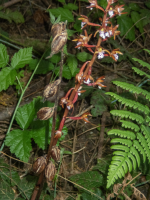
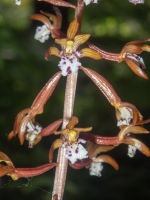
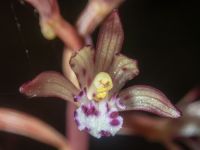
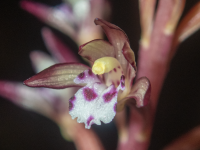
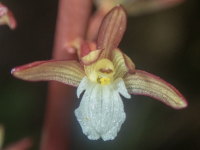
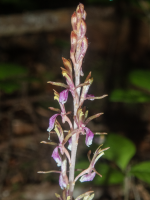
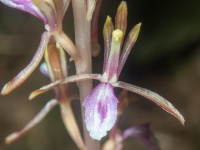
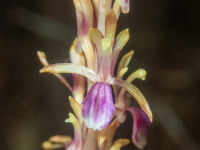
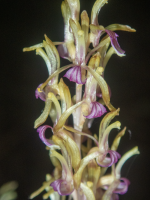
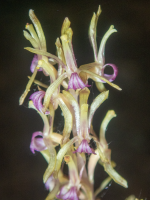
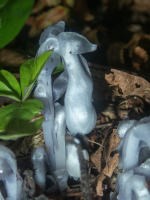
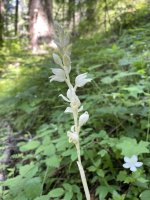
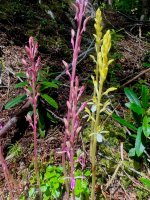
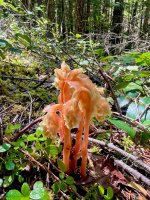
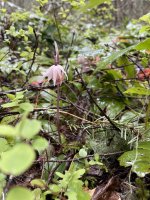
Coralroot orchids, Part 1 of 2. [Heavy on very cool core plant biology.] For over a month, I’ve fallen into a rabbit hole regarding coralroot orchids. I have made eight trips to locate and photograph them along the trails of the Evergreen State College and the Ralph Munro Trail near my house. At first, I was just happy to see such unusual, cryptic plants. Then, after taking some closeup pictures of the flowers, I realized that there were more than a single species here. In subsequent walks,I also realized that there were several “varieties” of one species in this small area. Finally, one dense patch of coralroot inflorescences produced flowers that don’t really match any of the described species or varieties. So, a rabbit hole (and I’m a marine fish biologist…).
So, let’s talk about these unusual plants, specifically orchids, and coralroot orchids in particular. Orchids really tickle my biological fancy. The family Orchidaceae is the second-most species-rich plant family with over 28,000 species (6-11% of all seed plants), with asters (Asteraceae) in first place at over 32,000 species. Orchids are found on all continents, except Antarctica, in a variety of habitats, but they are especially diverse in the tropics. Washington state has over 30 orchid species. These range in habitat from dense coastal forests to the edges of mountain streams and wet meadows.
Why are orchids cool? Let me count the ways. Orchids produce very specialized flowers. These flowers are central to their complex relationships with pollinators and the genesis of their biodiversity. While some orchids do self-pollinate, most orchids are pollinated by animals, especially insects, but also including hummingbirds. In particular, orchids have co-evolved intricate relationships with specialized pollinators. Charles Darwin included examples of these interactions in “On the Origin of Species” and described these pollinator-orchid relationships at greater length in the “On the Various Contrivances by Which British and Foreign Orchids Are Fertilized by Insects, and On the Good Effects of Intercrossing”. Inducements provided by orchids to attract pollinators include nectar, oils, waxes, resins, and perfumes. Orchids can also attract pollinators by deception, i.e., appearing to offer something that interests the pollinator but not delivering. The most infamous example of these deceptive strategies is “pseudocopulation”. Here an orchid flower mimics the appearance of a female insect and releases chemical attractants that are similar to the pheromones released by a female of this insect species. Single-minded males attempt to copulate with the orchid flower. (look it up…. Males can be so single-minded…). In the process, the males pick up pollinia (pollen sacs) and carry them to the next deceptive flower.
How do orchid flowers differ from typical flowers? Let’s use the Western white trillium as our model of a typical flower.
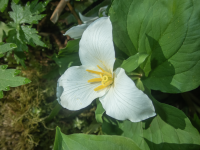
In trilliums, the flower bud is enclosed by three green sepals. When the bud opens, the sepals form the outer layer. Inside the sepals, three large tongue-shaped white petals unfold. Around the center of the flower, six golden rod-like stamens release pollen. At the very center, three curly yellow sticky stigmas emerge from the top of a central white style. At the base of the style lies the ovary which contains ovules (eggs).
[A deeper dive into sex and the single angiosperm. During angiosperm fertilization, haploid (cells with a single set of chromosomes) pollen grain sticks to a stigma. A pollen grain germinates into a multicellular male haploid gametophyte. Attracted by chemical cues released by the ovules, the male gametophyte drills a pollination tube down the cylindrical stigma into the ovary. Two sperm nuclei from each male gametophyte travel down each tube into an ovule. Just about all flowering plants undergo a “double fertilization” process. Once in the ovule, one haploid sperm nucleus fuses with the haploid nucleus of the egg to produce a diploid (a cell with two sets of chromosomes) zygote or sporophyte. This will develop into the next multicellular, macroscopic generation of the trillium plant. The zygote will start to form an embryo within the seed. It will then pause its development until the seed is stimulated to germinate and continue its development.
In an oddity of most angiosperms, the second haploid sperm nucleus fuses with two haploid polar nuclei to create triploid endosperm (the double part of “double fertilization”) within the ovule. As the embryo develops and the seed coat forms, the flowering plant directs a rich supply of nutrients to be stored in the endosperm. Just like the yolk inside a chicken egg, the endosperm becomes the nutritional reserve within the seed. The endosperm supports the growth of the embryo after its germination until the embryo can begin to photosynthesize for itself. [When you select white flour when baking a loaf of bread, you are using the starch in the ground endosperm after the bran (i.e., seed coat) and germ (i.e., embryo) have been removed during processing. In contrast, “whole wheat flour” contains not only the starchy endosperm, but also the bran and germ (and therefore the diverse nutrients contained in those areas as well.]]
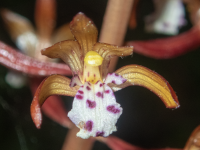
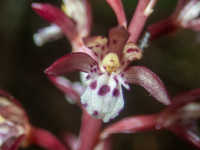
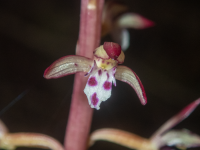
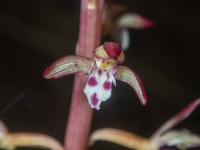
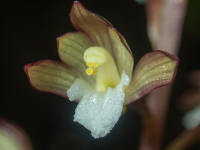
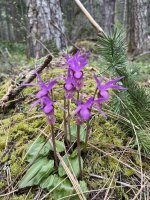
Like the trillium, a typical coralroot orchid flower has three sepals and three petals.
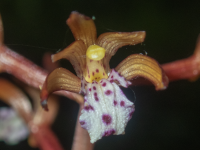
The sepals are arranged as an equilateral triangle (one dorsal sepal and two lateral sepals) forming the outer layer of the flower. The petals are arranged in a similar triangular arrangement but offset 180o relative to the sepals. Upright single petals sit to the left and right of the dorsal sepal. The ventral-most petal is enlarged and called the labellum (“lip”) positioned 180o below the dorsal sepal. The labellum is the landing platform for pollinators.
Unlike typical flowers where stamens and pistils are separate structures, the structural elements of the pistils and the stamen fuse together into a single structure, the column, in orchids. Also, unlike most flowering plants which release a cloud of individual pollen grains (to the discomfort of those who suffer from hay fever), the yellow pollen in coralroot orchids is packaged into a handful of sticky sacks, called pollinia, that are located at the top of this column.
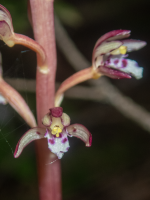
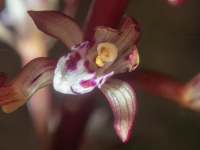
If a pollen sack from one flower has stuck to the body of a pollinator, this pollinia sack will be deposited to a sticky section of the column, equivalent to the stigma, of the next flower. These pollinia carry enough pollen to fertilize the hundreds of thousands of eggs in the ovary. As the flower matures, the ovary swells to form a capsule filled with multiple thousands of microscopic seeds.
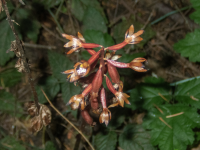
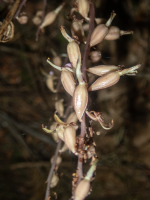
Second, the coralroot orchids are totally parasitic!!! Their highly-branched underground rhizomes of these perennials resemble the structure of a branched coral, hence the common name “coralroot”. The rhizomes connect to the mycelium (filaments) of soil fungi. These fungi (mycorrhizae) are in a true mutualistic relationship with forest trees, Douglas firs in this case. The fungi provide water and inorganic nutrients, such as nitrogen and phosphorus, to the trees in return for sugars from the tree. Coralroot orchid rhizomes steal what they need from these partners. Coralroot orchids are particular about which fungal mycorrhizae that they can exploit, typically species in the family Russulaceae.
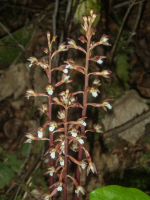
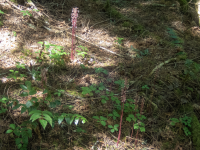
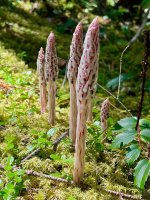
In the spring and early summer, the underground rhizome sends up a reddish-brown spear that extends a foot or two above the surface.
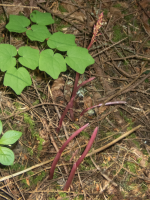
In some cases, only a single inflorescence breaks the surface but in other cases, you encounter a cluster of 15-20 inflorescences rocketing from the forest floor.
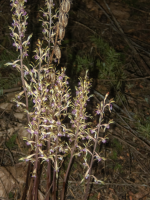
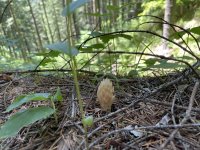
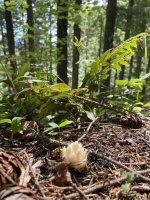
Because these orchids have NO photosynthetic structures, there is nothing visible outside of the flowering period, except perhaps for a stem and dried-out seed capsules from the previous year).
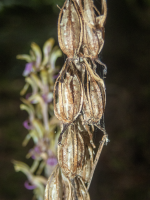
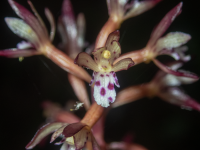
The inflorescence and multitude of flower buds emerge from the upper half of this spear.
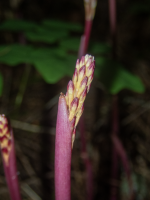
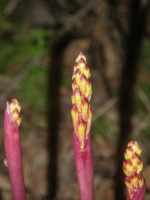
Flower buds open from the bottom to the top.
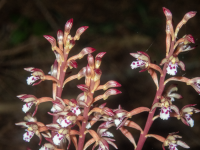
Single delicate tiny flowers emerge from around the stalk. These flowers are pollinated by insects, possibly mosquitoes, wasps, and gnats, but they may also self-pollinate. After fertilization, the ovary of each flower expands to produce a small oval capsule / pod (less than an inch long for the coralroot species). Each capsule contains literally many thousands to millions of dust-like seeds (often about 0.5mm in size).
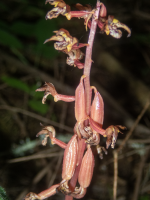
[The aromatic black dots that you scrape out of a vanilla pod (= orchid capsule) are the seeds of the vanilla plant, another orchid.]. When mature, the capsule splits at seams and releases dust-like seeds. The seeds are dispersed by the wind.
Third, orchids typically do not undergo double fertilization. One sperm nucleus fertilizes the egg to produce the zygote / embryo. However, almost all orchid seeds lack endosperm (i.e., a nutrient reserve). The tiny germinating embryo in an orchid seed must immediately start parasitizing an appropriate mycorrhizal fungus in order to survive. That is a key reason why orchids must produce millions of seeds each breeding season. If an organism produces a huge number of offspring, you know that survival to adulthood is VERY rare. The chances that a coralroot seed will land on a patch of soil with the appropriate physical conditions and the appropriate fungal network are incredibly slim (far slimmer than the chance of being dealt a Royal straight flush = 1 in 649,739).
To improve their odds in the absence of a mycorrhizal network, commercial orchid growers have developed a technique where orchid seeds are sown on sterile agar supplemented with the appropriate nutrients and carbohydrates. While this technique does would work for many photosynthetic orchids as they start life, it does not appear to work for totally parasitic orchids, such as coralroots.
So cool.
Steve
So, let’s talk about these unusual plants, specifically orchids, and coralroot orchids in particular. Orchids really tickle my biological fancy. The family Orchidaceae is the second-most species-rich plant family with over 28,000 species (6-11% of all seed plants), with asters (Asteraceae) in first place at over 32,000 species. Orchids are found on all continents, except Antarctica, in a variety of habitats, but they are especially diverse in the tropics. Washington state has over 30 orchid species. These range in habitat from dense coastal forests to the edges of mountain streams and wet meadows.
Why are orchids cool? Let me count the ways. Orchids produce very specialized flowers. These flowers are central to their complex relationships with pollinators and the genesis of their biodiversity. While some orchids do self-pollinate, most orchids are pollinated by animals, especially insects, but also including hummingbirds. In particular, orchids have co-evolved intricate relationships with specialized pollinators. Charles Darwin included examples of these interactions in “On the Origin of Species” and described these pollinator-orchid relationships at greater length in the “On the Various Contrivances by Which British and Foreign Orchids Are Fertilized by Insects, and On the Good Effects of Intercrossing”. Inducements provided by orchids to attract pollinators include nectar, oils, waxes, resins, and perfumes. Orchids can also attract pollinators by deception, i.e., appearing to offer something that interests the pollinator but not delivering. The most infamous example of these deceptive strategies is “pseudocopulation”. Here an orchid flower mimics the appearance of a female insect and releases chemical attractants that are similar to the pheromones released by a female of this insect species. Single-minded males attempt to copulate with the orchid flower. (look it up…. Males can be so single-minded…). In the process, the males pick up pollinia (pollen sacs) and carry them to the next deceptive flower.
How do orchid flowers differ from typical flowers? Let’s use the Western white trillium as our model of a typical flower.
In trilliums, the flower bud is enclosed by three green sepals. When the bud opens, the sepals form the outer layer. Inside the sepals, three large tongue-shaped white petals unfold. Around the center of the flower, six golden rod-like stamens release pollen. At the very center, three curly yellow sticky stigmas emerge from the top of a central white style. At the base of the style lies the ovary which contains ovules (eggs).
[A deeper dive into sex and the single angiosperm. During angiosperm fertilization, haploid (cells with a single set of chromosomes) pollen grain sticks to a stigma. A pollen grain germinates into a multicellular male haploid gametophyte. Attracted by chemical cues released by the ovules, the male gametophyte drills a pollination tube down the cylindrical stigma into the ovary. Two sperm nuclei from each male gametophyte travel down each tube into an ovule. Just about all flowering plants undergo a “double fertilization” process. Once in the ovule, one haploid sperm nucleus fuses with the haploid nucleus of the egg to produce a diploid (a cell with two sets of chromosomes) zygote or sporophyte. This will develop into the next multicellular, macroscopic generation of the trillium plant. The zygote will start to form an embryo within the seed. It will then pause its development until the seed is stimulated to germinate and continue its development.
In an oddity of most angiosperms, the second haploid sperm nucleus fuses with two haploid polar nuclei to create triploid endosperm (the double part of “double fertilization”) within the ovule. As the embryo develops and the seed coat forms, the flowering plant directs a rich supply of nutrients to be stored in the endosperm. Just like the yolk inside a chicken egg, the endosperm becomes the nutritional reserve within the seed. The endosperm supports the growth of the embryo after its germination until the embryo can begin to photosynthesize for itself. [When you select white flour when baking a loaf of bread, you are using the starch in the ground endosperm after the bran (i.e., seed coat) and germ (i.e., embryo) have been removed during processing. In contrast, “whole wheat flour” contains not only the starchy endosperm, but also the bran and germ (and therefore the diverse nutrients contained in those areas as well.]]
Like the trillium, a typical coralroot orchid flower has three sepals and three petals.
The sepals are arranged as an equilateral triangle (one dorsal sepal and two lateral sepals) forming the outer layer of the flower. The petals are arranged in a similar triangular arrangement but offset 180o relative to the sepals. Upright single petals sit to the left and right of the dorsal sepal. The ventral-most petal is enlarged and called the labellum (“lip”) positioned 180o below the dorsal sepal. The labellum is the landing platform for pollinators.
Unlike typical flowers where stamens and pistils are separate structures, the structural elements of the pistils and the stamen fuse together into a single structure, the column, in orchids. Also, unlike most flowering plants which release a cloud of individual pollen grains (to the discomfort of those who suffer from hay fever), the yellow pollen in coralroot orchids is packaged into a handful of sticky sacks, called pollinia, that are located at the top of this column.
If a pollen sack from one flower has stuck to the body of a pollinator, this pollinia sack will be deposited to a sticky section of the column, equivalent to the stigma, of the next flower. These pollinia carry enough pollen to fertilize the hundreds of thousands of eggs in the ovary. As the flower matures, the ovary swells to form a capsule filled with multiple thousands of microscopic seeds.
Second, the coralroot orchids are totally parasitic!!! Their highly-branched underground rhizomes of these perennials resemble the structure of a branched coral, hence the common name “coralroot”. The rhizomes connect to the mycelium (filaments) of soil fungi. These fungi (mycorrhizae) are in a true mutualistic relationship with forest trees, Douglas firs in this case. The fungi provide water and inorganic nutrients, such as nitrogen and phosphorus, to the trees in return for sugars from the tree. Coralroot orchid rhizomes steal what they need from these partners. Coralroot orchids are particular about which fungal mycorrhizae that they can exploit, typically species in the family Russulaceae.
In the spring and early summer, the underground rhizome sends up a reddish-brown spear that extends a foot or two above the surface.
In some cases, only a single inflorescence breaks the surface but in other cases, you encounter a cluster of 15-20 inflorescences rocketing from the forest floor.
Because these orchids have NO photosynthetic structures, there is nothing visible outside of the flowering period, except perhaps for a stem and dried-out seed capsules from the previous year).
The inflorescence and multitude of flower buds emerge from the upper half of this spear.
Flower buds open from the bottom to the top.
Single delicate tiny flowers emerge from around the stalk. These flowers are pollinated by insects, possibly mosquitoes, wasps, and gnats, but they may also self-pollinate. After fertilization, the ovary of each flower expands to produce a small oval capsule / pod (less than an inch long for the coralroot species). Each capsule contains literally many thousands to millions of dust-like seeds (often about 0.5mm in size).
[The aromatic black dots that you scrape out of a vanilla pod (= orchid capsule) are the seeds of the vanilla plant, another orchid.]. When mature, the capsule splits at seams and releases dust-like seeds. The seeds are dispersed by the wind.
Third, orchids typically do not undergo double fertilization. One sperm nucleus fertilizes the egg to produce the zygote / embryo. However, almost all orchid seeds lack endosperm (i.e., a nutrient reserve). The tiny germinating embryo in an orchid seed must immediately start parasitizing an appropriate mycorrhizal fungus in order to survive. That is a key reason why orchids must produce millions of seeds each breeding season. If an organism produces a huge number of offspring, you know that survival to adulthood is VERY rare. The chances that a coralroot seed will land on a patch of soil with the appropriate physical conditions and the appropriate fungal network are incredibly slim (far slimmer than the chance of being dealt a Royal straight flush = 1 in 649,739).
To improve their odds in the absence of a mycorrhizal network, commercial orchid growers have developed a technique where orchid seeds are sown on sterile agar supplemented with the appropriate nutrients and carbohydrates. While this technique does would work for many photosynthetic orchids as they start life, it does not appear to work for totally parasitic orchids, such as coralroots.
So cool.
Steve