

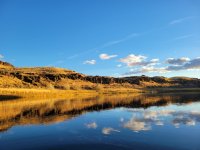
Tried a small seep lake in central WA yesterday, another general regulation lake that requires a hike to get into it. It can be a very temperamental lake, sometimes producing no fish, often only small fish, but once in a while, it will only have large, chunky fish, but not many of them. This was one of those times. I only landed 4 fish, but they were really nice, chunky rainbows (17, 18, 18 and 20 inches). Here's a photo of the 20 incher:
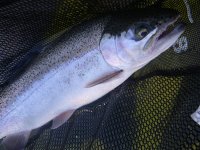
Here's a photo of the smallest one, a 17 incher (note the small head relative to the body, telling you that it has been eating well):
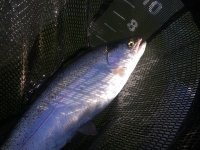
They all fought well and were a lot of fun to play, land and release. The water temperature was 50 degrees with about 5 feet of visibility. 3 gear anglers hiked in, but only fished a short time from shore without much luck, even with Power Bait and eggs, so they left to try some other lake, so I pretty much had the lake to myself for most of the day. A water boatman pattern seemed to be the preferred pattern, although I never saw a water boatman there on this outing. For that matter, I didn't see many insects at all, only a couple of adult chironomids and a few honeybees. I only saw a couple of fish rise all day, and then several more while I was packing up (should've stayed longer, I guess).
One odd feature of fishing this lake is that when we catch the big rainbows (18 to 22 inches or larger), we usually don’t catch many smaller rainbows. It seems like entire year classes are missing or mostly missing. My theory is that this lake is likely fed by a small, underwater spring that provides oxygenated water. When the lake is stressed and the dissolved oxygen levels are low, my hypothesis is that the bigger fish dominate the small spring and chase away the smaller fish. Thus, the lake has a partial kill, with the smaller fish dying off and the bigger fish surviving (whereas normally the larger fish die due to their greater need for oxygen, and the smaller fish survive). As the lake recovers, the bigger fish have more food due to the smaller fish being mostly gone, and thus get fatter than normal. When the lake is healthier, the smaller fish survive, and it seems that all we catch are the smaller or medium-sized fish. The bigger ones are probably there, but there are so many smaller fish that the smaller fish grab the fly before a big fish can get to it. However, I’m not a fisheries biologist, so I could be totally wrong about this, but I otherwise cannot explain this unique situation. Anyway, the moral of this story is that you have to keep going back to fish these lakes, as you never know what you'll find in them. The way it fishes in the spring may not be at all like the way it fishes in the autumn. Or, the way it fished last week may be totally different than the way it fishes today. I know that a good fly fisherman went to this lake last week and got skunked. That's why fishing can be so frustrating at times, yet rewarding at times.
Rex


