Chironomid Tying

For me, there are lots of places where I fish midges for trout that I don't want a bobber/indicator. I love a long leader/floating line and an unweighted/unbeaded midge. Generally this is a shoal.
Amen to that. In the past 2 years I have been fishing tiny soft hackles on long leaders with a floating line in some situations-almost the same as an unweighted/unleaded midge. I have had days where I couldn't buy a bite on the standard subsurface/sinking line stuff but had great action fishing tiny patterns near the top with a do-nothing presentation. At almost 87 now the do-nothing part has a lot of appeal to me!;)
 
For me, there are lots of places where I fish midges for trout that I don't want a bobber/indicator. I love a long leader/floating line and an unweighted/unbeaded midge. Generally this is a shoal.
I'll have to give unweighted midges a try...so far I do pretty good with the same setup and a small wetfly. Always room for improvement.

While I've expanded my indicator fishing I really don't enjoy it as much as flyfishing in a more active manner.
 
Amen to that. In the past 2 years I have been fishing tiny soft hackles on long leaders with a floating line in some situations-almost the same as an unweighted/unleaded midge. I have had days where I couldn't buy a bite on the standard subsurface/sinking line stuff but had great action fishing tiny patterns near the top with a do-nothing presentation. At almost 87 now the do-nothing part has a lot of appeal to me!;)
Ive -
Last year I kicked my float tube out of deep indicator water I usually fish with good results. That particular day I couldn't put together any consistency on a lake I know very well. Once up onto the shoal, I clipped off the fly, pulled the Seegercator™ off, then tied on a small midge.

DSCF2503 (1).JPG
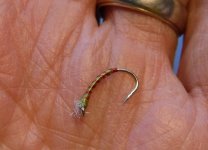
Watery Olive thead body, holographic tinsel rib - no bead, thread head.

I had to pay attention (that's what we are supposed to do), but how much fun this rig was to cast without the indicator on a long leader. In early spring, right after the opener, this shoal can be fished with a bead head but as fall approaches with all the aquatic plants, the unweighted fly is superior (at least for me).
 
I'll have to give unweighted midges a try...so far I do pretty good with the same setup and a small wetfly. Always room for improvement.

While I've expanded my indicator fishing I really don't enjoy it as much as flyfishing in a more active manner.
With this calm weather lately, I’ve gladly dispensed the bobber and have really enjoyed the long leader fishing. Slow retrieval or gentle breeze pushing things along is fun and I can cast without a f-ing birds nest happening all day..
 
Amen to that. In the past 2 years I have been fishing tiny soft hackles on long leaders with a floating line in some situations-almost the same as an unweighted/unleaded midge. I have had days where I couldn't buy a bite on the standard subsurface/sinking line stuff but had great action fishing tiny patterns near the top with a do-nothing presentation. At almost 87 now the do-nothing part has a lot of appeal to me!;)
This.

Some times, if it's real clear water or calm, I can see the fish but feel like the bobber splat is spooking them. A nekkid chronny is fun to sightfish with. Watch the fish and try to guess if he ate the fly...it can be difficult.
 
For me, there are lots of places where I fish midges for trout that I don't want a bobber/indicator. I love a long leader/floating line and an unweighted/unbeaded midge. Generally this is a shoal.
What factors help you decide to fish this way with chironomids?

Fish highly distributed across the water column? Shoals/sloped bottom? Calm day shallow water? Others?
 
What factors help you decide to fish this way with chironomids?

Fish highly distributed across the water column? Shoals/sloped bottom? Calm day shallow water? Others?
At the lakes I primarily fish (Crane Prarie, Paulina, East Lake and a couple others less well known), wind is critical...ideally, just enough to create a bit of surface chop which makes the fish less wary and adds movement to the various subsurface methods. If the wind picks up substantially, one of my go to methods is to drift a presentation covering a large area, and if I start picking up fish put a small buoy over the side and either anchor fish that spot or just make shorter drifts through it.
When the water is glass calm, however, the fish are much more wary and selective, perhaps a 'if I can see them, they can see me' situation. Under these conditions, smaller flies cast on a floater with long flouro leader, presented with either zero or very slow retrieves, is often the ticket to getting the takes other set-ups won't provoke. Under these conditions the water clarity is usually excellent because of the glass conditions, so I'll slow move under electric power in the shallows until I see fish, anchor as quietly as possible and start making the least noisy casts possible.
I've found in these situations the takes can be very subtle, so instead of a full 'rear back strip set', I'll just tighten the line with a short strip if I suspect a take and if I missed the take just leave the fly in place having been minimally moved.
Ideally, I'll take 5 knots of wind every time over less or more.

 
What factors help you decide to fish this way with chironomids?

Fish highly distributed across the water column? Shoals/sloped bottom? Calm day shallow water? Others?
Much of what Surfnfish says I agree with. On skinny water shoals, at least for me I like a long leader (15' plus) on my floating line. Too much wind makes this long leader unfun to cast unless it's with the wind. I've experimented with mixed results using this long leader in deeper water (naked). Again, for me, deeper water is (almost always) indicator water but getting naked fishing dialed in one afternoon on a local put n take lake was a lot of fun.

Thread drift: As others have mentioned. Small soft hackles, hares ears, damselfly nymphs, etc., are another great choice up on skinny shoals.
IMG_1167.JPG

Herb Superb on the edge of a shoal. Gotta love dropoffs.
 
Talking colors with a friend, Purple ? I see some using that. Deeper water shows up better ? IDONO. It's coming and we R getting that itch. That is a nice fish.
 
FWIW last year, whilst tying Chironomids, I started using straight edged fingernail clippers for cutting the wire. Keeps those spendy tying scissors sharper, longer. The straight edge allows one to get in closer to the fly body for more precise removal.

Have fun.

Bob
In order to save wear and tear on my scissors I use a very small pair of side cutters for wire of any size. I can get close enuf to the hook to do the job to my satisfaction. And it never wears out or gets dull.
 
In order to save wear and tear on my scissors I use a very small pair of side cutters for wire of any size. I can get close enuf to the hook to do the job to my satisfaction. And it never wears out or gets dull.
x2...BTW Joanne's craft stores are closing across the nation and they are having a 40% sale on products, and the stores carry an excellent selection of well made craft tools, as well as adhesives, tapes, etc.
 
When fishing chironomids, I will use the maximum number of flies that is allowed (2 in fly fishing only lakes, 3 in more general lakes). The top fly (or two) is the larger/largest and has a bead. The point fly is the smallest (16-18 generally) and beadless. My thinking is that the beadhead fly sinks the lot to the set depth. The beadless point fly will have the most motion (and be the least threatening to a cruising trout). Generally, the point fly will hook 3/4rs of the fish.
Steve
 
@Cabezon I like your thought process on how you set up your multi fly rigs. When nymphing rivers I have the same approach. Point fly gets you to the depth and the trailer(s) drift more naturally. On lakes though I usually go the with the opposite approach. Top fly(s) are mostly unweighted with the bottom fly carrying the most weight. My thought process on this is that I always want my line tight to the indicator to impart the chop/movement without slack and give direct feedback when a fish licks my bug. There are some days that half my fish come on really subtle takes. Clearly both systems work. I find the different perspectives quite interesting and would like to see more discussion on the subject.
 
@Cabezon I like your thought process on how you set up your multi fly rigs. When nymphing rivers I have the same approach. Point fly gets you to the depth and the trailer(s) drift more naturally. On lakes though I usually go the with the opposite approach. Top fly(s) are mostly unweighted with the bottom fly carrying the most weight. My thought process on this is that I always want my line tight to the indicator to impart the chop/movement without slack and give direct feedback when a fish licks my bug. There are some days that half my fish come on really subtle takes. Clearly both systems work. I find the different perspectives quite interesting and would like to see more discussion on the subject.
Your approach makes sense too. I tend to have a hair-trigger when fishing chironomids (unless I'm distracted by a passing bird, a pretty cloud, whatever...). My rationale is that the unweighted bottom fly will display the more natural movement. And because it is the smallest in the series, it is viewed as less of a threat / less suspicion by cruising trout.
Steve
 
Last edited:
Under the indicator I always have two flies (both bead-headed) because it gets my flies in the zone twice as fast. I would consider trying unweighted for the upper fly, but for the point I need to know that I am sitting at the exact depth that I am targeting...vast majority of the action will always be on that fly.
 
Back
Top