Bread Thread

Inspired in part by this thread, I have begun my sourdough journey. Three bakes so far have gone well and I plan to keep on working at it. I've been sticking to King Arthur's Naturally Leavened recipe.

My question is around starter and specifically why am I discarding so much? At some point I will graduate to recipes that call for discard but for now it's getting tossed. KA recommends 113 grams each starter/water/flour, but does it need to be 113? As long as the ratio stays the same couldn't it be say 80?
You can maintain a smaller starter. Also, after I feed my starter and it starts bubble, I put it in the fridge, where it keeps for about two weeks. I just need to wake it up with a couple feedings before I bake with it. (Wake and bake?)
 
Inspired in part by this thread, I have begun my sourdough journey. Three bakes so far have gone well and I plan to keep on working at it. I've been sticking to King Arthur's Naturally Leavened recipe.

My question is around starter and specifically why am I discarding so much? At some point I will graduate to recipes that call for discard but for now it's getting tossed. KA recommends 113 grams each starter/water/flour, but does it need to be 113? As long as the ratio stays the same couldn't it be say 80?
You can use more than you think, I start with 230 grams of starter, charged up. I feed it extra on days I plan to bake! About 100g or water and flour.. on non baking days I do 50 grams of each. Sometimes, if the starter doesn't seem like it has a lot for the 230 grams, I don't discard anything and do a 50 / 50 grams of water / flour.

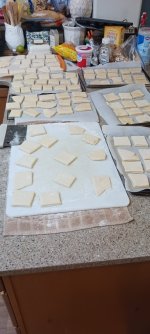
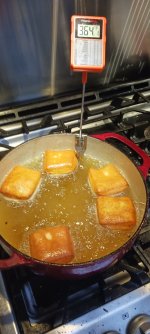
Use the discard for recipes, a quick and easy one is to pour the discard into a frying pan with olive oil.. make a savory pancake, salt and pepper it and add some scallions! Quick and easy snack or breakfast, lunch or dinner appetizer!
 
Inspired in part by this thread, I have begun my sourdough journey. Three bakes so far have gone well and I plan to keep on working at it. I've been sticking to King Arthur's Naturally Leavened recipe.

My question is around starter and specifically why am I discarding so much? At some point I will graduate to recipes that call for discard but for now it's getting tossed. KA recommends 113 grams each starter/water/flour, but does it need to be 113? As long as the ratio stays the same couldn't it be say 80?
A lot of nuance and too many people claiming there are hard and fast rules around this.

Once a starter is over 4-6 weeks old and is nice, active, and strong you can treat it incredibly poorly and it'll come right back with a few feedings.
You can keep it warm (up to about 100 degrees), cool, or cold. You can feed it in all kinds of ratios and intervals and flours. You can starve it for substantial periods of time. Its crazy.

You can maintain any size of starter you want. I bake 2 loaves on most weekends and I'll describe my standard feeding routine.

A couple of points up front:
I think starters are healthier with some amount of whole grain in it. I like 30% but anything in the 20-50% is a good choice. I prefer dark rye as my whole grain but any will work.

The flour I use is thirsty and needs more water than most grocery store flours. Assume a 1:1 ratio instead of the measurement I list.

I used to work in a lab studying yeast genetics so I've incorporated some of the yeast culture ideas we used there.

I keep mine in a wide mouth pint jar with a canning lid. And it will increase size to about 2.5 times original volume.

I mix dough on Saturdays. After dumping starter into my dough mix, I have about 15 g starter left.
I feed that 45 g flour and 50 g water. It is left at room temperature until risen about about 50% (about 4-5 hours)
At this point I put it in the fridge.
Over the next 16-24 hours it will reach double size in the fridge then fall back down over the next 16-24 hours.
It stays in the fridge unfed until Friday.
Friday night before bed I take it out of the fridge.
Discard until only about 15 g starter left.
Feed 75 g flour and 85 g water.
Leave at room temperature overnight (typically 10 hours until it's ready to add to dough)
Mix 160 g into a dough (2 batards)
That leaves 15 g of starter to repeat the cycle.

At most I would be tossing 100 g of discard weekly, but I use it for other things like savory pancakes.

 
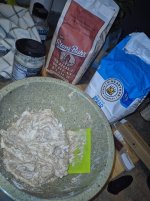
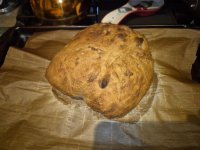
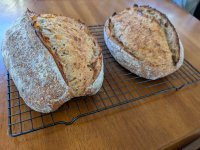
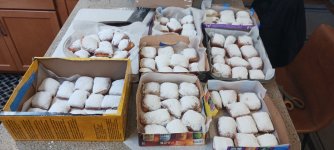
Rustic bread recipe from King Arthur. Added in some whole wheat flour and used KA bread flour! Added more water than I normally would have. About 170 grams but really until it looked and felt right.

Should turn out good. Learning that let it rise for too long isn't good. Ill put it in the fridge until tomorrow afternoon.
20260213_205520.jpg
 
Rustic bread recipe from King Arthur. Added in some whole wheat flour and used KA bread flour! Added more water than I normally would have. About 170 grams but really until it looked and felt right.

Should turn out good. Learning that let it rise for too long isn't good. Ill put it in the fridge until tomorrow afternoon.
View attachment 178373
Do you have a dough whisk? I find it very helpful for mixing dough. This looks undermixed to me. It should be much more uniform after the initial mix.
Did you mix the flours prior to adding water? If not, you should, you'll get much better bread.
 
Do you have a dough whisk? I find it very helpful for mixing dough. This looks undermixed to me. It should be much more uniform after the initial mix.
Did you mix the flours prior to adding water? If not, you should, you'll get much better bread.
No on the dough whisk! I'll order one though. I used to have a Kitchenaid with a dough hook and have a POS mixer now that does, but it's not that powerful.

I will start mixing the dry ingredients ahead of time. I've never seen the point of doing that, til now! LOL!
 
I will have a Dough Whisk, between 5pm and 10pm today... at my Amazon Locker named Olive!!
 
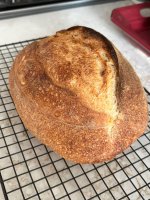
About 40% whole wheat flour!

Will cut into this afternoon! At the Bellevue FF Show at the Mayfly Project booth! It was mixed much better too!
20260214_081017.jpg
 
Last edited:
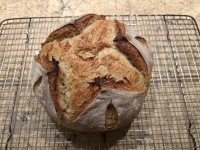
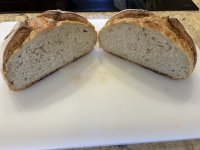
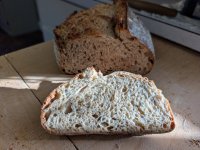
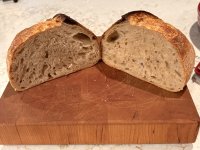
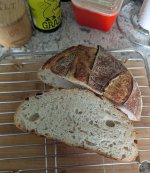
Today’s bake following the KA Naturally Leavened recipe to a T. Used Bob’s AP and KA Whole Wheat.

Outside looks good and it tastes ok but was hoping for a more open crumb structure.

Thought or tips?


View attachment 178507

View attachment 178508
You open baked it with a steam pan? What gas or electric oven?

That recipe is about 68% hydration, which makes sense to me given the AP flour and your loaves looks about what I would expect. To open up crumb there are a few options.
1. End bulk ferment 30 minutes early, shape, then add those 30 minutes back into the final proof. This will help if you knock any air out while shaping.
2. You can push the ferment longer and risk over proving, if you haven't already accidentally done that, it can be a good exercise to understand to fermentation curve of your dough. I'd make the same recipe 4-5 different times: first loaf bake when you think proved, next loaf 20 minutes after you think, then 40 minutes after and keep doing that until you get one that spread and doesn't puff in the oven.
3. Increase the hydration by 5% in this recipe. This will make handling and shaping more difficult and you'll need to develop the gluten a little better.
4. Sub 300 g bread flour for AP flour in this recipe and increase hydration 10%

Some people claim a cold retard helps with open crumb, I'm not convinced of that, but I do like it for flavor.
 
I always get a little nervous when I deviate from my typical process and timing, but today's bake went alright despite the changed.

Yesterday I drove to Burlington to pick up my latest order from Cairnspring Mills. I get 50 lbs of glacier peak and 5 pounds of Edison AP. Their 10-1, Saturday only pickup window interferes with my normal bread routine. Additionally I wanted to finish the previous bag of Edison. So here's how today's bake went.
8 am took starter out of fridge, fed 1:5:5
5 pm mix dough

290 g Edison AP
110 g Barton Springs Marquis
400 g glacier peak
6 g diastatic malt
90 g everything bagel seasoning (Kirkland)
640 g water
180 g starter

5 sets of stretch and folds, last one at 7:30
Normally, it would be about 5 hours until time for shaping. Well I wasn't going to be up until 2 am.
Instead I let bulk go until 10:00 then put it in the fridge overnight.
I took it out at 8:00 this morning and pre-shaped it. Only 1 turn of the dough since it's stuff when cold.
Let sit for 45 to relax and warm a bit then shaped.
2.5 hours at room temp in bannetons then into the fridge while I preheated the challenger for an hour.
Then baked at 465, 20 minutes covered, 12 minutes uncovered.
PXL_20260215_232740254.jpgPXL_20260215_232922726.jpg
 
You open baked it with a steam pan? What gas or electric oven?

That recipe is about 68% hydration, which makes sense to me given the AP flour and your loaves looks about what I would expect. To open up crumb there are a few options.
1. End bulk ferment 30 minutes early, shape, then add those 30 minutes back into the final proof. This will help if you knock any air out while shaping.
2. You can push the ferment longer and risk over proving, if you haven't already accidentally done that, it can be a good exercise to understand to fermentation curve of your dough. I'd make the same recipe 4-5 different times: first loaf bake when you think proved, next loaf 20 minutes after you think, then 40 minutes after and keep doing that until you get one that spread and doesn't puff in the oven.
3. Increase the hydration by 5% in this recipe
This was 20 mins in a Dutch oven and 15 with the lid off. Electric oven.

I did actually hold back a little water because previous efforts produced dough that was so sticky I couldn’t pick it up off the board without my bench knife. Less water made it easier to handle during the slap and fold.
 
This was 20 mins in a Dutch oven and 15 with the lid off. Electric oven.

I did actually hold back a little water because previous efforts produced dough that was so sticky I couldn’t pick it up off the board without my bench knife. Less water made it easier to handle during the slap and fold.
I don't do slap and folds or knead at all, but I know the initial mix and first 2 sets of stretch and folds the dough is very sticky, but as the gluten strength builds it will become less and less sticky.

I'd recommend adding some bread flour and upping the hydration.
 
My question is around starter and specifically why am I discarding so much? At some point I will graduate to recipes that call for discard but for now it's getting tossed. KA recommends 113 grams each starter/water/flour, but does it need to be 113? As long as the ratio stays the same couldn't it be say 80?

I think I posted about this before in this thread, but it bears repeating that the whole idea of needing to discard starter is just bullshit. As you imply, you can maintain a much smaller sourdough culture without any problems. I often just dump the entire contents of my starter jar into the dough mixing bowl, and use what remains stuck to the sides to keep it going.

Simple rule is that if you are planning to feed it twice, add a third of what you will need at the end the first time, two thirds the second time. For example, after I use the starter I have about 50 grams left behind, I add 50 grams of flour and water, let it do its thing for a couple of days, add 100g of flour and water, let it ferment, make bread with 150g of starter, repeat.
 
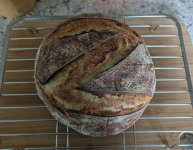
My breads have been getting flatter lately, I store my starter in the fridge, I typically do a 1:5:5 feed the night before I mix the bread. I decided to give my starter a little more love, and did twice daily feedings for a couple days before this bake. Certainly was worth the extra work, though I think I nailed bulk fermentation much better this time.

IMG_2356.jpegIMG_2357.jpeg
 
My breads have been getting flatter lately, I store my starter in the fridge, I typically do a 1:5:5 feed the night before I mix the bread. I decided to give my starter a little more love, and did twice daily feedings for a couple days before this bake. Certainly was worth the extra work, though I think I nailed bulk fermentation much better this time.

View attachment 178637View attachment 178638
Lovely looking bread, Wayne! 3 possibilities:
1) starter wasn't "active" enough, which just means you didn't have a high enough concentration of yeast. Repeated feedings like you did can help the density increase
2) starter was getting too acidic- can sometimes happen with refrigerated starter. Low pHs actively degrade the gluten cross linkages resulting in less tension. Feeding repeatedly at RT dilutes out the lactic acid and advantages the yeast over the LAB
3) over fermenting reduces the "last gasp" of the yeast once you start baking, resulting in less oven spring AND has a lower pH, weakening gluten.

Funnily enough, your solution could alleviate the issue caused by any of the three root causes. I'm glad you worked it out!
 
Back
Top