Last edited:
Follow along with the video below to see how to install our site as a web app on your home screen.
Note: This feature may not be available in some browsers.
#5 shore lunch.Came across this holdover today with a sz 6 baitholder from last year (very corroded) hooked at the back of the tongue in front of the throat. Obviously it's survived and it's feeding. Best option is?
1) Leave
2) Cut just outside mouth
3) trim at hook eye
4) Try to remove
5) Harvest
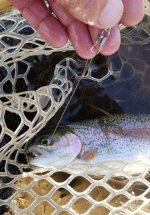
View attachment 12127
I went with 2..
I did keep one middle sized one, ~1.5#. We just finished dinner. Happy wife happy life.Given where you probably were fishing, 2 is a good option, but 5 would have been acceptable. Five would have made your wife happy, based on what you have posted.
I though about keeping it, but it was early, and I didn't want it to sit while I continued to fish.#5 shore lunch.
To me, building a small fire, especially if dead and dried alder is available, and roasting on a green willow stick connects you with your inner hunter gatherer. I've done similar when I can only seem to shoot/find one upland bird. Seems silly just dragging one home.I did keep one middle sized one, ~1.5#. We just finished dinner. Happy wife happy life.
thxIf legal retaining a deeply hooked fish is a good option; especially if one likes fresh fish.
In those situations where you don't want to the harvest the fish or prohibited from doing so the best option is to clip the leader/line as close to the mouth as can easily be done. Do not attempt to remove the hook! In the majority of the cases attempting to remove the hook will cause more bleeding and ultimately the death of the fish. It is surprising on easily fish can dislodge even barbed hooks from their mouth or throat though that process is enhanced by the use of barbless hooks (personally I use barbless hooks for all my salmonid fishing unless I expect to retain the fish caught -example kokanee in a lake).
In a related topic if a bleeding fish is to be released the best approach is to land the fish as quickly as possible with immediate release (in quiet water if that is an option). Attempting to revive a bleeding fish is usually contra productive as the handling associated with that effort doesnot allow the fish heart rate to slow thus preventing the clotting of its blood.
curt
That's a good point that I hadn't considered. I've got an email address for a WDFG enforcement officer (they tend to be wildlife biologists and/or have working relationships with department biologists). I wonder if that's a widely held recommendation.A fishery biologist said during a discussion always get the hook out even if it kills the fish, otherwise it can end up in a scavenger/predator.
Great point, especially because were in the beginner/novice section. I got braid snarls out of the grass, mono, sinkers, powerbait, all kinds of crap the other day. Found I forgot to replace my trash bag.I have (as I'm sure most of the members of the forum have) spent a lot of time picking up amazing quantities of discarded monofilament (often including hooks) around waterbodies...which also poses entangement risks to all sorts of wildlife.