Baby tarpon flies?

I was looking at various tarpon flies all over the web. There are so many variations and colors and patterns. A lot of really elaborate creations are out there. Does tarpon really care? It seems that those immature tarpons in 5 to 15# range will eat almost anything that imitates a bait fish of some kind if properly presented. If I try to keep it simple can I just get by with a few simple flies like these? White/pink, olive/green, and black/purple. What are your thoughts? TarponSimple.jpg
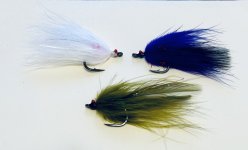
 
I think it would depend on where and when you are fishing. I don't have a pile of tarponita experience, but I've caught them on black, black/purple, white, chartreuse, tan, brown, light olive, light olive/white...

I know that water color plays a part in tarpon fly color selection, and size/profile can also be important.

My rule of thumb is to have a shitpile of flies in a bunch of sizes/color combos. A lot of that could be chalked up to my inexperience in the warm salty game of tarpon but it seems to work pretty OK for me.
 
Most of my tarpon are on toads because they are fun to tie. I usually use chartreuse/yellow, chartreuse/white, purple and black, and red and white. Also include some clousers or half and half with lead eyes. Sometimes they want deeper flies. Finally, two weeks ago our tarpon fishing was saved with a handful of poppers. The water was very dirty and once we had covered the water with streamers to no avail, the fish readily came up for poppers fished with as much noise and commotion as possible.
 
Guiding in the Keys we always had baby tarpon around unless extreme cold snaps sent them to deeper water. They are eager and aggressive and not usually very selective especially in low light conditions. My first fly choice was always some type of gurgler fished on top. They readily attempt to eat a fly off the surface and watching them make repeated efforts to do so is really a hoot. Once you have caught one the real joy is not in just landing another but the visual and tactile aspects of fishing for them. If all you are doing is looking for numbers to hand you may well be missing the boat.
 
Most of my tarpon are on toads because they are fun to tie. I usually use chartreuse/yellow, chartreuse/white, purple and black, and red and white. Also include some clousers or half and half with lead eyes. Sometimes they want deeper flies. Finally, two weeks ago our tarpon fishing was saved with a handful of poppers. The water was very dirty and once we had covered the water with streamers to no avail, the fish readily came up for poppers fished with as much noise and commotion as possible.
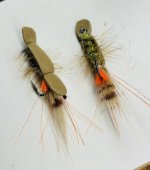
So, if I am not mistaken the toad is the same type of fly as what I have in the picture, but with an addition of a wide head to create more wake?
 
Guiding in the Keys we always had baby tarpon around unless extreme cold snaps sent them to deeper water. They are eager and aggressive and not usually very selective especially in low light conditions. My first fly choice was always some type of gurgler fished on top. They readily attempt to eat a fly off the surface and watching them make repeated efforts to do so is really a hoot. Once you have caught one the real joy is not in just landing another but the visual and tactile aspects of fishing for them. If all you are doing is looking for numbers to hand you may well be missing the boat.
I am just looking to have a decent chance to hook one. Never actually targeted a tarpon before. Sounds like I need to go tie a few gurglers! Thanks!
 
The Puglisi peanut butter is easy to cast and tie with inexpensive materials. Highly recommended.
 
Enrico Puglisi baitfish patterns in size 1, 1/0 are very effective for juvenile tarpon 20 pounds and under. Tan over white, olive over white, black/purple, black/red, etc with minimal flash and decent size eyes. Smaller toads work too of course. Bunny strip patterns swim well and get eaten. In some areas, semi buoyant shrimp patterns in size 1 are very effective. Surface poppers or gurglers can be fun in the mangroves when the juvenile tarpon are on the bite. Snook, redfish, and jacks will eat these flies as well with a different retrieve rate. I think that 2/0 hooks are not appropriate for baby tarpon, but great for targeting tarpon > 20 pounds.
 
So, if I am not mistaken the toad is the same type of fly as what I have in the picture, but with an addition of a wide head to create more wake?
Similar, but the wide head is to slow the sink rate rather than make more wake. Baby tarpon often want a fly that is pretty much just sitting there in midwater, occasionally twitching.
 
I am sure they would eat those in the right situation but don't have to be that "fancy." The ones I always used were tied with thicker foam doubled back at the head and propped up so the fly was extremely buoyant and created a somewhat resounding commotion when given a good hard strip. I found the action and "sound"of the fly, especially in low light and stained water, to be much more a factor than having eye balls, marker striped tails and a semi realistic shrimp impression. Also it's important to remember that hook gape is more important than shank length. The mouth of a tarpon, even a small one, is much like the side of a Samsonite suitcase and not the easiest thing to stick a hook into. Hard to tell from the photos what hook you are using but it should be stout and able to be sharpened to a fine point. You don't need a long shanked hook in fact a shorter shank gives a more direct pull when setting the hook. If you want the appearance of a larger fly just lengthen and increase the bulk of the tail. Their mouths are like buckets and when they commit they enthusiastically eat the whole thing. When they eat they open their mouth and flare their gills creating a suction the inhales the entire prey. They'll turn to go down and close that big trap door. Only then will a well timed strip set have a chance of a solid connection. If that does not occur it is not unusual for them to turn around and try to eat it again. When I get home I will look for some and take a pic or two. Don't be afraid to think outside the box. I have tied many using strips of foam cut from a tube of black foam pipe insulation close to 1/2 inch thick. Not pretty or delicate but you can't sink it.
 
Last edited:
All good points! Thank you!

The hooks I use for the newly tied gurglers are Gamakatsu Iseama size 1/0 and size 2 for smaller fish. The points are tweaked to pass the nail test. Also added the doubled foam and a more pronounced bill. Again, thank you for the feedback. Much appreciated!
 
Last edited:
Drew Chicone has some nice books and patterns for juvenile tarpon as well.


Chicone's "Tuscan Bunny" pattern is a very good surface slider (gurgler) for juvenile tarpon and snook.

 
Drew Chicone has some nice books and patterns for juvenile tarpon as well.


Chicone's "Tuscan Bunny" pattern is a very good surface slider (gurgler) for juvenile tarpon and snook.


That mono loop trick thru the zonker is pretty slick...
 
Back
Top