
Navigation
Install the app
How to install the app on iOS
Follow along with the video below to see how to install our site as a web app on your home screen.
Note: This feature may not be available in some browsers.
More options
Style variation
You are using an out of date browser. It may not display this or other websites correctly.
You should upgrade or use an alternative browser.
You should upgrade or use an alternative browser.
A monthly themed "contest"
- Thread starter Billy
- Start date
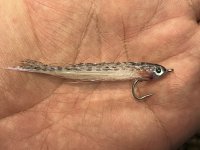

Very nice. What is the back material? Something like predator wrap?
SF
TheWhispering1
Steelhead
Predator wrap, UV Ice dubbing, eyes and UV resin. Easy as pieVery nice. What is the back material? Something like predator wrap?
SF
EmergingFisher
Life of the Party
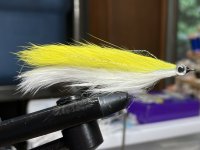


Happy to report that I tried several of those versions over the last 2 days, and all caught fish! Although the first, messy, ugly one (with the bunny only tied in at the front instead of secured matuka style...and now also one-eyed) seems to get wacked moreTrying out some scaled-down versions of that pink bunny...hoping to test them out this week
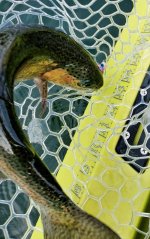

Scudley Do Right
Legend
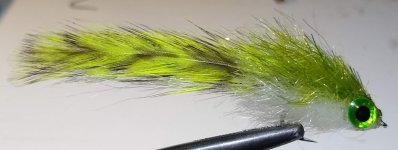
Father in law's pay for watching my son tomorrow.
Scudley, I love, love, love the look of this and the white one you posted earlier. How do they hold up to fish?View attachment 40620
Father in law's pay for watching my son tomorrow.
With the bunny flies, I can literally feel the rabbit strip drag thru their teeth when they miss the hook on the first bump. Do you find the feather tail gets shredded?
Hey, they're not pretty, so I gotta at least show they work!@Northern showing us all up!

Question for the minnow maniacs out there:
Is there any logic regarding when to add a bit of red flare where the gills of the minnow pattern are? Or is it just personal preference?
Is there any logic regarding when to add a bit of red flare where the gills of the minnow pattern are? Or is it just personal preference?
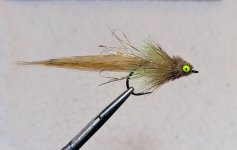

G_Smolt
Legend
Along with eye size/color/placement, I think red for gills is the number one way to catch fishermen.Question for the minnow maniacs out there:
Is there any logic regarding when to add a bit of red flare where the gills of the minnow pattern are? Or is it just personal preference?

I would tend to disagree on two counts. One, red heads and red feather throats on streamer patterns have been around a long time. Bates, Brooks, Edson, and others from the 1950s on have referenced patterns with predominant red aspects at the front of the fly. Two, at least for saltwater patterns targeting typically schooling predatory fish (preying on schooling baitfish), the addition of red aspects to the front of a baitfish pattern has some science behind it. One of the best discussions of this science as it relates to baitfish patterns is found in Fly-Fisher’s Guide to Saltwater Naturals and Their Imitations, George V. Roberts Jr. (1994). Experiments had shown that schooling baitfish have a defensive advantage when confronted with predatory fish lowering the probability that any given baitfish will be consumed. The predator has the advantage when it detects an injured baitfish. This might be irregular movement or unusual contrast like that of a hemorrhaging baitfish. Roberts gives a good discussion of the role of both color and contrast as it affects predatory fish behavior.Along with eye size/color/placement, I think red for gills is the number one way to catch fishermen.
There are many aspects of baitfish design more important than the depiction of gills or hemorrhaging. Shape, size, material behavior, and overall coloration are all important. But, as I said above, the efficacy of adding red gills or hemorrhaging aspects to baitfish patterns has a long history. There must be something to it.
G_Smolt
Legend
...There are many aspects of baitfish design more important than the depiction of gills or hemorrhaging. Shape, size, material behavior, and overall coloration are all important. But, as I said above, the efficacy of adding red gills or hemorrhaging aspects to baitfish patterns has a long history. There must be something to it.
There is little doubt that contrasting "color spots" can play a role in the "eat/ don't eat" matrix. (Insert color of choice here)-butted flies and lures have been a thing since folks have been tying flies, and the same is true for folks putting red for "gills". While there is some merit to the practice (in the form of contrasting colors), I would say the other factors in your assessment (most notably profile and size, IMO) are WAAAAY more important to successful fly design than the "bin appeal" of gills and eyes. Try a few different colors of gills besides red (chartreuse is one of my faves) and see what happens - you might be pleasantly suprised.


This thread is great. It's so far out of my wheelhouse, I'm getting a lot out of following along. Some really neat flies offered up, I can't see how you're going to pick a winner.
Wait, whaaaaatt??? Chartreuse gills?Try a few different colors of gills besides red (chartreuse is one of my faves) and see what happens - you might be pleasantly suprised.

I'll have to give it a try! If you had to pick, what's your top 3 colors to try?
G_Smolt
Legend
I like chartreuse first and foremost as a "color pop" -- it works on nearly every base color. Pink and cerise are good on a wide range of colors as well, and do well for me on darker colors. For dark (black, navy, purple, and dark olive), I've had good results with white.Wait, whaaaaatt??? Chartreuse gills?
I'll have to give it a try! If you had to pick, what's your top 3 colors to try?
I usually fish "gill-less" flies, but when something seems off or I see fish looking or half-ass chasing and not committing, I'll reach for the color-pop flies and that usually does the trick.
Here's another "guide fly" (a couple materials, takes, like...47 seconds to tie, works like a charm
 ) from the summer box - the chartreuse color pop is small, but some days it's what the fish want.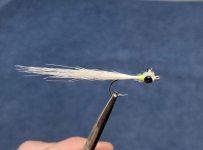

Dr. Magill
Life of the Party
What a great informative postI like chartreuse first and foremost as a "color pop" -- it works on nearly every base color. Pink and cerise are good on a wide range of colors as well, and do well for me on darker colors. For dark (black, navy, purple, and dark olive), I've had good results with white.
I usually fish "gill-less" flies, but when something seems off or I see fish looking or half-ass chasing and not committing, I'll reach for the color-pop flies and that usually does the trick.
Here's another "guide fly" (a couple materials, takes, like...47 seconds to tie, works like a charm
View attachment 40724
Thank you