
Navigation
Install the app
How to install the app on iOS
Follow along with the video below to see how to install our site as a web app on your home screen.
Note: This feature may not be available in some browsers.
More options
Style variation
You are using an out of date browser. It may not display this or other websites correctly.
You should upgrade or use an alternative browser.
You should upgrade or use an alternative browser.
What the heck did I catch?
- Thread starter Billy
- Start date


Landlocked chinook are a possibility. Banks lake has received hatchery Chinook in the past. Fish gonna move through connected waters.

I'm also saying chinook jack or landlocked chinook, especially if it had spots on the pecs. In fact, I would go so far as saying it's a female landlocked nookie hence the female looking head.
This is what a more typical Columbia basin jack nook looks like. I caught this one on the Deschutes, just downriver from Maupin.
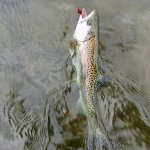
This is what a more typical Columbia basin jack nook looks like. I caught this one on the Deschutes, just downriver from Maupin.

The only part of this fish that resembles a chinook jack to me is the spotting (though chinook spotting tends to be more peppered-looking), which SOME kokanee can have. The head shape and mouth just don't look at all right to me. The body shape isn't right either from my experience.
Agree it's unlikely to be a jack. Just that the size and coloration reminded me of a few small chinook I caught many, many years ago on the Sandy. I recall those being a bit deeper bodied. Always in late spring and early summer, so just assumed they were waaay early return springers - but just a guess.
Would be interesting to know the actual life history on this fish.

Yeah I think an actual ocean-run jack is unlikely as it lacks a few traits like you mention. Plus, it wouldn't be in that bright of a coloration right now if it were. A landlocked chinook (or, not technically LOCKED, but living its life in fresh water) is seeming more and more the likely culprit.Agree it's unlikely to be a jack. Just that the size and coloration reminded me of a few small chinook I caught many, many years ago on the Sandy. I recall those being a bit deeper bodied. Always in late spring and early summer, so just assumed they were waaay early return springers - but just a guess.
Would be interesting to know the actual life history on this fish.
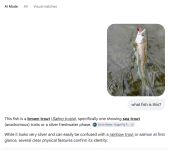

See? Closer to Atlantic Salmon than what any of these actual real people yahoos are trying to push on us.Haha! I love when Google is wrong-
View attachment 194070
For the record, I have no idea.
Another thing: Jacks are male. The one in Billy's photo is very likely a female.Agree it's unlikely to be a jack. Just that the size and coloration reminded me of a few small chinook I caught many, many years ago on the Sandy. I recall those being a bit deeper bodied. Always in late spring and early summer, so just assumed they were waaay early return springers - but just a guess.
Would be interesting to know the actual life history on this fish.
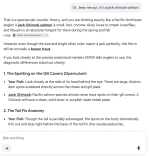
Did my own AI investigation here of that Deschutes fish. Played hard ball with it.Man, Google went hard on this one. Haha!
View attachment 194072

Google is wrong on the Deschutes fish. "Sea trout" gives away that it's improvising, since there's no sea-run brown trout population in the Deschutes. Its own evidence doesn't hold up either. It claims the spots stop before the tail, but when I zoom in on that photo they run straight down the wrist toward the tail. Nothing on that fish says brown to me: no red spots, no halos, and the flank has a pinkish cast with small spots all over it. I can't independently confirm jack from a fish thrashing on the surface, because the thing that settles it is the mouth, and you can't see it. Your buddy had it in hand, though: black gums along the lower jaw means chinook, and that's the end of it.
On the Nunya Lake fish, chinook actually fits better than my kokanee call. That's not me caving, it's the sources. Ecology documented Chinook salmon spawning in the creek system below Nunya Lake, and the lake drains through a culvert about half a mile into that creek. I found zero evidence of kokanee anywhere in that system. Physically, a young chinook matches everything we picked over: chrome, forked tail, peppered back, long-based anal fin, and a big terminal mouth. All of that fits kokanee too, which is why I couldn't split them from looks alone. The tiebreakers are that chinook have black gums and spots on both lobes of the tail, while kokanee have pale gums and a mostly clean tail. Early on I saw specks on the tail rays and then wrote them off as net mesh. If those are real, it's a chinook.
Two nitpicks on the forum take. A 10-inch fish in a lake isn't a jack: jacks are males coming back from the ocean a year early, usually well over a foot. And it's not landlocked, since Nunya Lake is connected to a creek that runs to the Columbia. More likely it's a juvenile from spawners in the creek below, rearing or hanging around in the lake. You also can't sex a 10-inch juvenile by its head, and jacks are male by definition anyway.
So my call is a young chinook, with kokanee second. If your buddy remembers black inside the mouth along the lower jaw, that settles it.

I see you talk to AI the same way I do

To be honest, I toned it down for this oneI see you talk to AI the same way I do

Every now and then, you can catch fish that just shouldn't be there. Long ago I was fishing The Metolius and one of the crew caught a fish that looked exactly like a 14-inch Atlantic Salmon (I'm not making this up). We stopped by Wizard Falls Fish Hatchery and told one of a tech what was caught and asked if they were now stocking The Met with atlantics. He said no but mentioned that they do have 13-14 inch Atlantic Salmon on hold to eventually plant in lakes like Hosmer. He said it wasn't uncommon for the planters to escape and end up in the river via one of the outflow pipes.
He also said that sometimes a fish could jump from one holding tank and into another, thus creating a mix of fish when they plant a fishery.
Someplace I have that photo of one of the guys holding a nice Atlantic Salmon he caught in The Metolius.
Back to the regular scheduled "what the hell is this fish" thread...
He also said that sometimes a fish could jump from one holding tank and into another, thus creating a mix of fish when they plant a fishery.
Someplace I have that photo of one of the guys holding a nice Atlantic Salmon he caught in The Metolius.
Back to the regular scheduled "what the hell is this fish" thread...

SeaRunner
Steelhead
The silver on the tail and spots look very chinook like to me. I think it is a mistake to try and compare this fish to a jack chinook. A jack chinook is a sexually mature fish and so has started end of life transitions in appearance that all salmon go through. This fish appears to be a juvenile. It looks similar to a shaker blackmouth.


I vote 'nook. Atlantics and Kokanee don't have the distinct spots on both lobes of the tail. More curious to how it got there.