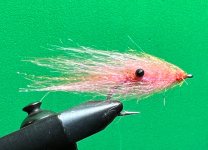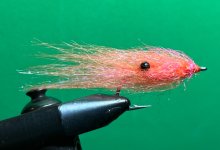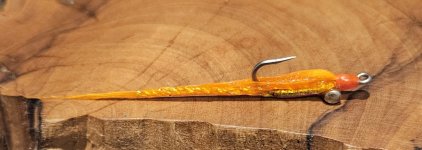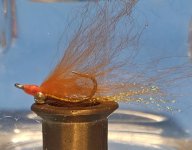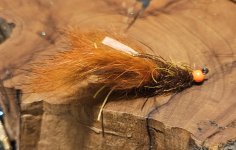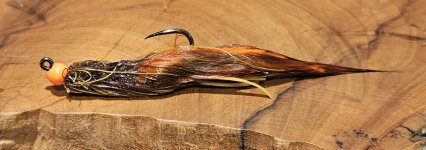
What's in your vise?

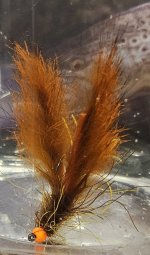
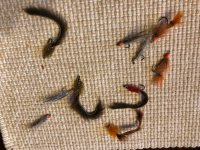
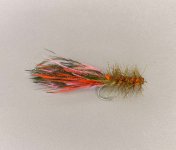
Seems like a lot of flies do, and a lot of tiers like to slick their flies back for photos. But have ya ever noticed how when the fly gets in the water, it opens back up, and doesn't look like the spit-shined fly anymore? They usually look good because the materials are moving and they look fishy, but they don't keep that tight glommed together taper.
Your materials are probably too long and not tied in properly. If your flies are doing that you should try harder. Flies tied in this style are actually designed to hold their profile when stripped or swung in moving water. When dropped in a toilette they probably will not hold the desired look very well. The UV coating on the head also helps to hold the proper shape. I run all of my streamers under the faucet to see how the materials react when they are wet. I think most of us do. Really great feedback though.
 
Cool-looking flies. Do you ever take photos of flies in the water? I’ve not yet tied minnow patterns like those, but I do like to check out some of my streamers. It’s amazing how some materials, like marabou, slick down to almost nothing when they’re wet and out of water. I like to toss flies in a sink or big glass mug, to get a much better idea of what fish see.
 
Your materials are probably too long and not tied in properly. If your flies are doing that you should try harder. Flies tied in this style are actually designed to hold their profile when stripped or swung in moving water. When dropped in a toilette they probably will not hold the desired look very well. The UV coating on the head also helps to hold the proper shape. I run all of my streamers under the faucet to see how the materials react when they are wet. I think most of us do. Really great feedback though.
I'm not sure I'm explaining it well. It's more about, say, the tail on those minnows. The tails stay all super-pointy like in the second photo in a gentle-ish current? Or on a pause in a strip? I don't know if trying harder prevents fibers from separating, I know that glues and UV epoxies and whatnot do, but maybe I'm just not trying hard enough. :) It seems like something inherent to the materials that if they aren't glued or glommed together that underwater the result is something in between the "dry look" and the "spit look." I think it has to do with hydrogen bonding of water that makes the fibers look stuck together and tapers are pointy when wet and out of the water. In the water they're more neutrally buoyant, flowy and separated, but not necessarily as wild as dry streamer can look.
 
Fly tiers would do no such thing!
Wouldn’t be the first time I’ve been accused of that. FWIW I like the minnows by @MillCreekMinnow and didn’t mean to come off disparaging. Just making conversation.
I totally get where you are coming from. My clousers splay out to some degree in the water, despite my careful attempts to taper them and keep them sparse. They still catch fish though. The free flowing movement of bucktail when it hits the water is something that cannot be tamed and the fish certainly like it, even if it doesn’t lay down into a perfect teardrop shape. I’d be kidding myself if I thought a slicked back and wetted bucktail fly is gonna look that way in the water. Other materials behave differently though.

It would be interesting to test different materials to see what retains the profiles we think fish are looking for. As mentioned above, marabou certainly slims down and tapers well in the water. I wonder if the barbules act like Velcro to keep them together. Slicker, non-kinky synthetics and hair don’t have those properties, thus are more prone to splaying out when wet?
 
I get what @Matt B is saying. I have some squimp type files that I fish for panfish that look much bigger in the water than I expected, especially when fished slow. It's like the material takes up as much space as possible.
 
Egg Laying Caddis II

54297679263_3f1a163517_c.jpg


54297413706_fd98d9d647_c.jpg


54297657219_9fa6777791_c.jpg


Another variation of Craig Mathews’ version; this time using a Spundun wing.

hook - WFC Model 3 #12
thread - Uni 8/0 rusty dun
tail - yarn chartreuse
rib - H2O Twist tan
abdomen - Ice Dub hare’s ear grey
underwing - Congo Hair shiner tan
wing - deer hair
shoulder - pheasant rump
thorax - Ice Dub hare’s ear grey

Regards,
Scott
 
Last edited:
I get what @Matt B is saying. I have some squimp type files that I fish for panfish that look much bigger in the water than I expected, especially when fished slow. It's like the material takes up as much space as possible.
For a lot of patterns, that's a feature, not a flaw. Bunny-clawed craws, webby buggers, shrimp, reverse spiders, etc. On the strip they tighten up like fleeing prey, but on the pause they puff back out as if in a defensive posture, and retain the illusion of being alive & breathing food.
Dry, wet, static in water:
1000008544.jpg
1000008545.jpg
1000008555.jpg


1000008548.jpg
1000008556.jpg
1000008554.jpg
 
For a lot of patterns, that's a feature, not a flaw. Bunny-clawed craws, webby buggers, shrimp, reverse spiders, etc. On the strip they tighten up like fleeing prey, but on the pause they puff back out as if in a defensive posture, and retain the illusion of being alive & breathing food.

View attachment 140264
That's a great craw. I agree, when it streamlines then opens on the pause it really seems to get their attention.
One of the reasons I have confidence in softhackles, they open, close and just look alive.
 
For a lot of patterns, that's a feature, not a flaw. Bunny-clawed craws, webby buggers, shrimp, reverse spiders, etc. On the strip they tighten up like fleeing prey, but on the pause they puff back out as if in a defensive posture, and retain the illusion of being alive & breathing food.
Dry, wet, static in water:
View attachment 140258
View attachment 140259
View attachment 140265


View attachment 140262
View attachment 140266
View attachment 140264
Great photo explanation!
 
Back
Top