Northern elephant seals are a significant conservation success story. Because of their large size and substantial blubber, northern elephant seals were hunted extensively to extract oil.
Charles Scammon, a whaler who first discovered (and tried to decimate) the birthing lagoons used by gray whales in Mexico, described recovering 210 gallons of oil from an 18 foot long elephant seal. Pre-harvesting populations of elephant seals may have been as large as several hundred thousand individuals. By the late 1800's, the sole population of northern elephant seals was reduced to perhaps 50-100 individuals that bred on Guadalupe Island, along Baja California (see
here). Northern elephant seals were protected from hunting by the Mexican government in 1922 and by the U.S. government shortly thereafter. Since becoming protected, their overall population size has recovered remarkably. There are perhaps
200,000 individuals today. But because this rebound has happened so quickly and from such as small starting population (a
genetic bottleneck), there is not much genetic diversity in the species.
Females come ashore to sandy beaches in late fall/winter to give birth. Dominant males (3000-5000lbs, 13-16 feet long ) fight vicious bloody battles to control a beach and its females (his 30-100 individual harem). These "beach-master" males will inseminate the females (880-2000lbs) within their territory. [Southern elephant seal bulls are even larger, 14-18ft long and up to 8000lb. I saw them hauled out on a gravel beach during a research trip to the Antarctic Peninsula in 1992 - just huge animals]. Some pups are crushed in these fights between bulls or when bulls are trying to mate with females. The pups are nursed intensively for a month. By the end of the nursing period, the females are emaciated and the pups have increased their weight by 3-7 fold to become "nearly globular". After cessation of lactation, the females head out to sea having lost 1/3rd of their body mass. The pups remain on the beaches for several more week as they continue to grow off stored fat and to learn how to adjust to the marine environment (see
here). Individuals of both sexes also come on shore to molt for a
month in summer.
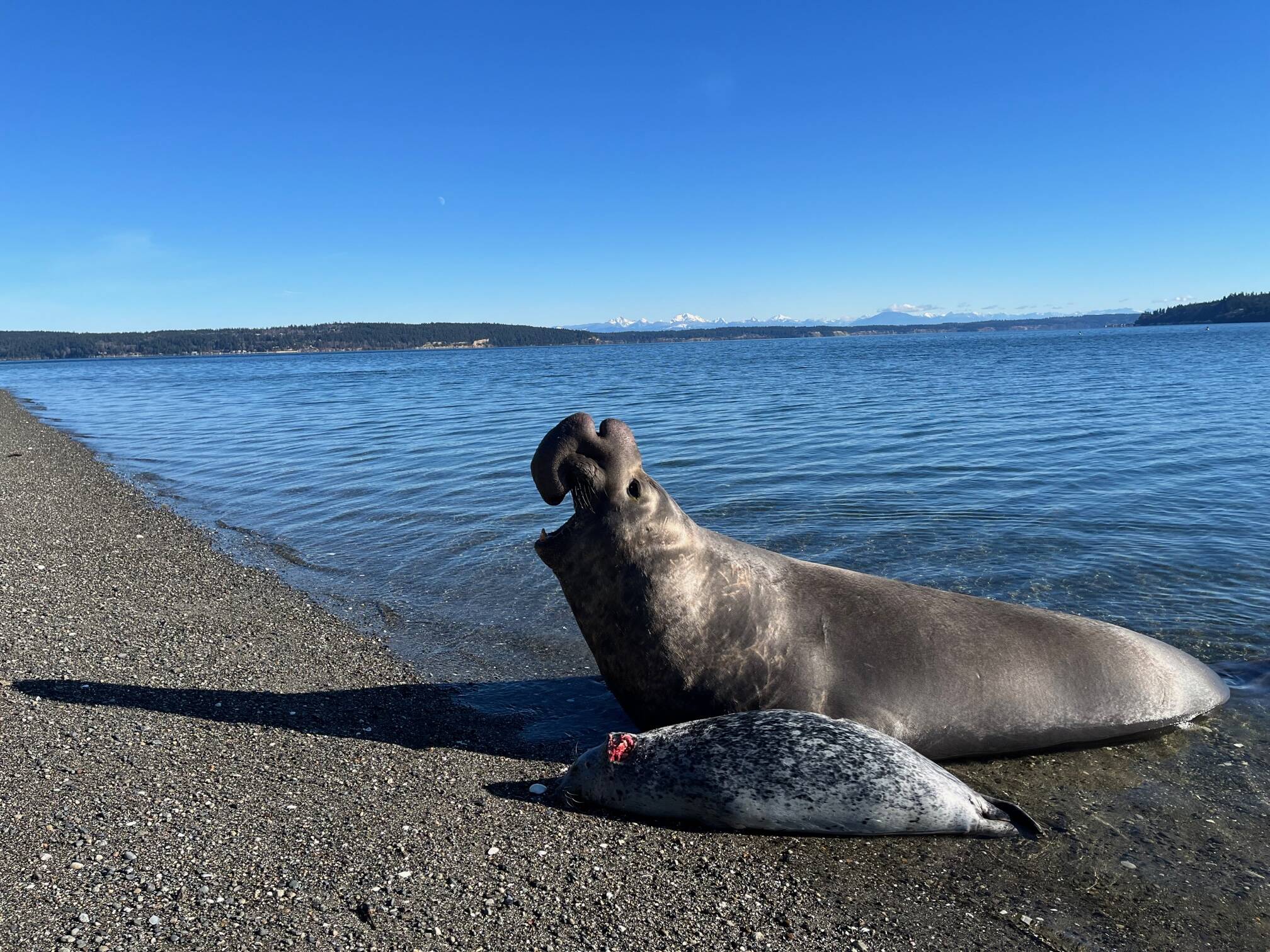
As the overall population has grown, the number of beaches that the species uses has also grown, primarily in Central and Northern California (like Point Reyes, Ano Nuevo, and San Simeon) and some of the Channel Islands (like San Nicholas Island). As the California beaches have filled up, females have been coming ashore farther north to give birth, such as at Whidbey Island and
Race Rocks on Vancouver Island.
Because of tagging
studies (and
here) we know learned quite a bit about the behavior of Northern elephant seals when at sea. After leaving the beaches, the females head into the open Pacific where they hunt along the boundary between cold nutrient-rich waters from the subpolar gyre mix with the waters of the warmer subtropical gyre; this
area, the North Pacific Transition Zone, is a magnet for a variety of other top ocean predators, such as tuna, pelagic sharks, albatross, and other predators. The males head to the continental shelf off coast of Alaska and out onto the Aleutian Islands. Females spend 80% or more of their time diving for their primary prey, squid. Dives may be as long as two-hours and reach depths of 1500-5000ft. Males include more benthic prey from the shelf, including hake, sharks, and skates.
Steve



 www.whidbeynewstimes.com


 .
.