Fiber options for squid flies?

SilverFly

Legend
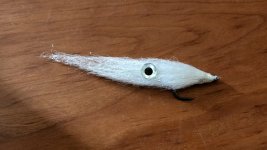
Variations on this small squid pattern in white or light pink have been consistent tuna producers for me two seasons and is now my "confidence" fly out there.

I got away from tying them with hackles for tentacles and doing them as a simple, all fiber shape. The problem has been fouling with fibers that have better movement like craft fur.

So, any suggestions on longish furs, or fiber products that have good movement, but less prone to fouling, would be appreciated.

20220820_142107.jpg
 
Bucktail under nayat.
 
Found a good video on it. Looks like great stuff. How does it compare to, say craft fur, movement wise?

 
Found a good video on it. Looks like great stuff. How does it compare to, say craft fur, movement wise?
It's a little more sparse and flows a bit better, tending not to glom/mat together. In part it’s because of the slight crinkle it has to it.

The undercoat also makes a really good dubbing for bigger flies.
 
I may be slightly heretical here. I wonder if "movement of materials" hasn't been oversold in streamer flies, especially for offshore tuna fishing (vs. trolling a streamer behind a pontoon boat in a lake or casting and retrieving a streamer on a lake). During the troll offshore, the turbulence in the wake is sure to give your fly plenty of movement [Certainly, a cedar plug has no intrinsic "movement"]. On the slide and even casting at a bait stop, the rocking of the boat and the erratic retrieval of the fly is sure to add movement. Clearly, a fouled fly will impart "unnatural" movement and likely inhibit a strike. If you are fishing a fouled fly while trolling, you might as well have your fly in the boat for that whole time. And if your fly is fouled while casting at a bait stop, that cast will be wasted in that narrow window when the action is hot.
Therefore, one could argue that the first priority to streamer fly design is to minimize fouling. Once that is accomplished, I can see adding materials that encourage movement.
Steve
 
Last edited:
I may be slightly heretical here. I wonder if "movement of materials" hasn't been oversold in streamer flies, especially for offshore tuna fishing (vs. trolling a streamer behind a pontoon boat in a lake or casting and retrieving a streamer on a lake). During the troll offshore, the turbulence in the wake is sure to give your fly plenty of movement [Certainly, a cedar plug has no intrinsic "movement"]. On the slide and even casting at a bait stop, the rocking of the boat and the erratic retrieval of the fly is sure to add movement. Clearly, a fouled fly will impart "unnatural" movement and likely inhibit a strike. If you are fishing a fouled fly while trolling, you might as well have your fly in the boat for that whole time. And if your fly is fouled while casting at a bait stop, that cast will be wasted in that narrow window when the action is hot.
Therefore, one could argue that the first priority to streamer fly design is to minimize fouling. Once that is accomplished, I can see adding materials that encourage movement.
Steve
Excellent points. Totally agree there.

Also a major reason I tie with a ton of bucktail. Great movement, virtually foulproof, durable. Nayat is similar, but longer and fouls some, but not nearly as much as most other softer materials.
 
I may be slightly heretical here. I wonder if "movement of materials" hasn't been oversold in streamer flies, especially for offshore tuna fishing (vs. trolling a streamer behind a pontoon boat in a lake or casting and retrieving a streamer on a lake). During the troll offshore, the turbulence in the wake is sure to give your fly plenty of movement [Certainly, a cedar plug has no intrinsic "movement"]. On the slide and even casting at a bait stop, the rocking of the boat and the erratic retrieval of the fly is sure to add movement. Clearly, a fouled fly will impart "unnatural" movement and likely inhibit a strike. If you are fishing a fouled fly while trolling, you might as well have your fly in the boat for that whole time. And if your fly is fouled while casting at a bait stop, that cast will be wasted in that narrow window when the action is hot.
Therefore, one could argue that the first priority to streamer fly design is to minimize fouling. Once that is accomplished, I can see adding materials that encourage movement.
Steve
I tend to agree when trolling. I’m convinced it’s the silhouette they’re seeing and movement and color have little effect on that.

On cast & retrieve, however, I think they matter more.

Which is why I went with nayat tube flies this year. Silhouette + no fouling + good movement when casting.
 
I agree with above comments regarding trolled flies. My concern with movement amps up when on slide, retrieved, or "drift jigging".

Looking at vids of live squid they aren't really "wiggling" a lot. Instead they tend to keep a "fusiform" shape. With most of the movement at fins and towards the tentacle tips. So I think a effective imitation really only needs some wiggle action near the tentacle tips.
 
I agree with above comments regarding trolled flies. My concern with movement amps up when on slide, retrieved, or "drift jigging".

Looking at vids of live squid they aren't really "wiggling" a lot. Instead they tend to keep a "fusiform" shape. With most of the movement at fins and towards the tentacle tips. So I think a effective imitation really only needs some wiggle action near the tentacle tips.
When cruising they really do tend to fit the profile of the photo at top, but they also do that pulse thing and then they really splay out—which is where my inexpert mind tends to go when stripping squid flies in.
 
When cruising they really do tend to fit the profile of the photo at top, but they also do that pulse thing and then they really splay out—which is where my inexpert mind tends to go when stripping squid flies in.
Good point. Now wondering about ways to build-in a bit of "splay bias" so the relaxed state of the tentacle fibers are slightly flared. But not so much that they don't taper down to a neat point with a bit of retrieve. Get that combination right and it could be a killer.
 
Good point. Now wondering about ways to build-in a bit of "splay bias" so the relaxed state of the tentacle fibers are slightly flared. But not so much that they don't taper down to a neat point with a bit of retrieve. Get that combination right and it could be a killer.
If you were using hackles as tentacles, could you position a sequin or something similar just behind them to flare the hackles out. But when you were stripping the fly, they would conform to a more streamlined shape.
Steve
 
If you were using hackles as tentacles, could you position a sequin or something similar just behind them to flare the hackles out. But when you were stripping the fly, they would conform to a more streamlined shape.
Steve
Hmm, might a good reason to go back to the hackle tentacles. The nice thing about those is that they can be pre-formed to any shape using UV resin, although not quite the flexibility I'd like. Might be able to get around that by thinning the resin, or switching to silicone. High-tech bleach bottle form I used last year.

1665856705484.png
 
Good point. Now wondering about ways to build-in a bit of "splay bias" so the relaxed state of the tentacle fibers are slightly flared. But not so much that they don't taper down to a neat point with a bit of retrieve. Get that combination right and it could be a killer.
Perhaps a hollow fly with a small collar of thread and dubbing just behind where the hair ties in to splay it out?

Then hot water soak to relax the fibers a bit?
 
Perhaps a hollow fly with a small collar of thread and dubbing just behind where the hair ties in to splay it out?

Then hot water soak to relax the fibers a bit?
Going that route I'm envisioning a short tag of straightened, heavy FC, inline with the shank and sticking straight back. With a small disk or wad of dubbing roughly a third to mid-point into the tentacles.
 
Back
Top