
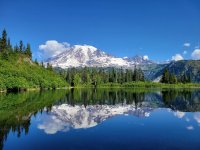
Haven't been to Mount Rainier National Park in a while to fish, so I thought I try one of the small sub-alpine lakes at around 4,500 feet. The main attraction of this lake is the awesome view of Mount Rainier:
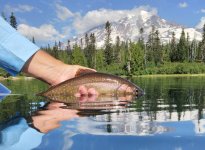
As for the fishing, it turned out that there were Brookies in this lake. I landed 11 Brookies in the 12 to 14 inch range. My friend landed 10 in the same size range, and he took this photo of a typical Brookie from this lake:
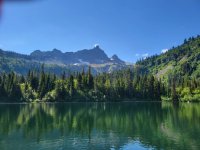
This lake also has a nice view of Unicorn Peak (6,871 feet):
Lots of hikers passing through, but no other anglers were seen. The water temperature was surprisingly warm at 70 to 71 degrees F. Normally I recommend ceasing to fish for trout at 70 degrees, but these Brookies were down deep around 28 to 32 feet down in cooler water, and the fishing regulations for the park are very clear about their policy of trying to eradicate non-native fish (like the Brookies). There is also no limit (either size or number) on the fish you catch in a park lake. In a park lake, you can fish for spawning fish and you are allowed to snag fish. This a quote from the park fishing regulations: “Retention or humane euthanization of non-native fish is encouraged to reduce competition and likelihood of hybridization with native fish, as well as to restore ecosystems for other native aquatic species. Euthanize fish as humanely as possible (i.e. a blow to the head followed by pithing or decapitation).” While I can technically understand why the park fisheries biologists want us anglers to either keep or kill the non-native fish, like the Brookies, Kokanee or westslope cutthroats, I just had a hard time killing those Brookies that we were catching. I released all the Brookies I landed. This does mean that continuing to fish when the water reaches 70°F or higher is ok, as any fish incidentally killed would help the park. However, I find it hard to believe that anglers alone can get rid of entire populations of non-native fish, as it only takes a few fish to rapidly re-populate a lake. It also seems to me that rotting fish carcasses would ruin the pristine environment that the swimmers at this lake enjoy. I am admittedly conflicted over this policy.
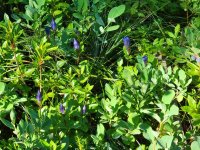
The wildflower meadows are pretty much done for the summer, but there are still a lot of wildflowers around, like Pearly Everlasting, Fireweed, Spiraea and these Rainier Gentians that are just opening up:
The mosquitoes and biting flies were surprisingly not attacking, and I didn't have to use any insect repellent.
About a half dozen hikers took a swim in the lake, mainly by the end of the trail, but one woman swam out to the middle of the lake where I was, close enough to be within casting distance, and it so happened that I hooked a fish at that moment, and she asked what kind of fish I had caught. I could tell from her accent that she was from Britain, and she confirmed that she was from London. She sounded just like the actress, Emma Thompson, and could have been Emma’s daughter, for all I know. That was a unique encounter that I doubt I’ll ever see again.
It was a nice summer outing and the view of Mount Rainier made it special.
Rex
As for the fishing, it turned out that there were Brookies in this lake. I landed 11 Brookies in the 12 to 14 inch range. My friend landed 10 in the same size range, and he took this photo of a typical Brookie from this lake:
This lake also has a nice view of Unicorn Peak (6,871 feet):
Lots of hikers passing through, but no other anglers were seen. The water temperature was surprisingly warm at 70 to 71 degrees F. Normally I recommend ceasing to fish for trout at 70 degrees, but these Brookies were down deep around 28 to 32 feet down in cooler water, and the fishing regulations for the park are very clear about their policy of trying to eradicate non-native fish (like the Brookies). There is also no limit (either size or number) on the fish you catch in a park lake. In a park lake, you can fish for spawning fish and you are allowed to snag fish. This a quote from the park fishing regulations: “Retention or humane euthanization of non-native fish is encouraged to reduce competition and likelihood of hybridization with native fish, as well as to restore ecosystems for other native aquatic species. Euthanize fish as humanely as possible (i.e. a blow to the head followed by pithing or decapitation).” While I can technically understand why the park fisheries biologists want us anglers to either keep or kill the non-native fish, like the Brookies, Kokanee or westslope cutthroats, I just had a hard time killing those Brookies that we were catching. I released all the Brookies I landed. This does mean that continuing to fish when the water reaches 70°F or higher is ok, as any fish incidentally killed would help the park. However, I find it hard to believe that anglers alone can get rid of entire populations of non-native fish, as it only takes a few fish to rapidly re-populate a lake. It also seems to me that rotting fish carcasses would ruin the pristine environment that the swimmers at this lake enjoy. I am admittedly conflicted over this policy.
The wildflower meadows are pretty much done for the summer, but there are still a lot of wildflowers around, like Pearly Everlasting, Fireweed, Spiraea and these Rainier Gentians that are just opening up:
The mosquitoes and biting flies were surprisingly not attacking, and I didn't have to use any insect repellent.
About a half dozen hikers took a swim in the lake, mainly by the end of the trail, but one woman swam out to the middle of the lake where I was, close enough to be within casting distance, and it so happened that I hooked a fish at that moment, and she asked what kind of fish I had caught. I could tell from her accent that she was from Britain, and she confirmed that she was from London. She sounded just like the actress, Emma Thompson, and could have been Emma’s daughter, for all I know. That was a unique encounter that I doubt I’ll ever see again.
It was a nice summer outing and the view of Mount Rainier made it special.
Rex


