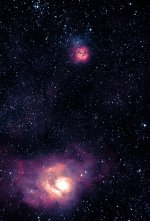
Up early (12:30 AM) to get some work done so I can pack up the house during the day (movers coming Saturday). As such, given the clear skies and late rising and waining moon, I again pointed the scope to the low southern sky (azimuth: 180° 27’ 07.2”; altitude: 22° 58' 39.8”), for about an hour of imaging during the narrow window I have through the trees. Low and behold, the Trifid (M 20) and Lagoon (M 8) nebulae, both in the Sagittarius-Carina spiral arm of our Milky Way Galaxy.
The Trifid Nebula (upper middle) gets is common name due to the three lobes. Interestingly, it is also composed of 3 separate types of nebulae, emission nebula (the reddish glow) where new star formation is occurring, reflection nebula (the blue glow), and a dark nebula, which divides the emission nebula into its 3 parts. The Trifid was discovered by Le Gentil before 1750. Charles Messier added it as the 20th entry in his catalog in June, 1764, and described it as "a cluster of stars of 8th to 9th magnitude, enveloped in nebulosity". The Lagoon Nebula (M 8) is a massive star forming region some 4,800 to 6,500 light years away. The earliest observations of this object were made by Giovanni Battista Hodierna before 1654. When Charles Messier cataloged this object in 1764, he primarily described the cluster, and mentioned the nebula separately as surrounding the star 9 Sagittarii. Although most sources identify only the nebula as "Messier 8", it is clear from Messier's description that he found both the nebula and the cluster.
The Trifid Nebula (M 20), Lagoon Nebula (M8), and in the upper left quadrant, M 21 (an open, but compact cluster containing 57 stars of 7th magnitude and fainter): 15x 240 second light exposures; 15 darks, OIII/H-alpha duo-narrowband filter:
Information brought to you via SkySafari 6 Pro.
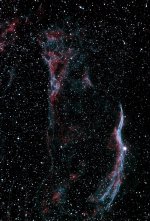
Tonight, the Veil Nebula???
Cheers


www.techexplorist.com












 ?
?