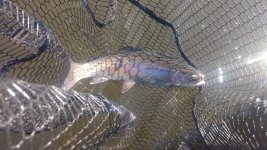
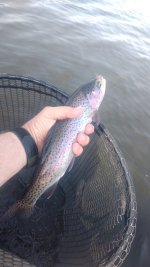
Hit Martha again bloom in full swing, it was moving around ? Is it turning, not heard of this till this spring. Anyway I went 2 for 3 on my cronimids. Happy times, 14" on the nose.

Navigation
Install the app
How to install the app on iOS
Follow along with the video below to see how to install our site as a web app on your home screen.
Note: This feature may not be available in some browsers.
More options
Style variation
You are using an out of date browser. It may not display this or other websites correctly.
You should upgrade or use an alternative browser.
You should upgrade or use an alternative browser.
T
Tombraider
Guest
T
Tombraider
Guest
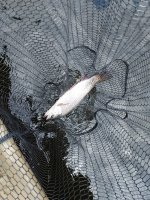
I'm going to agree that it is a Cutt. Yes, they are there, but they're really, really hard to find. Given that Martha has Cutts, Browns, and Rainbows, a trifecta is possible--something I've done (maybe two or three times?) a long time ago in the past. The cutts were rather small those times, though. Kudos to @Tombraider for his catch. Maybe he'll tell us the size. The best I've ever brought to hand was a 16" on a very small #14 or #16 Hungarian Partridge and Peacock herl fly. You just have to target likely habitat.@Tim Lockhart @Ceviche , is it just me? - the spotting on this one seems cutty-esque. not a clear pic, and i don't see slashes, but those aren't always there. i've never seen one of the cutts from martha except in a pic from tim years ago... based on the stocking reports since 2016 6/10 fish there should be a cutts....
T
Tombraider
Guest
I'm really disappointed in The size of the fish. All of the illegal fishing has taken its toll on that lake. Fish caught were 10-14".

I doubt that even with a decent amount of illegal fishing, a lake that is nearly 60 acres, 70' deep and had 12,000 bows planted in it over the past four years will have all the large fish get fished out. There will always be some carryovers. You just haven't found them yet.
SF
SF

Dr. Magill
Life of the Party
I would agree with thisI doubt that even with a decent amount of illegal fishing, a lake that is nearly 60 acres, 70' deep and had 12,000 bows planted in it over the past four years will have all the large fish get fished out. There will always be some carryovers. You just haven't found them yet.
SF

Me too. I think all lake with plants do. Mike got a 4#'er this morning, must of been in here a while. He seems to get more than the rest of us.I would agree with this
i wish they'd do away with the legal sized plants. i don't claim to know how the whole stocking plan works together, but what's the point of these fish in a selective fishery that already has plenty of fish that have grown from fingerling stage?
It is interesting how they plant some of the lakes. If I'm reading the 2022 planting document correctly, they planted 3,000 catchable bows plus 3,500 fry / fingerling browns and 10,000 fry / fingerling cutthroat in Martha. That is a lot of fish regardless of whether they are catchables or not, especially if you do that year over year.
I do agree with @Tombraider that it is nice to have quality fish. Many of the quality or selective lakes really aren't that great with non selective, put and take lakes providing better fishing in my opinion. Here is a link if anyone is interested in seeing the stockings for a particular lake.
SF
The majority of the trout I’ve caught so far this year have been over 14”. They’re there, but you have to figure out what they want.
What I’ve seen of the recent planters is that they have spread out a bit by now. The last time I went out, I found a tight collection of them in a shaded spot along the southeast shoreline. The spot looked fishy, so I had to see what might be hiding there. Dinkerville.
What I’ve seen of the recent planters is that they have spread out a bit by now. The last time I went out, I found a tight collection of them in a shaded spot along the southeast shoreline. The spot looked fishy, so I had to see what might be hiding there. Dinkerville.
Last edited:

T
Tombraider
Guest
That looks fun

I'm not familiar with Martha but assume it's a natural lake. That being said, with the stocking of various sizes and varieties of trout along with the presence of warmwater species, the principles of reservoir biology apply. Back during my working days, we managed (or attempted to manage) trophy fisheries in reservoirs on state wildlife areas in northern California. In one case on a newly acquired wildlife area, we had a 200 surface acre reservoir that had an existing largemouth bass and bluegill population along with native rainbow trout (steelhead fingerlings). The rainbows accessed the lake via an unscreened diversion from a stream in the Upper Klamath River Watershed. After initial electrofishing surveys, the diversion was screened and we switched to an annual planting of 10"-12" Eagle Lake strain rainbow trout. These fish were planted in the fall (after the lake had closed to fishing) and allowed to grow through the winter months until the spring trout opener.
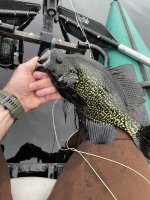
I had about 28 years of involvement in this program and can say there's a lot of variability in the food chain from year to year with booms and busts of various fish and prey species populations. Given the intensity of stocking as stated in Brian's post, I would expect the same sort of variability in Martha. Warmwater species compete with trout for prey as well, as that giant black crappie will attest. I would expect that some years (or a series of years) will be more favorable for rapid growth than others.
I had about 28 years of involvement in this program and can say there's a lot of variability in the food chain from year to year with booms and busts of various fish and prey species populations. Given the intensity of stocking as stated in Brian's post, I would expect the same sort of variability in Martha. Warmwater species compete with trout for prey as well, as that giant black crappie will attest. I would expect that some years (or a series of years) will be more favorable for rapid growth than others.
Last edited:

Uptonogood
PNW raised
Those rainbow trout are an ideal forage fish for LMB. Conversations with biologists stocking 8” rainbows in Southern California lakes who laughed at the feeding frenzy when stocking trucks unloaded their contents at boat launches. Of course, my memory is going back to grad school in 1977! If a trout made it to 12” it was probably safe.
Ideal forage for LMB? 8”-10”, cylindrical body, no spines in fins, stupid and schooling like they’re still in Their rearing ponds.
Ideal forage for LMB? 8”-10”, cylindrical body, no spines in fins, stupid and schooling like they’re still in Their rearing ponds.

There’s good reason of the most popular swim baits for LMB in California reservoirs is an 8” rainbow trout jointed lure.
I haven't fished there in a number of year, but besides warmwater fish predation how much do you think birds may also be playing a part?
Seems crazy to spend money on cutthroat if they aren't really contributing much to catches.
SF
Seems crazy to spend money on cutthroat if they aren't really contributing much to catches.
SF

I go back 10-15 yrs at Martha WB (whenever Dave/Ceviche first took me there). All my experience bares that out, and I've found that to be the case almost everywhere else. Martha has a very good history of fat 20+" browns; I've never seen sizable warmwater fish there - plenty of dinks; carryover RB's have typically been solid (and fun), and I'll add the jumbos are worth looking for and not hard to find - seek them in the weeks following arrival (assuming that's still a thing).I'm not familiar with Martha but assume it's a natural lake. That being said, with the stocking of various sizes and varieties of trout along with the presence of warmwater species, the principles of reservoir biology apply. Back during my working days, we managed (or attempted to manage) trophy fisheries in reservoirs on state wildlife areas in northern California. In one case on a newly acquired wildlife area, we had a 200 surface acre reservoir that had an existing largemouth bass and bluegill population along with native rainbow trout (steelhead fingerlings). The rainbows accessed the lake via an unscreened diversion from a stream in the Upper Klamath River Watershed. After initial electrofishing surveys, the diversion was screened and we switched to an annual planting of 10"-12" Eagle Lake strain rainbow trout. These fish were planted in the fall (after the lake had closed to fishing) and allowed to grow through the winter months until the spring trout opener.
I had about 28 years of involvement in this program and can say there's a lot of variability in the food chain from year to year with booms and busts of various fish and prey species populations. Given the intensity of stocking as stated in Brian's post, I would expect the same sort of variability in Martha. Warmwater species compete with trout for prey as well, as that giant black crappie will attest. I would expect that some years (or a series of years) will be more favorable for rapid growth than others.
Also of note, Martha's year round regs have served her well, as the masses tend to focus on nearby Lk Ki. Of those who fish using gear, they tend to be little impact on the game we're most interested in. Timing, location, methods and a general lack of ability are factors in all my observation - pretty typical stuff.
In all that time, the present is by far the worst I've encountered there for brown trout. My last was Nov 2021 and I only had a single one, albeit a nice fish. Granted I'm out of state and don't go there often these days, but I know what to expect. That said, I'd be surprised if they didn't come back around. And I've seen very similar cycles among browns in other lakes, Pass among them.
Until then, it's still a good rainbow fishery - if anything Martha could use a few less. Plus if warmwater species are becoming more of a trend there I'd change focus. Sizable crappie and bass are great fun on a fly.
Just wish we had a better program for brown trout in Ohio lakes. I'd be very interested to see how they compare with the rainbows in this environment.
Last thought - from above regarding bird predation - anything that thins out fish stocks is a good thing as far as I'm concerned. Washington's #1 issue for trout in lakes: Overpopulation
Last edited:
I'm a little blown away with the shear number of fish being dumped into a 63 acre lake on an annual basis. Personally, I would not expect many of the fingerlings to reach catchable size - it must be a helluva productive lake. I just read Brian's comment and agree wholeheartedly, if few if any cutthroat reach catchable size, why does the state continue to dump 1000's in each year?
Uptonogood
PNW raised
As I recall, the lakes were in the Sad Diego area which was producing potential world record LMB frequently.except none of the bows are planted as fry and the species that ARE planted as fry are nowhere to be found. i don't doubt there are some alpha lmb in there that could choke down one of the planted legals once or twice a week - but a lake that size can only accomodate so many of those specimens, right? and there are still plenty of those bows getting caught. i think it is the fry those bass and crappie are feasting on.
maybe the secret strategy is to create an exceptional bass and crappie fishery by feeding them 15,000 trout babies every spring, then distracting the trout anglers with a few easily catch-able legals =)