Well, as we wrap up Galaxy season, I had 2 relatively clear and moonless nights. Took the opportunity to visit a new galaxy (Sunflower) that I hadn't visited before, and a revisit to the Whirlpool Galaxy, which I hadn't been to with the new rig.
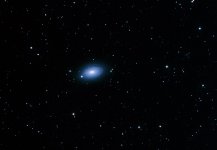
The Sunflower Galaxy (M 63, NGC 5055), is a spiral galaxy in the constellation Canes Venatici. It was discovered by Pierre Mechain, Charles Messier's friend, on June 14, 1779. On the same day, Messier included it as the 63rd object in his catalog. Lord Rosse listed M 63 as one of the fourteen "spiral nebulae" known up to 1850. The distance to M 63 is about 37 million light years, and it has a diameter of some 90,000 light years. Although it appears 6° south of the Whirlpool Galaxy (M 51), it apparently forms a physical group with that galaxy and several others, known as the M 51 Group.
The Sunflower Galaxy (20 x 240 second light exposures, 20 darks):
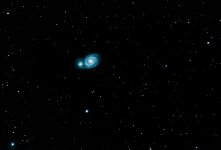
The Whirlpool Galaxy (M 51, NGC 5194), which we have visited previously with the older setup (
#22 ), is also in the constellation Canes Venatici. The Whirlpool's spiral pattern was not seen until 1845, when Lord Rosse discerned it in his 6-foot reflector at Parsonstown, Ireland. Lord Rosse made a very accurate painting of M 51; hence M 51 is sometimes referred to as Rosse's Galaxy or Lord Rosse's "Question Mark". Halton Arp included M 51 as No. 85 in his Catalogue of Peculiar Galaxies and described it as a "Spiral with Large High-Surface-Brightness Companion".
The Whirlpool Galaxy (30 x 240 second light exposures, 30 darks):
Information from SkySafari 6 Pro.
Now we start into the Milky Way season. Hoping for clear skies.
Cheers