Puget Sound and cheap boots

skyriver

Legend
Forum Supporter
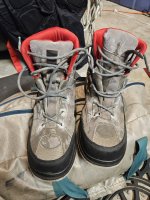
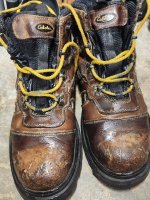
I got em cheap from ebay back in 2017. I didn't want to get salt on my nice pair so these became my salt boots. I religiously washed them off every time, but it didn't matter. The material they used for the eyelets was exactly the wrong material for salt. Haha! I had lost one eyelet after only a few trips. Then I lost some more the next year. Then I stopped fishing the sound. Fast forward to now-
New/old salt shoes. No oxidation/rust now. 😁
20261104_204311.jpg

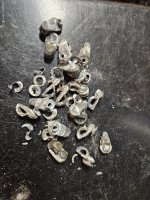
Here's the carnage to rid them of said inferior material.
20261104_203842.jpg

Now I just have to fish the sound...
 
I can't remember if they were "cheap" back in 2009 but I bought a pair of Cabela's "Guide" model boots to replace my felt-soled Weinbrenner Wood n'Stream Borgers from the 1990s. The Cabela's are obviously rebranded, rubber-soled Chota genuine leather SSTs with screw in studs. But they soak up water and get very heavy from wading. Also the studs quickly started coming out, got lost and were real expensive to replace. That was not good for hike-in stream destinations. In 2011 I replaced the Chotas with 1st gen Korkers for freshwater and the Cabela's were relegated to the beach only.

I needed studs because the nearby beaches are fairly high gradient and those rubber soles on beach cobble are like rollerskates. I learned about Kold Kutters in the old forum. They still get lost but a box of 250 KKs cost me about what 28 replacement studs were going for. Using a dab of adhesive to seat the studs has helped with retention. I only fish saltwater a dozen or less times a year and am still on the first box of studs.
After 10 years, with the last 8 only in saltwater, the uppers' stitching started to fail. I took them into Ardessons and they restitched both uppers at a very reasonable cost. They also recommended and sold me some Obenauf's LP leather preservative that has kept them in pretty good shape.
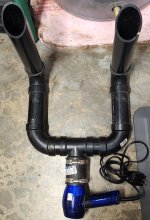
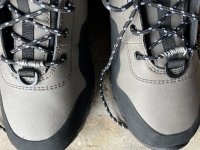
The lacing guides are definitely steel but have not corroded. Maybe because I actually put the boots in a 5 gallon bucket of water at home to soak after every trip and change the water a couple of times. Then I put them on my DIY 78° hair dryer-powered boot dryer and grease 'em up with the Obenauf's when dry.
1793904224469.jpeg1793906626416.jpeg
OK for 17 year old boots?​
I see @skyriver 's boots have felt soles.
I still have the Borgers that are also in pretty good shape. The felt could really use a refresh.
How does the felt hold up to barnacles?
Do they work on high, steep, and often muddy access trails that South Sound beaches frequently have?

 
Last edited:
Felt consistency and traction varies quite a bit. This pair is better in mud than some others I've had.
In the fall of 2020 I slipped big-time on a muddy off-chamber slope hiking to a nice run on the Klick on a rainy November day. I hit hard! Luckily, nothing on me or my rod was broken. My boots were Hodgman H3s that I'd only worn 5 or 6 times. They were affordable, but really comfortable and light. I liked them for long hikes. But that felt was no bueno on mud and snow. I put studs in them after that slip!

I run studs in all my felt boots except for these salt boots.
 
Jake Watrous told me about zinc wire mitigating saltwaters effects on metal on boots. So far so good . . .

View attachment 196063
I am not an expert but I believe that a sacrificial anode would need a direct electrical connection between all of the metal eylets. The shoelace itself is made of fabric (an electrical insulator), so wrapping zinc wire at the bottom of the lace does not form a circuit with the eyelets.

I think you're taking adequate care of your boots, and-or the eylets are corrosion resistant.
 
Like the built-in clips for wader hooks vs snagging the laces. Wish more wading boots had those. Or maybe it is being implemented more in newer made boots.
 
Doesn't anyone wear old fashioned rubber hip boots anymore? Hodgeman cheapies are what I wear even though owning a pair of G3's. Never ever in the water much over my knees anyway. The older I get the more work it is just to get dressed and undressed in chest waders with separate boots.
 
I am not an expert but I believe that a sacrificial anode would need a direct electrical connection between all of the metal eylets. The shoelace itself is made of fabric (an electrical insulator), so wrapping zinc wire at the bottom of the lace does not form a circuit with the eyelets.

I think you're taking adequate care of your boots, and-or the eylets are corrosion resistant.
I'm pretty sure that saltwater-soaked shoelaces would conduct electricity quite well.
There are actually sweat-activated cloth/yarn batteries developed for wearables
 
Back
Top