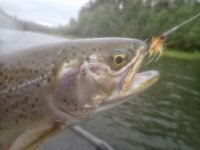
Sea Run Cutthroat in rivers. What's your jam?

This thread has drove home how staggering the loss of sea-run cutthroat opportunities on North Sound "S" rivers has been. As one that enjoyed those fisheries since the mid 1960s, I have had my days enjoy this marvelous resource. In many ways the status of the resource is greater today than it was 60 years ago. However, it saddens my heart that the younger generations may well never have the chance to experience that resource in any meaningful way.

Those wonderful fall days as the leaves turn chasing those cutthroat are firmly etched in my mind and I'll take those PNW iconic memories to my grave.

WDFW's decision makers should be hanging their heads in shame.

Curt
 

Seems like the YouTube link doesn't work there either


This fly appeals to me a lot and some version of it will be in my saltwater SRC box this fall and winter.
 
This thread has drove home how staggering the loss of sea-run cutthroat opportunities on North Sound "S" rivers has been. As one that enjoyed those fisheries since the mid 1960s, I have had my days enjoy this marvelous resource. In many ways the status of the resource is greater today than it was 60 years ago. However, it saddens my heart that the younger generations may well never have the chance to experience that resource in any meaningful way.

Those wonderful fall days as the leaves turn chasing those cutthroat are firmly etched in my mind and I'll take those PNW iconic memories to my grave.

WDFW's decision makers should be hanging their heads in shame.

Curt
Fishing for sea-runs in the fall was one of my favorite activities. Fishing a "S" river was always a great time, even though hip boots made wading interesting.
 
This thread has drove home how staggering the loss of sea-run cutthroat opportunities on North Sound "S" rivers has been. As one that enjoyed those fisheries since the mid 1960s, I have had my days enjoy this marvelous resource. In many ways the status of the resource is greater today than it was 60 years ago. However, it saddens my heart that the younger generations may well never have the chance to experience that resource in any meaningful way.

Those wonderful fall days as the leaves turn chasing those cutthroat are firmly etched in my mind and I'll take those PNW iconic memories to my grave.

WDFW's decision makers should be hanging their heads in shame.

Curt
Curt, how far would (or do) sea runs go upstream?

Like do they follow salmon to spawning beds in order to feed on the eggs?

Or do they tend to stay in the lower in the river and not stray too far from the tide waters?

In the past, I’ve caught cutts 20 or 30 miles upstream on the SF Nooksack when chasing silvers but I have no idea if they were resident or sea runs.
 
The coastal cutthroat on the north Sound rivers that adapt the sea-run life history are typically fish of small, low gradient streams. Thus, they typically spawn and do their early juvenile rearing in those smaller tributaries in the broad lower river valleys. Once the tributaries become steep rainbows tend to dominate the "trout" populations. In a basin like the Skagit roughly 90% come from the tributaries downstream of the Baker though adult sea-runs can be found as far upstream on the Skagit as the Barnaby slough area and as far up as Darrington on the Sauk. On the Stillaguamish they can be found as far upstream as the Squire Creek drainage on the North Fork and Canyon Creek on the South Fork. On the Snohomish as far upstream on the Skykomish as the Reiter area and the Falls on the Snoqualmie. On the Nooksack they are found a little above Kendall Creek on the North Fork and the Skookum area on the South Fork. Obviously, there are a lot of such tributaries in the various large Rivers of the north Puget would equates in some very significant populations.

It probably is not correct to say these north sound fish are following the salmon to take advantage of the spawning. While they will and often do consume loose salmon eggs and even have been observed ramming the sides of ripe female salmon to dislodge loose eggs the vast majority of their freshwater diet are insects (both aquatic and terrestrial) with a smorgasbord of various small fish. Unlike the fish in south and central Sound these north Sound fish spend much of their year in freshwater. While the adult fish typically spawn mid-winter though spring (January to May with peak spawning varying form late February through late March) they enter the rivers well in advance of that spawning period. Once the main rivers summer flows fall to seasonal low floods one can find fishable numbers of adult sea-runs as early as late July. While those early fish are not near as numerous as the September and October fish they tend to be older and larger fish.

The other interesting twist with those north Sound sea-runs is the immature fish also return to the rivers to over-winter with most entering the river in the September to November period. Those fish do not usually return to their natal tributaries, rather holding in the lower mainstem areas (usually within 30 miles of so of the salt water. Those over-winter "maiden" fish begin moving back to the salt about the same time as the adult kelts and a little earlier than the smolts (leaving the river in late April/May/early June.

These nuances in the sea-run behaviors depending on the characteristics of their home basin is just another example that can makes them so interesting and why those that chase them can be addicted to chasing them.

Curt
 
Back
Top