U.S. Forest Restructuring Plan

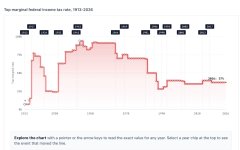
In a progressive tax system higher income brackets will always pay more in income taxes, however they also get the lions share of tax deductions...

Take this one

The real breaks aren't even in earned income of course, but for those who itemize, there's lots of deductions available for those who can, averaging 44k per return

Itemizing is heavily concentrated among higher earners; fewer than 6% of households earning under $100,000 itemize.

There's a lot to tax policy, far more to it than any thread on a fishing board can dig into.

If you have a job, get a paycheck, and think you're getting fucked when your AGI rate is 22% ($50,401 to $105,700 AGI), while Tesla paid just 0.4 percent of its U.S. profits in federal income taxes, which is another way of saying the company reported an effective federal income tax rate of 0.4 percent...

You're correct.
 
The social security "crisis" was known to be coming a long long time ago, and could have been avoided by an adjustment in the payroll tax rate, and also the payroll tax base, by raising the income cutoff number. As long as we allow a minimum wage that can't be lived on let alone save for retirement, social security is needed. at least if we want to look at ourselves as a humane society.
The Reagan administration shifted the Forest Service from a model in which the American taxpayer paid to administer a multi use system that wasn't just an industrial resource to a model in which it was expected to pay for itself through income it could generate, which mostly equals resource extraction. Personally I believe that having a National forest that was free for all Americans to use even if they can't afford a forest pass, or a camping fee was a good thing.
We now have an administration that is again working towards making the federal lands an asset to be used by the rich, and a bit less by the rest of us.
It isn't necessary, but that's who they are working for. I just read a thing Bill Gates wrote where he said we should have a tax on robots, so that the tax on wages that is lost every time a worker is replaced by an automated system, would not be lost. Taxes are necessary to keep government functioning. Bezos isn't hurting, but most of the retail workers who have lost their jobs to automated distribution systems like amazon are.
 
wrong - the top 200 richest families in the US pay approx 16% of total taxes collected in the US.
The top 20% 350,000 and up pay 70% of all federal taxes
Aka rich people. Yes at 350,000+ per year you're filthy rich and that's awesome.
 
“ Tax the rich and tax the corporations because we the general population are the ones who directly pay for roads, airports, shipping ports, social nets, public schools, etc etc through our personal and local taxes, which without there are no business owning billionaires.”

Statements like the above fail to recognize the historical nation building contributions enabled by individuals who risked their reputations, capital and livelihoods by investing in theirs and their communities future. A minor, but true story about one such man who became Montana’s 1st millionaire. In the post civil war era, a Bullwacker (aka truck driver) made his way to the gold fields of Montana and eventually amassed a fortune of $20,000, not a tiny sum at the time. Imagine at this point in his life if the government had confiscated all or most of his wealth because he was rich. Instead he took that wealth, made his way to Texas and purchased several 1000 head of Texas Longhorn Cattle. He successfully drove those cattle to Montana along the Bozeman Trail despite government efforts to impede him and immense risk of failure. It was 1866 and those cattle established the first Montana beef herd in what is now Paradise Valley. Bozeman was just a small village at the time and that beef fed not only the military but the population of a growing town in the Gallatin Valley. Of course he profited from his enterprise which enabled him to invest in other businesses in the area. As Bozeman grew, so did his businesses and his profits. Hundreds of employees and the general population of Bozeman benefited from those enterprises. Eventually he became a millionaire, not without his critics, but none the less a very rich man. As he built businesses, Bozeman thrived along with it’s residents. However one lasting legacy stands out—Montana State University. In 1893, he spearheaded efforts to establish a land grant college in Bozeman by donating $$$, land and buildings necessary to get the college started. He never stopped investing in the community, even as he migrated to Los Angeles, CA to continue a successful real estate career. That man was Nelson Story.

Imagine again however what would have become of Bozeman if the government had confiscated—as many in this forum have advocated—his wealth back in 1866 because he was rich.
 
Imagine again however what would have become of Bozeman if the government had confiscated—as many in this forum have advocated—his wealth back in 1866 because he was rich.


Another true story.

White people with no sense of western forest ecology started populating Montana around that time. Indigenous burning slowed … and ceased abruptly in 1875 when white law enforcement killed Pend d’Oreille peoples for setting traditional fire. Controlled tribal burns stopped and dense forest overgrowth began. It was the start of the tinderbox that Montana has become.

The flipside of “progress” is often hubris.
 
“ Tax the rich and tax the corporations because we the general population are the ones who directly pay for roads, airports, shipping ports, social nets, public schools, etc etc through our personal and local taxes, which without there are no business owning billionaires.”

Statements like the above fail to recognize the historical nation building contributions enabled by individuals who risked their reputations, capital and livelihoods by investing in theirs and their communities future. A minor, but true story about one such man who became Montana’s 1st millionaire. In the post civil war era, a Bullwacker (aka truck driver) made his way to the gold fields of Montana and eventually amassed a fortune of $20,000, not a tiny sum at the time. Imagine at this point in his life if the government had confiscated all or most of his wealth because he was rich. Instead he took that wealth, made his way to Texas and purchased several 1000 head of Texas Longhorn Cattle. He successfully drove those cattle to Montana along the Bozeman Trail despite government efforts to impede him and immense risk of failure. It was 1866 and those cattle established the first Montana beef herd in what is now Paradise Valley. Bozeman was just a small village at the time and that beef fed not only the military but the population of a growing town in the Gallatin Valley. Of course he profited from his enterprise which enabled him to invest in other businesses in the area. As Bozeman grew, so did his businesses and his profits. Hundreds of employees and the general population of Bozeman benefited from those enterprises. Eventually he became a millionaire, not without his critics, but none the less a very rich man. As he built businesses, Bozeman thrived along with it’s residents. However one lasting legacy stands out—Montana State University. In 1893, he spearheaded efforts to establish a land grant college in Bozeman by donating $$$, land and buildings necessary to get the college started. He never stopped investing in the community, even as he migrated to Los Angeles, CA to continue a successful real estate career. That man was Nelson Story.

Imagine again however what would have become of Bozeman if the government had confiscated—as many in this forum have advocated—his wealth back in 1866 because he was rich.
Those that advocate for the taking…
Still believe that money grows on trees.
🤦🏼‍♂️
 
Imagine again however what would have become of Bozeman if the government had confiscated—as many in this forum have advocated—his wealth back in 1866 because he was rich.
I didn't read any statements advocating the confiscation of all the wealth of the rich. That would clearly be counter productive. All I'm seeing is recommendations for graduated tax rates, something that is a sustainable tax policy.

Dimebrite posted some graphics illustrating that Social Security and Medicare have become the largest components of the federal budget. Well gee whiz, the closest straight line path to a balanced federal budget is to simply eliminate Social Security and Medicare. Problem solved, right? The only other big line items in the federal budget are defense spending and interest on the debt, and we wouldn't long be a nation if we didn't fund those. The total budgets funding the Forest Service and all the other federal agencies amounts to "mouse nuts," as Ive of Ione would say. Conversely, increasing the marginal tax rates on the wealthiest individuals and corporations, while not solving the issue of national debt, would go a long ways toward eliminating the annual deficits that continue adding to that debt.

Additional measures would have to be added to the mix to actually reduce the national debt. Toward that end I propose a modest solution. A couple years ago, billionaire Peter Thiel was quoted saying, "I don't believe democracy and freedom are compatible." Ha! Whose freedom? Apparently the freedom of billionaire oligarchs to shape the government to their own ends, even at the expense of the majority. To that I am left only to say, "Eat the fvcking rich!" At this point they have outlived their utility to society, and society might just be better off without them. I'd go French Revolution style and set up a guillotine in the Capitol Mall, next to the Reflecting Pool. Behead the billionaire oligarchs and the government administration and Congress who serve them. No longer would we be bothered whether the Reflecting Pool is blue or green when it runs red with the blood of the traitors to an America that works for all of us and not just the ultra wealthy. Hey, I might just be on to something! Watch yer backs, billionaires!
 
Have 'em all do the 'Spandau Ballet' and sell tickets...
😁
 
Back
Top