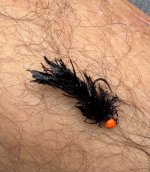

“Icewater Lake”, 11 August 2026. I haven’t done much fishing this summer (but the pace will rise for the next several months). With a nice, but not blazingly hot day in the forecast, I decided to load up my pontoon boat and head up to “Icewater Lake”.

This is a very oligotrophic (i.e., low nutrient) lake. Due to the low productivity, the trout in the lake (west slope cutthroats, coastal cutthroats, and rainbow trout) are heavily dependent on terrestrial resources, especially in summer. In the past, the lake can experience a “hopper fall” when gusty winds carry male grasshoppers that are on display flights from the grasslands onto the lake.
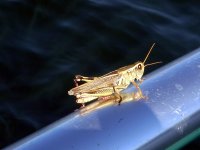
Theses are major attractors for big trout. In addition, during summers when tent caterpillars break out, the trout will also target them. Unfortunately, neither of these major attractors were present this day.
I typically have three rods strung up when fishing here. Today, I fished a sinking 5 wt. line with streamers, a 3 wt. dry-fly line with a small insect (often a parachute Callibaetis but an EHC this day), and a 4 wt. dry-fly line with a larger terrestrial, such as a hopper or a stimulator. The day was sunny with periods of gusty winds and also dead calm. The water in the lake can become extremely temperature-stratified if it is a hot, calm day, but the periodic breezes kept the lake mixed and the surface temperatures were 65oF.
I did pick up one rainbow on a small bead-head streamer as I slowly kicked my way over a shallow shoal.
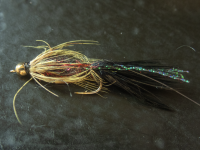
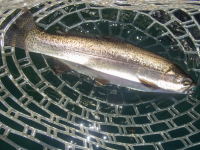
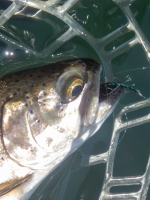
I tossed an EHC around the edge of a submerged boulder pile and picked up two rainbows. I feared that I had lost one of the two when it dove to the bottom and I couldn’t move it. When I handled the line, I could feel that the fish was still present. With gentle pressure, I pulled the fish from submerged weeds that it dove into. These wild fish always give a good showing and are often quite acrobatic.
In pursuit of larger fish, I finned my way over to the shoreline and tossed a stimulator at the drop-off.
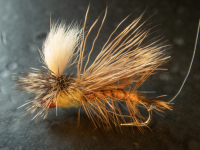
A fish exploded on the stimulator but was not hooked. Later, a nice fish came up confidently to grab the stimulator. I guided it into deeper water and we tussled around until I slipped it into the net, removed the fly, and released it after a few pictures.
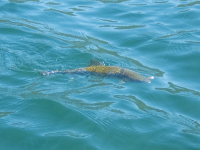
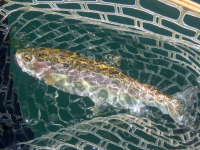
While cruising the shoreline, I did see several nice trout jump completely out of the water in an attempt to capture passing damselflies. Damselflies were the only flying insect present in any numbers along the shoreline.
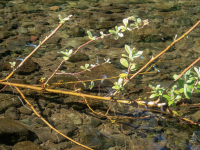
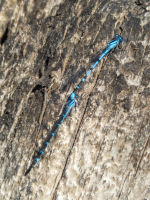
I had one fish miss the stimulator when I dropped it close to where it had just jumped after a flying damselfly. But it didn’t respond to my fly a second time. I switched out the EHC on the 3 wt. for a damsel dry. I tried casting a damsel dry for a while by the structures where the damsels were congregating and the trout were jumping. But the rainbows were not interested in damsel patterns floating at the surface. I need to work again on that hydrogen-filled hovering damsel pattern that I’ve speculated about before…
It was a nice day to get out and an osprey and pair of bald eagles came by during the day.
Steve
Postscript. At lakes that have substantial duck populations, I alway wear waders because of past experience with “swimmer’s itch’. Swimmer’s itch occurs when the larval stages (cercariae) of schistosome parasites (blood flukes) are attracted to the flesh of warm-blooded organisms, like birds or mammals. They attach to your bare skin and try to burrow into your tissues to reach the circulatory system. Fortunately, humans are NOT appropriate hosts for the PNW schistomes whose normal life cycle includes snails and waterfowl (see here), at least for the local schistosome species. [Yes, schistosomes do infect humans in other parts of the world, especially in the tropics and subtropics where they are a major public health problem]. The local larvae die in your skin but their corpses trigger a immune response (like mosquito bites on steroids). At “Icewater Lake”, I have never encountered this affliction. So, I typically to wear neoprene booties on my feet and shorts as I fin my way around the like. I may need to reconsider my protective gear in future.
At the launch, I broke down my three rods, loaded my fly boxes and other gear, and the pontoons boat and accessories, probably a 20ish minute process. As I drove away from the lake, the mountain was out and I decided to stop at a nearby overlook to snap a picture or two.

As I exited my truck, I felt a sharp pain on the outside of my left shin. I looked down to see a fat 1.5” sausage-shaped leach attached to my leg. I quickly flicked it off my skin into the dry grass.
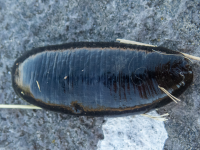
The bugger had penetrated my skin as a trickle of blood dribbled down my leg. But unless this leach can travel miles to the nearest water, I was the ultimate victor in this encounter.
This is a very oligotrophic (i.e., low nutrient) lake. Due to the low productivity, the trout in the lake (west slope cutthroats, coastal cutthroats, and rainbow trout) are heavily dependent on terrestrial resources, especially in summer. In the past, the lake can experience a “hopper fall” when gusty winds carry male grasshoppers that are on display flights from the grasslands onto the lake.
Theses are major attractors for big trout. In addition, during summers when tent caterpillars break out, the trout will also target them. Unfortunately, neither of these major attractors were present this day.
I typically have three rods strung up when fishing here. Today, I fished a sinking 5 wt. line with streamers, a 3 wt. dry-fly line with a small insect (often a parachute Callibaetis but an EHC this day), and a 4 wt. dry-fly line with a larger terrestrial, such as a hopper or a stimulator. The day was sunny with periods of gusty winds and also dead calm. The water in the lake can become extremely temperature-stratified if it is a hot, calm day, but the periodic breezes kept the lake mixed and the surface temperatures were 65oF.
I did pick up one rainbow on a small bead-head streamer as I slowly kicked my way over a shallow shoal.
I tossed an EHC around the edge of a submerged boulder pile and picked up two rainbows. I feared that I had lost one of the two when it dove to the bottom and I couldn’t move it. When I handled the line, I could feel that the fish was still present. With gentle pressure, I pulled the fish from submerged weeds that it dove into. These wild fish always give a good showing and are often quite acrobatic.
In pursuit of larger fish, I finned my way over to the shoreline and tossed a stimulator at the drop-off.
A fish exploded on the stimulator but was not hooked. Later, a nice fish came up confidently to grab the stimulator. I guided it into deeper water and we tussled around until I slipped it into the net, removed the fly, and released it after a few pictures.
While cruising the shoreline, I did see several nice trout jump completely out of the water in an attempt to capture passing damselflies. Damselflies were the only flying insect present in any numbers along the shoreline.
I had one fish miss the stimulator when I dropped it close to where it had just jumped after a flying damselfly. But it didn’t respond to my fly a second time. I switched out the EHC on the 3 wt. for a damsel dry. I tried casting a damsel dry for a while by the structures where the damsels were congregating and the trout were jumping. But the rainbows were not interested in damsel patterns floating at the surface. I need to work again on that hydrogen-filled hovering damsel pattern that I’ve speculated about before…
It was a nice day to get out and an osprey and pair of bald eagles came by during the day.
Steve
Postscript. At lakes that have substantial duck populations, I alway wear waders because of past experience with “swimmer’s itch’. Swimmer’s itch occurs when the larval stages (cercariae) of schistosome parasites (blood flukes) are attracted to the flesh of warm-blooded organisms, like birds or mammals. They attach to your bare skin and try to burrow into your tissues to reach the circulatory system. Fortunately, humans are NOT appropriate hosts for the PNW schistomes whose normal life cycle includes snails and waterfowl (see here), at least for the local schistosome species. [Yes, schistosomes do infect humans in other parts of the world, especially in the tropics and subtropics where they are a major public health problem]. The local larvae die in your skin but their corpses trigger a immune response (like mosquito bites on steroids). At “Icewater Lake”, I have never encountered this affliction. So, I typically to wear neoprene booties on my feet and shorts as I fin my way around the like. I may need to reconsider my protective gear in future.
At the launch, I broke down my three rods, loaded my fly boxes and other gear, and the pontoons boat and accessories, probably a 20ish minute process. As I drove away from the lake, the mountain was out and I decided to stop at a nearby overlook to snap a picture or two.
As I exited my truck, I felt a sharp pain on the outside of my left shin. I looked down to see a fat 1.5” sausage-shaped leach attached to my leg. I quickly flicked it off my skin into the dry grass.
The bugger had penetrated my skin as a trickle of blood dribbled down my leg. But unless this leach can travel miles to the nearest water, I was the ultimate victor in this encounter.


 -
-