
Navigation
Install the app
How to install the app on iOS
Follow along with the video below to see how to install our site as a web app on your home screen.
Note: This feature may not be available in some browsers.
More options
Style variation
You are using an out of date browser. It may not display this or other websites correctly.
You should upgrade or use an alternative browser.
You should upgrade or use an alternative browser.
Coralroot orchids
- Thread starter Cabezon
- Start date
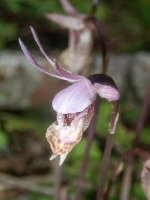
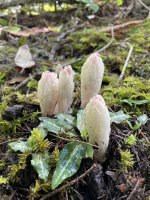
More gnomes
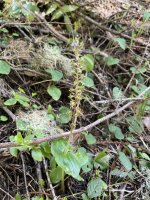
Twayblade

And rattlesnake plantains that may bloom later.View attachment 186341
More gnomes
Steve
Steve
If you don’t have this reference it is as thorough as I have seen.
If you don’t have this reference it is as thorough as I have seen.
While I have several field guides at my elbow (literally...), I have been finding two web-based resources to be very valuable. The first is wildflower search.org (see https://wildflowersearch.org/). Once you provide your location and observation time, you can search possibilities by plant category (including mosses and lichens), by number of flower petals, color of the flower, size of the flower, etc. It provides an overall identification percentage based on likely location, elevation, date, showiness. It has links to other collections of plant photographs and plant descriptions. The other source that I like is Pl@ntnet.org (see https://identify.plantnet.org/). You can download the app or use the online version. If you have an unknown plant, you can upload up to four pictures of the plant. The site uses AI engines to compare your image to images posted in the web either in regional floras or worldwide flora. Compared to the regulated common names of birds, the proliferation of various common names for the same plant is annoying, however.
Steve
Steve
Last edited:

the proliferation of various common names for the same plant is annoying.

I hate common plant names with a passion, they mean nothing in many cases, and yet...when asked about some favorite plant by a customer, with a vague description and no real details {and I don't know what Aunt Mary called it 30 years ago} , it is assumed I am not up to speed on things.
Words have meanings, botanical Latin makes perfect sense, and there is very little if any confusion.
Except for those damn splitters, whose life isn't complete unless they can find a reason to move things into a different genus, or put a name on species...they need to go back and find a new career

The bird folks (such as the American Ornithological Society and the International Ornithological Union) have done a great job of standardizing common names. In the scientific literature, common names are often used to identify that target species. This standardization provides stability to naming and a group process for lumping vs. splitting. [Although there is going to be some pushback when they implement a policy to change the common names of birds that were named after individuals with questionable histories, (for example, see here discussing Audubon and here)].
I hate common plant names with a passion, they mean nothing in many cases, and yet...when asked about some favorite plant by a customer, with a vague description and no real details {and I don't know what Aunt Mary called it 30 years ago} , it is assumed I am not up to speed on things.
Words have meanings, botanical Latin makes perfect sense, and there is very little if any confusion.
Except for those damn splitters, whose life isn't complete unless they can find a reason to move things into a different genus, or put a name on species...they need to go back and find a new career
In 1933, the American Society of Ichthyologists and Herpetologists (basic research side of Ichthyology) and the American Fisheries Society (applied research side of Ichthyology) established a joint committee to standardize common names of fishes which they publish periodically (see here). They have been somewhat successful among professionals but little penetration in the general public.
The molecular revolution in evolutionary science has provided the evidence to overturn many formerly-stable scientific groupings. For example, Pacific salmon, rainbow trout, and cutthroat trout were placed in the same genus, Oncorhynchus. In addition, it has fostered finer resolution of evolutionary relationships among genera that were overloaded with species. A consequence, as you have described, is that many traditional scientific names have been changed. That creates challenges in investigating the scientific literature in the period before the flurry of changes versus more recently. Ironically, some common names have been more stable...
Steve
The molecular revolution in evolutionary science has provided the evidence to overturn many formerly-stable scientific groupings.


JARS v61n2 - The Ericaceae of the Pacific Northwest, Part V
Scholarly Communication is a dynamic landscape, and we are continually evolving. Many scholarly communications activities have spun-off into their own departments, such as VT Publishing and Digital Imaging and Preservation Services, and Digital Library Development. Our focus is on supporting the...
 scholar.lib.vt.edu

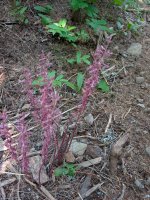
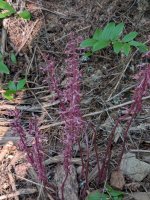
Yes, definitely coralroots. Given the time of year (but without seeing a close-up of a flower), I would predict that this is a cluster of spotted coralroots [edit, nope...]. [Edit: there is one clear flower in the second image (top center inflorescence). And flowers emerge from bottom of the inflorescence to the top. Based on the thin lateral sepals and tall column, this is a Pacific coralroot cluster, Corallorhiza mertensiana.] Pink is one option for the stems. Were these plants at altitude? At sea-level (aka, my neighborhood), the Pacific coralroots were done over a month ago.@Cabezon
Did I find some coralroot orchids on my hike last week?
View attachment 188345View attachment 188346
Steve
Last edited:
~3500 feet of elevation a bit east of Snoqualmie pass 1 week ago today.Yes, definitely coralroots. Given the time of year (but without seeing a close-up of a flower), I would predict that this is a cluster of spotted coralroots [edit, nope...]. [Edit: there is one clear flower in the second image (top center inflorescence). And flowers emerge from bottom of the inflorescence to the top. Based on the thin lateral sepals and tall column, this is a Pacific coralroot cluster, Corallorhiza mertensiana.] Pink is one option for the stems. Were these plants at altitude? At sea-level (aka, my neighborhood), the Pacific coralroots were done over a month ago.
Steve
Steve
I only recognized it because you taught me about them through this thread!
Monotropa uniflora
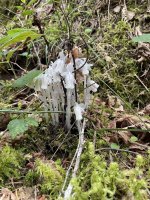
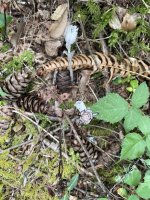
The VT link above provides both the mushrooms and trees/plants that are associated with this and all of the other PNW Monotropes.
The VT link above provides both the mushrooms and trees/plants that are associated with this and all of the other PNW Monotropes.

Same common name here.When I was growing up in Vermont we called those Indian Pipes.