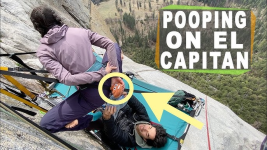
NFR Talk to me about portaledges (climbing sleeping systems) - your likes/dislikes

Non-fishing related
How far a drop before reaching terminal velocity?

It depends on its mass and shape, as well as the fluid it's moving through. Terminal velocity is when the gravitational force (and buoyancy, if it's significant) balances out the drag force caused by the object moving through a fluid. Drag increases with velocity, so only at some given velocity will these forces balance each other.

There's a formula here, which can be derived from the explanation above. Let's estimate the parameters in this formula.

  • As you mentioned below, the average weight is 0.25-1 lb. Taking the average is 0.5 lb, or around 0.25 kg.
  • Gravity is 9.81 m/s2
  • Density of air is around 1.2 kg/m3
  • Area will depend on the orientation the shit is falling in. Drag coefficient depends on the area, as well as the Reynolds number (which I will not get into here). I will estimate a rough area of 50 cm2 (or 0.005 m2) and drag coefficient of 0.5
Working the numbers yields 40 m/s, or around 91 mph.
 

It depends on its mass and shape, as well as the fluid it's moving through. Terminal velocity is when the gravitational force (and buoyancy, if it's significant) balances out the drag force caused by the object moving through a fluid. Drag increases with velocity, so only at some given velocity will these forces balance each other.

There's a formula here, which can be derived from the explanation above. Let's estimate the parameters in this formula.

  • As you mentioned below, the average weight is 0.25-1 lb. Taking the average is 0.5 lb, or around 0.25 kg.
  • Gravity is 9.81 m/s2
  • Density of air is around 1.2 kg/m3
  • Area will depend on the orientation the shit is falling in. Drag coefficient depends on the area, as well as the Reynolds number (which I will not get into here). I will estimate a rough area of 50 cm2 (or 0.005 m2) and drag coefficient of 0.5
Working the numbers yields 40 m/s, or around 91 mph.

Your math assumes one cohesive piece that maintains structural integrity all the way down.

The amount of alcohol I would have had to imbibe to find myself on a portaledge renders this assumption dubious at best.

Where the variables and their assumed values for the droppings are:

m = Mass of the droppings (0.5 kg for someone my size and 0.25 kg for all you hobbits)

g = Acceleration due to gravity (9.81 m/s^2)
rho (rho) = Density of air at sea level (\sim 1.204 kg/m^3)

C_d = Drag coefficient. For a smooth sphere, this is typically around 0.47. However, because falling alcohol-affected excretia would deform into a less aerodynamic shape, a more realistic drag coefficient is closer to 1.0 (similar to a flat plate or a highly deformed droplet).

A = Cross-sectional area of the falling object (A = pi r^2).

To get the area, we need the radius of the blobs. After an extreme bout of drinking, based on studies conducted in college, it has a density very close to toilet water, roughly 1,060 kg/m^3.

Radius (r): Derived from the volume of a sphere
Area (A): A = pi r^2

Which yields a cross-sectional area a .00463 m² for 0.25 kg and .00733 for 0.5 kg

Plugging all of that into the Terminal Velocity equation from before we get about 107 km/h for 0.25 kg and 124 km/h for 0.5. Roughly 67 and 74 freedom units per hour for mud pies.

That said, the most common drug used by rock climbers and not acrophobic fly fisherman such as myself, is marijuana. This can have a constipating effect on chronic chronic users. Which would raise the structural integrity, decrease the area, and greatly increase the speed. Although, if said climber stopped using marijuana to prepare for such a climb, their quitting could have the reverse effect on their bomb movement (BM) in which case it would be more like the shat splat discussed previously.

 
The likelihood of catastrophic fecal failure and doodie deconstruction is high...even if you're high...
 
Curiosity got the better of me. I promptly ended my search after the initial results populated my screen....

1779567704808.png1779567767369.png

You guys failed to mention the whole buddy system thing.
 

Attachments

  • 1779567723231.png
    1779567723231.png
    77.7 KB · Views: 4
Fecal friends. Fortunately, how to pinch a loaf on the sheer side of a vertical rock wall is just another problem I'll never have to endure.
 
Your math assumes one cohesive piece that maintains structural integrity all the way down.

The amount of alcohol I would have had to imbibe to find myself on a portaledge renders this assumption dubious at best.

Where the variables and their assumed values for the droppings are:

m = Mass of the droppings (0.5 kg for someone my size and 0.25 kg for all you hobbits)

g = Acceleration due to gravity (9.81 m/s^2)
rho (rho) = Density of air at sea level (\sim 1.204 kg/m^3)

C_d = Drag coefficient. For a smooth sphere, this is typically around 0.47. However, because falling alcohol-affected excretia would deform into a less aerodynamic shape, a more realistic drag coefficient is closer to 1.0 (similar to a flat plate or a highly deformed droplet).

A = Cross-sectional area of the falling object (A = pi r^2).

To get the area, we need the radius of the blobs. After an extreme bout of drinking, based on studies conducted in college, it has a density very close to toilet water, roughly 1,060 kg/m^3.

Radius (r): Derived from the volume of a sphere
Area (A): A = pi r^2

Which yields a cross-sectional area a .00463 m² for 0.25 kg and .00733 for 0.5 kg

Plugging all of that into the Terminal Velocity equation from before we get about 107 km/h for 0.25 kg and 124 km/h for 0.5. Roughly 67 and 74 freedom units per hour for mud pies.

That said, the most common drug used by rock climbers and not acrophobic fly fisherman such as myself, is marijuana. This can have a constipating effect on chronic chronic users. Which would raise the structural integrity, decrease the area, and greatly increase the speed. Although, if said climber stopped using marijuana to prepare for such a climb, their quitting could have the reverse effect on their bomb movement (BM) in which case it would be more like the shat splat discussed previously.
I love science...between the ganja and massive amounts of energy bars & dried fruit, I would expect very dense pellets the size of elk droppings...
 
I love science...between the ganja and massive amounts of energy bars & dried fruit, I would expect very dense pellets the size of elk droppings...
I wouldn’t bet on it; I've seen the results of dirtbag climbing bums dipping their fingers in communal jars of peanut butter.
 
The real risk takers are those delegated to open and dump the contents of the Poop Tube.
Pack it in, pack it out...
 
Check out the new inflatable portaledges. Way more comfortable.
What could possibly go wrong...
wideGIFsmall.gif
 
read this thread and found myself clenching my jaw and grinding my teeth...I'd rather fight a grizzly with a Bowie knife
If you were on your portaledge you would be safe from that grizzly! Just sayin'...
 
Your math assumes one cohesive piece that maintains structural integrity all the way down.

The amount of alcohol I would have had to imbibe to find myself on a portaledge renders this assumption dubious at best.

Where the variables and their assumed values for the droppings are:

m = Mass of the droppings (0.5 kg for someone my size and 0.25 kg for all you hobbits)

g = Acceleration due to gravity (9.81 m/s^2)
rho (rho) = Density of air at sea level (\sim 1.204 kg/m^3)

C_d = Drag coefficient. For a smooth sphere, this is typically around 0.47. However, because falling alcohol-affected excretia would deform into a less aerodynamic shape, a more realistic drag coefficient is closer to 1.0 (similar to a flat plate or a highly deformed droplet).

A = Cross-sectional area of the falling object (A = pi r^2).

To get the area, we need the radius of the blobs. After an extreme bout of drinking, based on studies conducted in college, it has a density very close to toilet water, roughly 1,060 kg/m^3.

Radius (r): Derived from the volume of a sphere
Area (A): A = pi r^2

Which yields a cross-sectional area a .00463 m² for 0.25 kg and .00733 for 0.5 kg

Plugging all of that into the Terminal Velocity equation from before we get about 107 km/h for 0.25 kg and 124 km/h for 0.5. Roughly 67 and 74 freedom units per hour for mud pies.

That said, the most common drug used by rock climbers and not acrophobic fly fisherman such as myself, is marijuana. This can have a constipating effect on chronic chronic users. Which would raise the structural integrity, decrease the area, and greatly increase the speed. Although, if said climber stopped using marijuana to prepare for such a climb, their quitting could have the reverse effect on their bomb movement (BM) in which case it would be more like the shat splat discussed previously.

Outstanding, Jake!
Really only tiny nitpicks.
CBD oils on the other hand have a potential for oily diarrhea
On steep head walls there are potential updrafts, so say a fecal context of liquid or near aerosolized stool may never reach terminal velocity, particularly if dehydration of particulate matter during air journey occurs. Fecal dusts might, like Sahara sands, cross oceans....
 
Obviously diet and terminal velocity are interrelated in ways many have not fully considered...
 
Back
Top