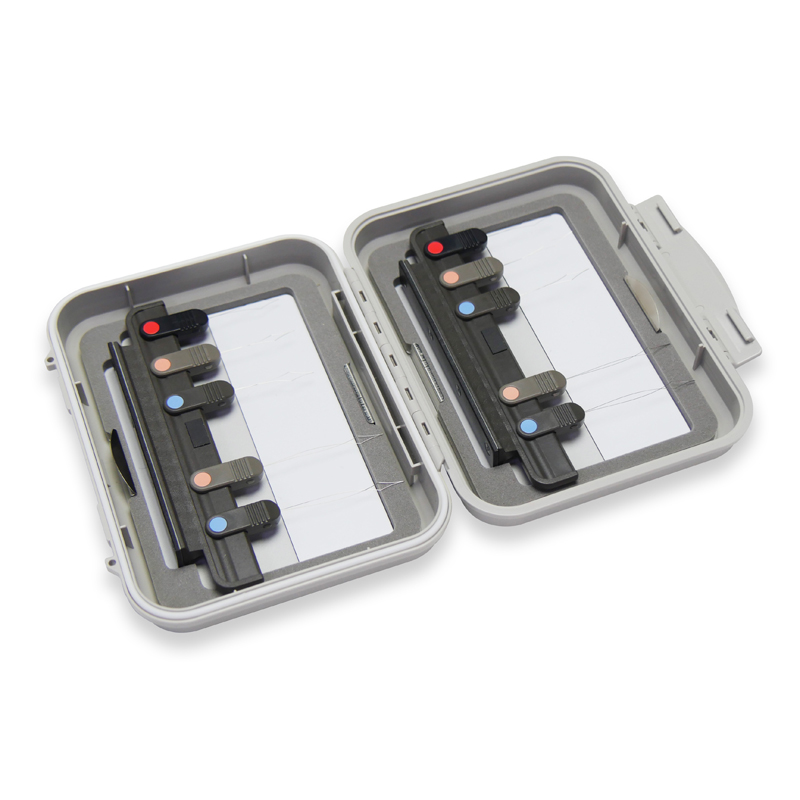
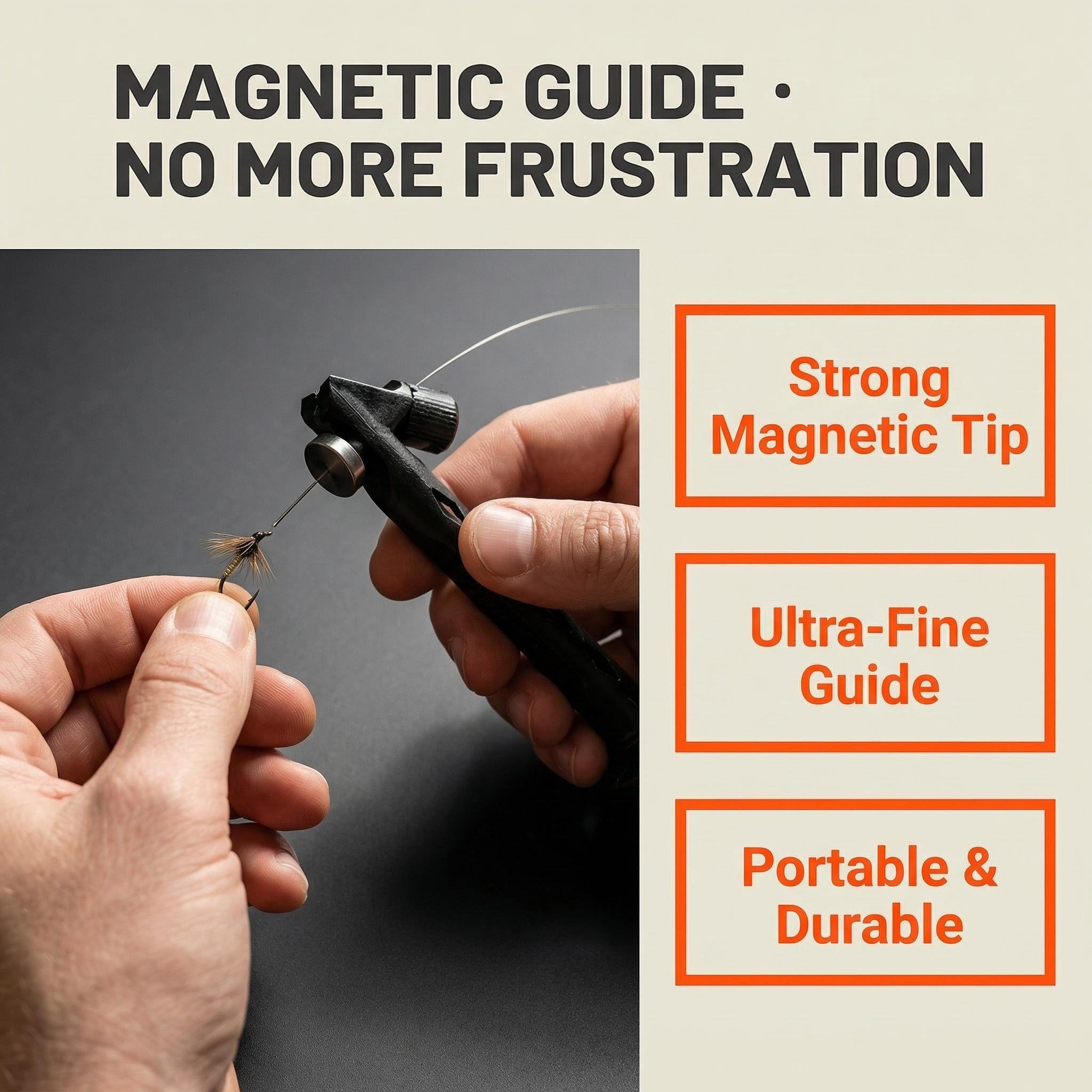
Best Fly Threader And Knot Tying Tool For Visually Impaired?

I ordered one of the Fly Roost Magnetic Fly Threader back on March 29th and still do not have the item. I have checked the tracking and the item has been stuck in Miami Florida since April 25. Also when I ordered there was also a 40% tax added.
I got mine thru Amazon in less than 24 hours. Still haven't had time to mess with it.
 
I have worn glasses for 50 years, ...
I am trying "new eyes", or rather "multifocal interocular lenses"...

Maybe, just maybe...
@ 20 hrs after 2nd eye done 20/20 each eye. 20/15 both eyes together, but just barely.
Can thread #16 hook if holding with hemostats. 👀

Should improve slightly & stabilize over next 3-6 weeks.
 
@krusty recently gave him an Angler's Image tool tool that looked like it would help but he struggled with it and I ended up tying his knots for him.
1777818133695.png
BTW, tonight I found I had one of these in my tying table drawer. I cannot recall ever really trying to use it. I put a #10 Parachute Adam's on it to see how it works. I had not seen the MRO video and didn't follow Brian Flechsig's instructions on orienting the fly vertically to the threader's slot but it worked anyway.

Funny, I think my wife gave it to me many years ago, and now I may never actually need to use it.

****EDIT**** A #10 Parachute Adams is simple. But a #16 or smaller PA hook eye does not line well with the tool's tippet slot. When I push the tippet through the V - shaped slot it wants to go around the hook eye.

That may be why it was in my drawer rather than with the tools I actually use.

It's now easiest to just hold the fly steady with hemostats after cataract surgery and getting the fancy new multifocal interocular lenses that insurance does not pay for.
My apologies for not testing the tool more thoroughly with small flies before posting about it.


In searching, I saw this one and wonder if anyone has any experience with it?
1777818253781.png
I read some Amazon reviews on this one. There are a bunch of listings for essentially the same tool, and none of them have very many reviews. I always start with the one ⭐reviews. Some reviewers describe it as appearing to be 3D printed, and the finish being rough, along with other flaws; no magnet, threading hole not aligned with line slot, or completely missing, and delivery delays.

But if it actually can securely hold the fly in position aligned with a slot to thread tippet through while twisting the line into multiple wraps to tie the knot like I saw in the video @kmudgn posted, that could be useful. But then hemostats make it a lot easier to tie some of the basic knots we use.
Beware....

 
Last edited:
BTW, tonight I found I had one of these in my tying table drawer. I cannot recall ever really trying to use it. I put a #10 Parachute Adam's on it to see how it works. I had not seen the MRO video and didn't follow Brian Flechsig's instructions on orienting the fly vertically to the threader's slot but it worked anyway.
IT IS STUPID SIMPLE.

Funny, I think my wife gave it to me many years ago, and now I may never actually need to use it.


I read some Amazon reviews on this one. There are a bunch of listings for essentially the same tool, and none of them have very many reviews. I always start with the one ⭐reviews. Some reviewers describe it as appearing to be 3D printed, and the finish being rough, along with other flaws; no magnet, threading hole not aligned with line slot, or completely missing, and delivery delays.

But if it actually can securely hold the fly in position aligned with a slot to thread tippet through while twisting the line into multiple wraps to tie the knot like I saw in the video @kmudgn posted, that could be useful. But then hemostats make it a lot easier to tie some of the basic knots we use.
Beware....


I bought that tool a few years ago . I think I gave it a quick try ,did not like it . No idea where it is at . I may try find it , and try it again . Not sure why I bought it ,probably thinking it would make tying on a fly a bit quicker I guess . As long as I have my cheaters on tying on a fly is still okay . Being cold or bouncing around in a boat makes it a bit difficult .
 
Great hooks for failing sight EZEYEFLY has a larger eye no need for threaded if you tie your own flies works for my 80 yr.old eyes
 
Simms has some ridiculously expensive nippers with a magnetic thingy to help with threading. Then you have to be able to see to tie a knot. I have a fly box that I'm not sure if it is made anymore that has a bunch of wire threaders in it that you can pre load in good light at home. It works, but you still have to tie the knot.

Like that but I think I paid like 15 bucks. Is inflation this bad?
 
This looks interesting.
Might be to good to be true.

 
I'm not at all impressed with the quality of the Fly Roost device; it's very rough poorly printed plastic and the magnet tends to fall out.

While this (and many other devices designed to facilitate threading tippet THROUGH the eye of the flyhook) do indeed accomplish that part of knotting on a fly none of them actually help threading the tippet through the small space between the tippet winds and the outside FRONT of hook eye....which is every bit as challenging as the original problem solved by these threaders.

I am not visually impaired nor dealing with any sort of tremors (yet anyway) but I have acquaintances who have such problems and have tried out several of these aids in an attempt to help them keep fishing, but so far haven't found anything that eases their frustration.

At some point the frustration (including frustration of having to rely upon fishing buddies who are quite happy to assist in those tasks) begins to far outweigh everything else.

It's sad to watch somebody lose access to an activity that once provided so much personal pleasure. Unfortunately visual acuity and steadiness are key requirements for both flyfishing and flytying.
 
Last edited:
@ 20 hrs after 2nd eye done 20/20 each eye. 20/15 both eyes together, but just barely.
Can thread #16 hook if holding with hemostats. 👀

Should improve slightly & stabilize over next 3-6 weeks.
If anyone is interested, 1 month after 2nd eye cataract surgery with multi-focal lenses, threading a #12 - #16 hook with 5X is fairly easy even with forward facing hackle partially obscuring the hook eye. I haven't been able to do that without 2.75 readers or a progressive prescription for about 20 yrs. Holding the fly with hemostats to thread the hook does help. Then I use it to tie the knot that helps mitigate my 10 thumbs or lack of practice. However yesterday I was able to easily tie a beautiful 5 turn bloodknot using my teeth as a third hand for the wraps ;).
 
Shame on me...like the majority of things, at this age, I've somehow managed to misplace it.🙄
Yeah, it's a little harder to misplace my new eyes. But after 55 yrs of spectacles, for a moment a few times a day I think that I need to grab my glasses.
 
3 years in & I still experience spectacle spectacles . . .
 
In my case I went to my doc because those giant billboard roadsigns where fuzzy.

The surgery is great but just remember you'll still have to deal with aging eyes years on down the road.
 
Yeah, it's a little harder to misplace my new eyes. But after 55 yrs of spectacles, for a moment a few times a day I think that I need to grab my glasses.
I have gotten in the habit of having those clickits hanging around my neck , if fishing I have sunglasses with the bifocals as many do . I can usually tie on a fly in good lighting without the bifocals , but usually I will look down ,and use them . I am pretty fortunate actually having 20/20 at nearly 79 . Even before cataract surgery my vision was very good ,but it was time ,after him telling me for nearly 15 years I have cataracts , but you see well. He decided it was time . I didn't notice any change in my vision after except some colors seemed to be more vivid . He told me occasionally he will have a patient like me that has cataracts that doesn't affect their vision much .
 
The surgery is great but just remember you'll still have to deal with aging eyes years on down the road
Standard monofocal lenses that correct vision for only one distance. Extended depth of focus lenses stretch a continuous focal point to provide sharp distance and intermediate vision.

Modern multifocal lenses split incoming light like a prism. The brain quickly learns to automatically interpret the split light from the multifocal IOL as distance, intermediate, and near vision through a process called neuroadaptation. It provides clear focus at multiple distances rather than relying on muscles in the eyes to focus.

That means they can permanently correct for presbyopia. While there are no promises that patients will not develop other problems with their eyes, up to 90% of patients achieve lifetime total spectacle independence.
 
A few years ago wife had the type of cataract surgery with lenses that are incrementally adjusted within the eyes via clinical exposure to light at various UV exposures/wavelength (which actually changes the lenses' optical dimensions and properties) over the course of weekly visits with the clinic. The final adjustment is 'locked in' with a burst of UV at a specific wavelength. The lenses were adjusted such that she no longer needs glasses for distance or close work.

It all went very well, although the necessity to blockout any UV during the entire adjustment period and weekly clinic visits were a PITA...and the cost for her lenses were far beyond what is covered by Medicare. She's always hated wearing glasses.

I've got cataracts such that I qualify for surgery, but I think I'll just get the traditional type and continue to wear glasses that allow closeup work. I'm near-sighted but still see quite well with glasses, and can easily manage fine work such as tying small flies and using tippet without any additional magnification. I've worn glasses most of my life and have been grateful for the protection they've inadvertantly provided many times....having worked much of my life in industrial facilities and laboratories. I'm a firm believer in safety glasses/protective gear anyway, having witnessed first hand the consequences of serious eye injuries.
 
Last edited:
Back
Top