Yellow perch…

I see that the boys fishing the Lenice/Nunnally chain are catching perch there as well. Does this signal an end to this treasured fishery or will WDFW plant catchables? (I think that's all they have done there for a number of years.) Blue and Park lakes have become quite the perch and smallmouth fisheries; WDFW has ceased planting fry in those two lakes, instead they plant catchables. Maybe there's a lunker or two in Blue or Park but last fall they certainly eluded me.

Nice perch, Steve!
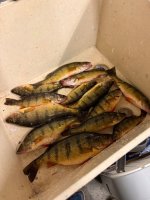
Today at Nunally. Lots of fresh planter rainbows and …
IMG_1119.jpeg
Lost a bunch of them too. Sad for the lake, but good for my breakfast(s)
 
I dunno but I'd be surprised if those were put there by a bucket. There is so much interconnectedness in those systems my guess is natural migration. Doesn't change anything but I highly recommend eating them.. in fact id spend the morning trout fishing then target perch after the hatch and hope for a fish fry
 
I dunno but I'd be surprised if those were put there by a bucket. There is so much interconnectedness in those systems my guess is natural migration. Doesn't change anything but I highly recommend eating them.. in fact id spend the morning trout fishing then target perch after the hatch and hope for a fish fry
Shallow spawning fish (warm water species primarily) can have their eggs consumed by waterfowl and up to 3% have been shown to pass through the GI tract and remain viable. With chains of lakes like we have on the east side, they can spread very quickly through this manner.
 
This sounds very plausible. Thanks!

I have seen zero bucket biologists over a l o n g outdoor career but have seen lots of waterfowl.
 
I fish a storm water/runoff pond that has never been stocked. But there is a major lake nearby with strong populations of invasive smallmouth and bluegill ans native 3 spine stickleback. All shallow, still water spawners and all 3 of those species are present in the pond. There is a constant procession of waterfowl between the pond and the lake, and im pretty sure that's how they got there.

Also had bluegill appear in my pond in the 90s without ever introducing them.
 
This sounds very plausible. Thanks!

I have seen zero bucket biologists over a l o n g outdoor career but have seen lots of waterfowl.
Doubt if they’ll be doing wrong in broad daylight with others around……not sure if I blame it on birds.
 
Logged my share of outdoor hours in the dark too with no questionable activity sightings then either. I still believe waterfowl are a real possibility.
 
I have actually caught individuals illegally plant fish (aka bucket biologists) have also had others admit to being "bucket biologist". There are number of examples of exotic species being introduced in waters far from a source population. For example, in the last couple decades northern pike have shown up in 3 lakes and walleyes in at least water all likely from eastern Washington. Other examples would be green sunfish showing up in Pass Lake (nearest source at that time was near Spokane), fathead minnows that were confined to labs magically showed up in a couple Snohomish County lakes and Pass lake all about the same time. Another interesting example is native Olympic mud minnows (native to waters south of Olympia) showing up in a beaver pond in the Snohomish basin. Twice following a lake rehab I had observed freshly dead largemouth bass at the boat launch of the treated lake 2 to 3 weeks post treatment - some "bucket Biologist" had missed timed their release and the lake was still toxic to the bass.

I have read the study that documented fish eggs (2 different species of carp) surviving being eat by birds (mallard duck) that seem to generate this speculation that fish are being regularly spread by the fish egg eating birds. In this experiment 8 mallards were feed each 500 carp eggs (4,000 eggs in total) and a similar group for the second carp species. In all roughly 8,000 eggs were fed the mallards and the duck's poop was collected a few hours later. Of those 8,000 eggs 18 survived their "journey through the ducks system. Of those 18 survivors 3 actually hatched. Thus yield the astounding survival rate after being consumed by said mallards of 0.000375%. As you know carp are a long-lived species and they once reaching maturity lay 100,000s to a million or more eggs annually. Such long lived species with that high of fecundity have developed those life strategies to insure that at least a few of those eggs make it to mature to continue the species. The odds of those few eggs surviving being eat by a mallard actually making it to maturity is exceeding low. Not impossible but highly unlikely.

Those bucket biologist are planting their fish for a variety of interests - spreading their favorite fish, or in some case lake residents trying to spoil the fish by far the vast majority of exotics in our waters show up either through fish being introduced somewhere in the watershed and then spreading easily through the watershed or those being intendedly being release directed in a water of choice.

curt
 
I fish a storm water/runoff pond that has never been stocked. But there is a major lake nearby with strong populations of invasive smallmouth and bluegill ans native 3 spine stickleback. All shallow, still water spawners and all 3 of those species are present in the pond. There is a constant procession of waterfowl between the pond and the lake, and im pretty sure that's how they got there.

Also had bluegill appear in my pond in the 90s without ever introducing them.
Pink Nighty
Not sure how the smallmouth and bluegill got into that storm water pond but am sure that the sticklebacks did not make that journey via a friendly duck. When sticklebacks spawn the make constructs a pretty elaborate nest. They construct basically a ball of vegetive materials with a tunnel through it. The male escorts the female to the nest site and encourages her to enter the tunnel, deposit her eggs while he fertilizes the eggs. They go through that effort to protect their few hundred eggs form being predated on other fish, ducks, etc.

Curt
 
... green sunfish showing up in Pass Lake (nearest source at that time was near Spokane)

curt
at what time? i was catching greenies from a seepage ditch next to the snohomish river on the lowell river road 15 years ago or more, FWIW. that's obviously on the flood plain, and i've always assumed they got in there during a flood from an adjacent farm pond. it also held largemouth, shiners, pumpkinseed, crappie, brown bullhead, and smolts - at least.

i feel like the pass lake reports of green sunfish were much more recent than that, no? if so, the nearest source was much closer than spokane.

folks are talking as if a bucket biologist couldn't possibly drop several hundred fry into a lake without being seen, day or night. it strikes me as an act that would be extremely easy to accomplish undetected for someone with a will to do it.
 
Pink Nighty
Not sure how the smallmouth and bluegill got into that storm water pond but am sure that the sticklebacks did not make that journey via a friendly duck. When sticklebacks spawn the make constructs a pretty elaborate nest. They construct basically a ball of vegetive materials with a tunnel through it. The male escorts the female to the nest site and encourages her to enter the tunnel, deposit her eggs while he fertilizes the eggs. They go through that effort to protect their few hundred eggs form being predated on other fish, ducks, etc.

Curt
Curt,

What i can promise is that this lake was infested with the little prickly bastards, and I can't imagine even the most intrepid bucket bio stocking stickleback in a manner that allowed them to coexist with bass and bluegill. They were an incredible forage base, whatever brought them there.

The study I read was long ago, but my recollection of it was significantly different than what you are quoting aside from the mallard. Used bass, and had a hatch rate of 3-5%. Absolutely could be misremembering, but i can also absolutely envision ducks getting past the defenses of a stickleback nest. They are 2" long and ducks are aggressive little bastards. I've also noticed a distinct lack of largemouth in what is definitely better LM habitat than SM. The other lake has SM predominantly but not exclusively, but all the bucket bios I know around home transport LM. 🤷‍♂️

It only takes one male and one female egg to hatch to start an infestation. You wouldn't know it until you started catching them and it's too late.
 
While I first saw the green sunfish in Pass maybe 25 years ago reliable reports have them being in Pass at least 40 years and maybe as far back as the 1960s (there were reports of sunfish either bluegills or green sunfish depending on who was telling the story in the lake). To my knowledge bluegills have not been found in Pass
 
Around 2005 I was fishing Beda Lake and saw a person literally dump a bucket in the northly end of the lake that could be accessed by the gated road at the east end of the parking lot. I suppose that there might be an innocuous reason for someone to do that but the location and their demeanor were suspicious. I'm curious if anyone on the forum can point to when Beda lake declined as a trout fishery.
I miss what was a great lake.
 
A very well known pay to play fly fishing lake in BC I’ve fished for the past 18 years now has crappy little bait fish introduced by illegal ice fishers. The lake/resort is closed during the winter but some assclowns illegally ice fished there with live bait and the result is a bunch of unwanted shit fish….
 
  • Sad
Reactions: Zak
Around 2005 I was fishing Beda Lake and saw a person literally dump a bucket in the northly end of the lake that could be accessed by the gated road at the east end of the parking lot. I suppose that there might be an innocuous reason for someone to do that but the location and their demeanor were suspicious. I'm curious if anyone on the forum can point to when Beda lake declined as a trout fishery.
I miss what was a great lake.
I can't remember when Beda declined, it's been a long time. WDFW with $$ from a couple clubs planted some brown trout six or seven years ago, I don't think they lasted but a year or two (huh, @Pez Vela?). @Starman77 and I fished the lake (When was that, Rex?) and had no luck. Two years (or was it three?) WDFW set nets in Beda to try to get a handle on perch/sunfish etc. population. They didn't get many and on the day I helped relocate the nets, the nets were empty. I'm surprised that the bucket biologists haven't dumped bass in it. (Maybe they have.) Beda was pretty darn amazing - I miss it too.
 
Back
Top