
Navigation
Install the app
How to install the app on iOS
Follow along with the video below to see how to install our site as a web app on your home screen.
Note: This feature may not be available in some browsers.
More options
Style variation
You are using an out of date browser. It may not display this or other websites correctly.
You should upgrade or use an alternative browser.
You should upgrade or use an alternative browser.
YOLO! - FlyBillz' First Bamboo Build
- Thread starter flybill
- Start date


Mike's first ASMR video! LOL!That splitting sound is mesmerizing Mike! I’ve only hand split a few with a knife for PMQ’s and some Hotrodz so far……
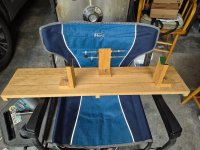
I am plainly aware of this.. can I outsource this work? Asking for Jake!Here are the three bundles of 6 strips (looks like a Tuna Rod LOL) after heat treating waiting for some node work and the kiss of the plane. Things will slow down at this point. A bit more prep work and many, many, planing strokes are ahead of Bill.
View attachment 178192
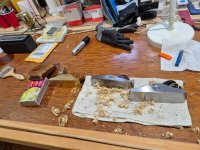

Bambooflyguy
Legend
The real fun begins!

Time to make 100's of plane strokes and possibly shed some blood. These strips will be razor sharp on the apexes and will make a paper cut feel like it was done with a butter knife. Time to put on the gloves or leave the DNA tag on the rod itself. Most of my rods that I have made over the years have a DNA signature on them in addition to my inscription above the grip.
Bambooflyguy
Legend
So that’s how you get your cane darker eh Mike??
Last edited:
Haven't made the 100's of strokes yet, just a quick primer today, but blood has been spilled! The good news, is if my rod is ever lost, then I'll be able to have it proved to be mine with a quick DNA test!! HA!Time to make 100's of plane strokes and possibly shed some blood. These strips will be razor sharp on the apexes and will make a paper cut feel like it was done with a butter knife. Time to put on the gloves or leave the DNA tag on the rod itself. Most of my rods that I have made over the years have a DNA signature on them in addition to my inscription above the grip.
The real fun begins!
Yes, the REEL fun begins... fixed it for ya!So that’s how you get your cans darker eh Mike??
Cans? Somebody hates those CANS! Do you mean hands? OMJ is confused.. okay, OMBZ is confused.. not that hard for me to get that way! LOL!
Bambooflyguy
Legend
Cane…not cans!

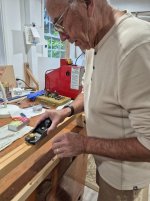
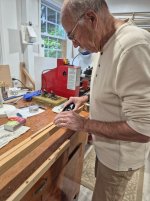
Here is Bill making the first few passes with the plane on a bamboo strip.
While watching this is like watching paint dry it's a big part of bamboo rod making. The bamboo is a very hard material to plane because of the silica embedded in the fibers. The iron takes a real beating so sharpening is something you will learn to do and enjoy knowing that nice clean curls will result from a fine edge.
Last edited:
I'm going to spend a little time addressing the perceived expense of making a bamboo fly rod, how to start with a minimum cost investment. After getting your hands on a culm of bamboo ($60 now I believe) you will have the potential to make two single tip rods. First thing you will want to do is heat treat the material to temper the strips. You can build a heat gun oven that will cost you some money or use a method developed by Darrel Hayashida using a plumber's torch with a bottle of Maps gas. I used this method for the first few rods I made and it works just fine. The only down side is that the two outside strips on each half of the culm get a bit toasted. So if you make those strips a bit wider you can just plane off the excess burnt material. One thing he did not mention is that a quick wire brush scrub of the charred inside of the culm removes all the charred material.
I found a video posted on YouTube that shows how this is done and explains it well saving me the trouble. Credit goes to the creator of this video.
I found a video posted on YouTube that shows how this is done and explains it well saving me the trouble. Credit goes to the creator of this video.
Last edited:
Next step you will need a medium sized knife to split the culm into strips. I use an old bread knife fo this step. After splitting the culm into strips, you should have about 24 strips from the top half of the 10' culm (tip strips) and 24 strips from the bottom half (base strips). The strips are nearly rectangular if you look at the end of them.
Some Node work and straightening of the strips is the next order of business, a simple cheap heat gun will provide enough heat for this step. A small 4" vice and bastard file will pretty much round out the basic tools necessary. This is not a difficult process but it has a bit of a learning curve. Some coaching will help you get started. There are quite a few internet articles to give you the basics.
Next step is rough planing the strips into a triangular shape. Here is where you'll need to spend about a $100 for a decent tool. I bought a Stanley Sweet Heart and I'm really impressed with it. I find it comfortable in the hand and the iron is a quality one. You are going to need to be able to sharpen the plane iron so a wet stone combination or a flat surface with wet or dry sandpaper will also get the job done. I bought a honing guide to keep my angles consistent when sharpening.
For the form to plane on a simple 2"X2" piece of maple about 3-4' long is the base. You will need to route out a 60 degree groove with a router on each of the four sides. Each side will have a progressively deeper groove routed into it. The groves are consistan in depth on each side, not sloped. this will enable you to create triangular strips ready for your planing form.
Some Node work and straightening of the strips is the next order of business, a simple cheap heat gun will provide enough heat for this step. A small 4" vice and bastard file will pretty much round out the basic tools necessary. This is not a difficult process but it has a bit of a learning curve. Some coaching will help you get started. There are quite a few internet articles to give you the basics.
Next step is rough planing the strips into a triangular shape. Here is where you'll need to spend about a $100 for a decent tool. I bought a Stanley Sweet Heart and I'm really impressed with it. I find it comfortable in the hand and the iron is a quality one. You are going to need to be able to sharpen the plane iron so a wet stone combination or a flat surface with wet or dry sandpaper will also get the job done. I bought a honing guide to keep my angles consistent when sharpening.
For the form to plane on a simple 2"X2" piece of maple about 3-4' long is the base. You will need to route out a 60 degree groove with a router on each of the four sides. Each side will have a progressively deeper groove routed into it. The groves are consistan in depth on each side, not sloped. this will enable you to create triangular strips ready for your planing form.
Great thread and appreciate all the updates!
The next requirement will probably be the most expensive of your acquisitions, the adjustable planing form. This is the piece of equipment that will allow you to create nearly every published taper and whatever taper you create yourself. For a new form you are looking at $800 plus. The Bellinger forms are going to set you back over $1K. If you are patient and watch the right classified ads you might find a used set and save a lot of money. Another approach that I took was to make a set of forms out of Maple. It's not that hard and you really only need a drill press, and a couple more tools that you can make yourself. I'm guessing that you are looking at about $100 plus about 20 hours of your time. Thomas Penrose has a great tutorial on how to make a set of metal forms. Here is a video of making forms out of wood "making a bamboo rod planing form (wood DIY Project" on YouTube, I followed a similar process and made my first set of forms. I made about 4 or 5 rods on them before I came across a used set of Bellinger forms that I could not pass up. I sold the wood forms for the cost I spent making them.
This is probably the biggest hurdle for a person interested in making a bamboo fly rod. But once you have a set of forms you're pretty much there in the necessary special tooling for making bamboo fly rods. Time to set the forms and start making curls of bamboo shavings.
This is probably the biggest hurdle for a person interested in making a bamboo fly rod. But once you have a set of forms you're pretty much there in the necessary special tooling for making bamboo fly rods. Time to set the forms and start making curls of bamboo shavings.
Last edited:

Really fun and informative thread guys. Thanks for taking the time to post this stuff for our enjoyment.
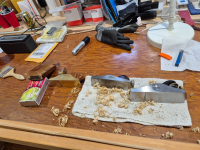
So now we are needing the plane I mentioned before, about $100. This will be the tool for making all the passes on the strips when they are in the form set to the taper of the rod you are making. As you get very close to having the plane kiss the forms many of us change up to a scraper plane. Lie Nielson has a dandy one that I bought well into my rod making efforts. This little tool with the rod makers groove is about $225, yikes! So before that purchase was financed, I made a home made scraper tool using sone 3/4" hardwood trim cutoffs and a drywall cutter blade. the blade is set a few degrees negative to the bottom of the block plus it is just slightly proud of the base. If you push it along the strip you can remove very small amounts of material as you zero in on your taper station settings. In the picture the Lie Nielson scraper is second from the left and the home-made budget saver is far left. Let your wallet make the choice.

there was so much going on in these pics....View attachment 178159View attachment 178160View attachment 178161
Mike and I are now on the NSA watch list for the missile we're using, err the heat gun oven!!