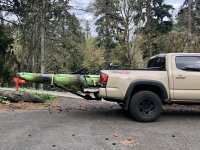
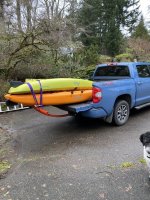
I have a Tacoma with a 6' bed (I suppose it's about 8' with the tail gate down). I have carried my kayaks (longest is 12'9") using the following method for many years, over thousands of miles.
1) I place the kayak in the bed, hull down, on top of a cheap closed cell dense foam sleeping pad (to eliminate point loads on the hull from the hard truck bed).
2) I place an appropriately sized climbing sling around the end of the kayak sticking out beyond the tailgate, such that it fits about 1' to 2' from the end of the kayak. The climbing loop will only go so far as it snugs against the increasing diameter of the kayak. A climbing sling is webbing sewn together to form a loop, and available at places like REI in a variety of sizes (size required will depend upon kayak diameter at the its exposed end). A climbing sling is incredibly strong (as you suspect because climbers use them to attach a carabiner and run climbing ropes through them to rappel down vertical terrain). The climbing sling distributes the weight of the kayak to the entire kayak...NEVER use the kayak's bow or stern carrying handles to support the kayak when transporting the kayak in a truck bed)
3) I then use two cam cargo straps with hooks on each end to connect the climbing sling (position the hooks in the sling on each side of the kayak) to two attachment points in the top part of the truck bed on each side. The truck bed attachment points should be a couple of feet from the end of the truck bed, so as to provide solid support to the exposed end of the kayak. Positioning the attachment points is particularly easy with the Tacoma's adjustable mounts.
4) I pull the cam cargo straps tight (lifting the end of the kayak a bit will facilitate doing so) such that the weight of the kayak hanging out of the truck bed is receiving support from the cargo straps. Do NOT use ratchet cargo straps, since you do not want to place excessive force on the kayak.
5) Finally, I strap the kayak down laterally against the foam pad. This reduces bouncing on rough roads, as well as keeping the kayak's orientation against the forward head of the truck bed. I place a high visibility flag at the end of the kayak so I don't get a ticket from an over-zealous trooper.
It's easier than the directions might appear. Next time I load up I will try to post some pictures to illustrate this simple, cheap, and very secure means to carry a kayak in the bed of a pickup. I've carried my kayaks for many years in this manner, over all sorts of roads, with no damage to any of the 7 kayaks I own.