So will O.D.F.W. pay any heed to the C.C.W. guy who told them about the changes in the Sandy delta and how the nets are cleaning out the coho ? Or will O.D.F.W . just tell us to pound sand because they love the nets ?

Navigation
Install the app
How to install the app on iOS
Follow along with the video below to see how to install our site as a web app on your home screen.
Note: This feature may not be available in some browsers.
More options
Style variation
You are using an out of date browser. It may not display this or other websites correctly.
You should upgrade or use an alternative browser.
You should upgrade or use an alternative browser.
Sandy
- Thread starter cchinook45
- Start date

i always wonder, why they need 'testimony' . arent they supposed to be on top of these things??I'm the one of the two guys who testified to ODFW. Things are moving in the right direction.

You'd think so.i always wonder, why they need 'testimony' . arent they supposed to be on top of these things??
Here is a copy / paste of the email to ODFW commission prior to our testimony to them. They put this together based on information I provided them from all the time I've spent around the delta in all my fishing endeavors the past few years.
I'm on my phone so too lazy to get the attached documents with photos.
- In recent decades, the flow from the eastern mouth of the Sandy River has shifted due to habitat restoration projects and natural causes.
- During low flows, which are typical during the summer and fall months when commercial gillnetting takes place in the area, the current sanctuary boundary provides little protection (in fact, it is likely on dry land – see attached image).
- The current sanctuary boundary appears to end at the westernmost channel of the eastern mouth, but it does not include outflows upriver of that area.
- During low flows, the Sandy River often flows towards the east (upriver), including behind Gary Island.
- Local residents have witnessed commercial fishing activity immediately upriver of the eastern mouth (approx. river mile 123/124), where fish returning to the Sandy River are staging.
Thank you.I'm the one of the two guys who testified to ODFW. Things are moving in the right direction.
thx !You'd think so.
Here is a copy / paste of the email to ODFW commission prior to our testimony to them. They put this together based on information I provided them from all the time I've spent around the delta in all my fishing endeavors the past few years.
I'm on my phone so too lazy to get the attached documents with photos.
- In recent decades, the flow from the eastern mouth of the Sandy River has shifted due to habitat restoration projects and natural causes.
- During low flows, which are typical during the summer and fall months when commercial gillnetting takes place in the area, the current sanctuary boundary provides little protection (in fact, it is likely on dry land – see attached image).
- The current sanctuary boundary appears to end at the westernmost channel of the eastern mouth, but it does not include outflows upriver of that area.
- During low flows, the Sandy River often flows towards the east (upriver), including behind Gary Island.
- Local residents have witnessed commercial fishing activity immediately upriver of the eastern mouth (approx. river mile 123/124), where fish returning to the Sandy River are staging.
Without the nets I bet the counts for coho would have been 13000 or more instead of the terrible 2600.You'd think so.
Here is a copy / paste of the email to ODFW commission prior to our testimony to them. They put this together based on information I provided them from all the time I've spent around the delta in all my fishing endeavors the past few years.
I'm on my phone so too lazy to get the attached documents with photos.
- In recent decades, the flow from the eastern mouth of the Sandy River has shifted due to habitat restoration projects and natural causes.
- During low flows, which are typical during the summer and fall months when commercial gillnetting takes place in the area, the current sanctuary boundary provides little protection (in fact, it is likely on dry land – see attached image).
- The current sanctuary boundary appears to end at the westernmost channel of the eastern mouth, but it does not include outflows upriver of that area.
- During low flows, the Sandy River often flows towards the east (upriver), including behind Gary Island.
- Local residents have witnessed commercial fishing activity immediately upriver of the eastern mouth (approx. river mile 123/124), where fish returning to the Sandy River are staging.
Now that I've had a moment, I went and dug up the email that originally went to the commissioner prior to the hearing. Visuals included:
We respectfully request an urgent review and modification of the current boundary of the
Sandy River commercial gillnet sanctuary, which we believe is inadequate to protect
salmon staging to return to the Sandy River.
As you know, gillnet sanctuaries exist to protect salmon that are staging at the mouths of
tributaries. Salmon congregate at these areas for two primary reasons: waiting at the
mouth of their natal stream until water conditions are conducive for them to migrate
upstream or upriver bound fish that may dip into the area to find cold water refugia.
The Sandy River is somewhat unique in that it has two mouths, or areas where it flows into
the Columbia River. The westerly mouth was historically the only migration corridor into the
Sandy River. However, after a large salmon restoration project was completed a secondary
mouth of the Sandy River was created upstream – creating a new easterly migration
corridor for salmon to access the Sandy River.
Unfortunately, the current Sandy River sanctuary is insu[icient to protect salmon staging at
the easterly mouth of the Sandy River. During low flows, which are typical this time of year,
a significant portion of the Sandy River flows into the Columbia at the easterly mouth.
When flows are low, which is when gillnets are fishing this area, the easterly end of the
sanctuary is dry or swampy land – it is not a salmon migration corridor. As such, the salmon
migration corridor and staging areas are not protected by the current sanctuary.
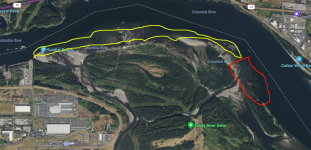
The eastern end of the sanctuary should be expanded in two ways: into the mainstem
Columbia River and above the easterly mouth of the Sandy River. This will help ensure that
the sanctuary includes the salmon migration corridor during low flows. Below is an image
that roughly illustrates the current boundary (in yellow) and a suggested expanded
boundary (in red) to provide protection for those fish staging at the easterly mouth of the
Sandy River. The area highlighted in yellow is dry or swampy land that salmon do not
migrate through during low flows.
Given the urgent nature of this matter, we respectfully ask that you consider an emergency
rule to provide additional protection during this current fall fishing season.
Thank you for your attention to this matter.
We respectfully request an urgent review and modification of the current boundary of the
Sandy River commercial gillnet sanctuary, which we believe is inadequate to protect
salmon staging to return to the Sandy River.
As you know, gillnet sanctuaries exist to protect salmon that are staging at the mouths of
tributaries. Salmon congregate at these areas for two primary reasons: waiting at the
mouth of their natal stream until water conditions are conducive for them to migrate
upstream or upriver bound fish that may dip into the area to find cold water refugia.
The Sandy River is somewhat unique in that it has two mouths, or areas where it flows into
the Columbia River. The westerly mouth was historically the only migration corridor into the
Sandy River. However, after a large salmon restoration project was completed a secondary
mouth of the Sandy River was created upstream – creating a new easterly migration
corridor for salmon to access the Sandy River.
Unfortunately, the current Sandy River sanctuary is insu[icient to protect salmon staging at
the easterly mouth of the Sandy River. During low flows, which are typical this time of year,
a significant portion of the Sandy River flows into the Columbia at the easterly mouth.
When flows are low, which is when gillnets are fishing this area, the easterly end of the
sanctuary is dry or swampy land – it is not a salmon migration corridor. As such, the salmon
migration corridor and staging areas are not protected by the current sanctuary.
The eastern end of the sanctuary should be expanded in two ways: into the mainstem
Columbia River and above the easterly mouth of the Sandy River. This will help ensure that
the sanctuary includes the salmon migration corridor during low flows. Below is an image
that roughly illustrates the current boundary (in yellow) and a suggested expanded
boundary (in red) to provide protection for those fish staging at the easterly mouth of the
Sandy River. The area highlighted in yellow is dry or swampy land that salmon do not
migrate through during low flows.
Given the urgent nature of this matter, we respectfully ask that you consider an emergency
rule to provide additional protection during this current fall fishing season.
Thank you for your attention to this matter.
its funny... or not so much. the gill netters figure this out in nooooo time. and odfw is clueless until someone puts in front of them.
Well it's been like this for years and as far as I know nobody but me has brought it up with them or anyone else. Even CCA had no idea.its funny... or not so much. the gill netters figure this out in nooooo time. and odfw is clueless until someone puts in front of them.
Why would O.D.F.W . care ? They still get paid.its funny... or not so much. the gill netters figure this out in nooooo time. and odfw is clueless until someone puts in front of them.
they are all we got.Why would O.D.F.W . care ? They still get paid.
Guess we will have to wait until end of Aug. to see if anything comes of this.Well it's been like this for years and as far as I know nobody but me has brought it up with them or anyone else. Even CCA had no idea.
Do you think they will decide this issue before the coho show up in Aug. 2026 . And springers way before that.Now that I've had a moment, I went and dug up the email that originally went to the commissioner prior to the hearing. Visuals included:
We respectfully request an urgent review and modification of the current boundary of the
Sandy River commercial gillnet sanctuary, which we believe is inadequate to protect
salmon staging to return to the Sandy River.
As you know, gillnet sanctuaries exist to protect salmon that are staging at the mouths of
tributaries. Salmon congregate at these areas for two primary reasons: waiting at the
mouth of their natal stream until water conditions are conducive for them to migrate
upstream or upriver bound fish that may dip into the area to find cold water refugia.
The Sandy River is somewhat unique in that it has two mouths, or areas where it flows into
the Columbia River. The westerly mouth was historically the only migration corridor into the
Sandy River. However, after a large salmon restoration project was completed a secondary
mouth of the Sandy River was created upstream – creating a new easterly migration
corridor for salmon to access the Sandy River.
Unfortunately, the current Sandy River sanctuary is insu[icient to protect salmon staging at
the easterly mouth of the Sandy River. During low flows, which are typical this time of year,
a significant portion of the Sandy River flows into the Columbia at the easterly mouth.
When flows are low, which is when gillnets are fishing this area, the easterly end of the
sanctuary is dry or swampy land – it is not a salmon migration corridor. As such, the salmon
migration corridor and staging areas are not protected by the current sanctuary.
The eastern end of the sanctuary should be expanded in two ways: into the mainstem
Columbia River and above the easterly mouth of the Sandy River. This will help ensure that
the sanctuary includes the salmon migration corridor during low flows. Below is an image
that roughly illustrates the current boundary (in yellow) and a suggested expanded
boundary (in red) to provide protection for those fish staging at the easterly mouth of the
Sandy River. The area highlighted in yellow is dry or swampy land that salmon do not
migrate through during low flows.
Given the urgent nature of this matter, we respectfully ask that you consider an emergency
rule to provide additional protection during this current fall fishing season.
Thank you for your attention to this matter.
View attachment 176098
At this point I don't have a good read on the timeline. Once I hear anything new I will post it up.Do you think they will decide this issue before the coho show up in Aug. 2026 . And springers way before that.
Thanks for all your efforts . I tried for a couple of years by calling them and of course got nowhere.At this point I don't have a good read on the timeline. Once I hear anything new I will post it up.