Nisqually NWR, mid-August 2025. American bitterns are masters of camouflage. Their preferred habitat is deep in the reeds and cattails of a freshwater marsh. When stalking prey, their movements are very stealthy. Their plumage is a great match to their environment. You know that they must be there, but good sightings are rare. [Frankly, I see more Wilson’s snipes than bitterns each year.]. But for the last week or so, a family group of American bitterns has been putting on a show at Nisqually Billie Frank Jr. NWR.
A week ago, I noticed a cluster of excited birders / photographers along the Causeway Trail. Hurrying to join them, I was delighted to share this special opportunity. Four fledgling bitterns were on display. Fluffy feathers from their nestling phase still adorned their heads, giving them a “punk” appearance. Two fledglings were perched separately on cattail blades at the edge of the marsh, perhaps 20 feet from the edge of the Causeway Trail. This one has some “grumpy-old-man" vibes.
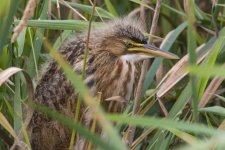
They spent most of time preening their feathers, removing the fluffy feathers of their nestling phase.
The other two fledglings stood in the midst of a patch of mare’s tail that had developed in a mud flat in the freshwater marsh.
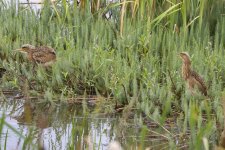
These fledglings made some half-hearted foraging movements or craned their heads toward the sky in the typical bittern camouflage pose.
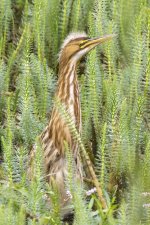
After giving everyone a good view of the fledglings, a parent flew into the patch of mare’s tail to deliver lunch. The parent inserted its bill deep inside the wide throat of the fledgling
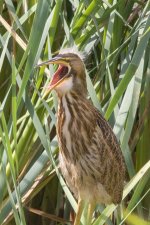
and regurgitated a meal. Lunch looked to be a fish.
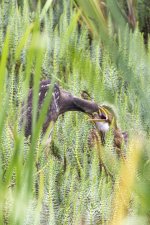
While the overall plumages of the fledglings were a tawny brown, the parent’s plumage was darker, grayer.
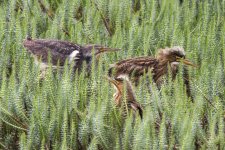
Later, the parent stalked for additional food at the edge of mare’s tail patch and cattails.
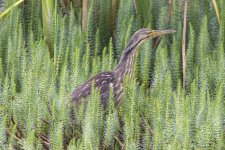
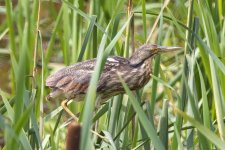
So, five bitterns in about 50’ of marsh… According to “All about Birds”, the parents will feed the fledglings for up to six weeks after they emerge from the nest.
I brought my wife to Nisqually a few days later so that she might have a chance to see this family group too. The bitterns weren’t out on our first pass down the Causeway trail. But several folks pointed them out to us on our walk back. Three bittern fledglings were in view perched on cattail blades. They were not doing much except preening. Later, a parent flew in and again fed a fledgling. A four bittern morning.
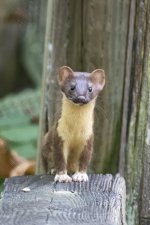
And the unusual sightings on that trip didn’t just include the bitterns; we saw a long-tailed weasel scampering along the boardwalk of the Twin Barns loop
and a sora
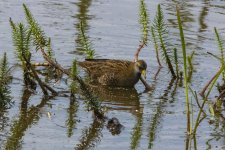
and its chick were feeding in the marsh opening where I had seen the bitterns a few days earlier.
Better to be lucky than good.
Steve