Navigation
Install the app
How to install the app on iOS
Follow along with the video below to see how to install our site as a web app on your home screen.
Note: This feature may not be available in some browsers.
More options
Style variation
You are using an out of date browser. It may not display this or other websites correctly.
You should upgrade or use an alternative browser.
You should upgrade or use an alternative browser.
Backyard Wildlife
- Thread starter Canuck from Kansas
- Start date





the_chemist
Life of the Party
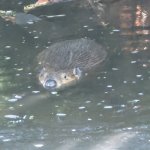

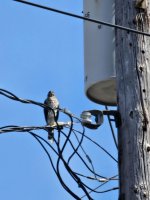
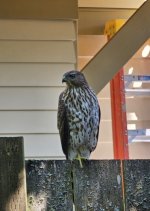
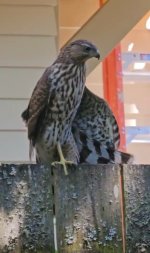
We’ve had a nesting pair of Coopers Hawks in my neighbors tree, two years in a row now. They (and presumably a few offspring) are super chatty and active right now. So much so that they dominate the soundscape. Listening to them is a nice break from the usual urban soundtrack.

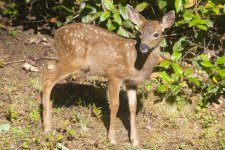
My yard continues to be a deer superhighway. For some deer, it serves as a rest stop, with facilities for a quick snack, a nap, or a poo as required. While the older fawns have begun to lose their spots, the younger ones still have their initial markings.
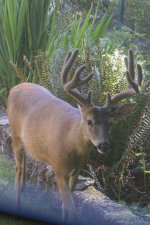
The does and their fawns appear throughout the day. But the small herd of bucks most commonly passes quickly past my window at dawn and dusk. The top buck is growing an impressive rack.
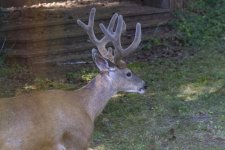 He is followed by his subordinate, the number two buck, whose rack is a bit smaller and less elaborate.
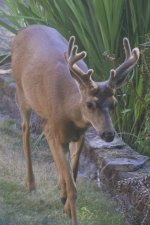
Trailing these two is typically a spike buck – maybe next year kid.
Steve
The does and their fawns appear throughout the day. But the small herd of bucks most commonly passes quickly past my window at dawn and dusk. The top buck is growing an impressive rack.
He is followed by his subordinate, the number two buck, whose rack is a bit smaller and less elaborate.Trailing these two is typically a spike buck – maybe next year kid.
Steve
Last edited:

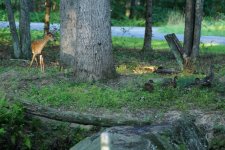
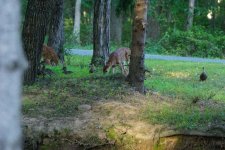
We have a few deers about as well; side yard on the sand mound:
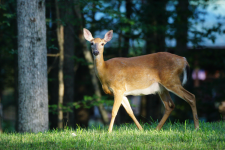
Front yard, across the pond, "Oh, there's a duck":
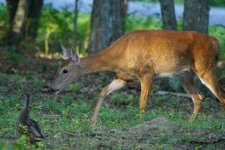
"Look Ma, there's a whole herd of ducks":
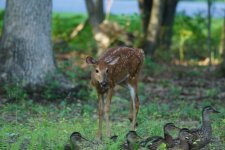
"Where they going"?
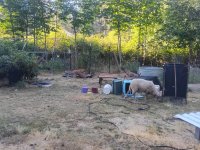
Mixed stock grazing:
Cheers
Front yard, across the pond, "Oh, there's a duck":
"Look Ma, there's a whole herd of ducks":
"Where they going"?
Mixed stock grazing:
Cheers

"Look Ma, there's a whole herd of ducks"
The ducklings are looking good!
the_chemist
Life of the Party
Still hanging around
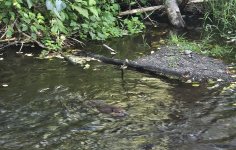
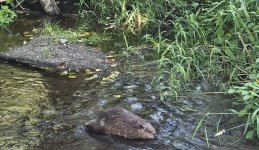
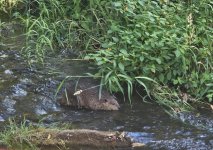
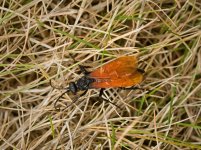

The other night our cat heard something outside that piqued her interest. We went outside to investigate and heard an adult owl plus something I'd never come across, a juvenile's "sheeew" call. A minute or two later I saw an adult fly from a cedar tree a block to the east. This is in the N end of West Seattle. We think it was a Great Horned Owl; pretty cool that they live in the megalopolis. There are lots of bunnies around to keep them in business. No pics.

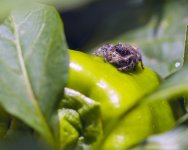
Looking for a spider.
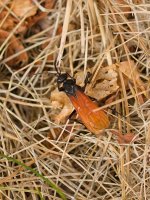
A week or so ago, I saw exactly this wasp/spider interaction that I had read about and even seen on video, but that I had never seen myself. As I was walking back from my mailbox, I caught the last act of this gruesome predator-prey drama (unfortunately with no camera at hand. How rare is that!). An adult female wasp dragged a large paralyzed spider (seemed to be about the same size as the wasp) into a burrow that she had dug in the dirt at the edge of my lawn. The wasp also likely laid an egg on the spider or in the burrow. The larval wasp will eat the living paralyzed spider, saving the spider’s vital organs for last. The larva will then pupate and emerge as a flying, reproductive adult. This is a “parasitoid” life cycle – think Alien. I came back the next afternoon and the female wasp had totally restored the surface; I could not see where the burrow was.Looking for a spider.
Steve
It is amazing how these solitary wasps can transport such large prey. By using their wings, legs and dragging the spider along the ground, the wasps can cover some impressive distances. I followed one wasp which was dragging a large Garden Spider to see where the brood chamber had been excavated. The wasp worked on this journey fairly swiftly along a sidewalk, across landscape rock and over a gravel area where it finally deposited the spider. The journey had covered over 20 yards. As with Steve's observation, when I looked later there was no indication of the hapless spider's "tomb." Some Mud Daubers specifically target Black Widow spiders. I found a spent 14-chamber Mud Dauber "nest" on a protected niche of my house one time. 13 of the 14 chambers had successfully hatched wasps. That's quite a success rate.wasp/spider interaction

tkww
Life of the Party
It is amazing. Admittedly this is a fairly long wasp, but the ratio of its mass vs the caterpillar is crazy.It is amazing how these solitary wasps can transport such large prey.
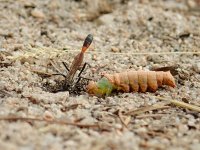
I was at a seldom-used camp site last summer, and as we were leaving a wasp drug in a spider to a hole near the fire pit. What amazed me wasn't just how well it covered the actual hole, but how much time it spent "randomizing" the area. It drug in multiple rocks and twigs into the general vicinity (but not actually over the hole), and then spent a couple minutes kicking sand/dust into the general from multiple directions, just to make sure there wasn't any sort of pattern. Really amazing.As with Steve's observation, when I looked later there was no indication of the hapless spider's "tomb."
A few posts ago, I shared some pictures of the bigger bucks in the local population. These bucks are the major leagues. A few days ago, two spike bucks, Double A quality?, posed in the yard.
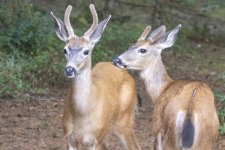
The bigger of the two has quite long spikes.
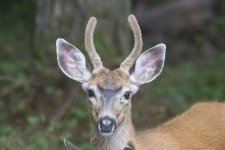
The smaller spike buck has been through some stuff as he has scars/bare areas above his tail and on his "shoulder".
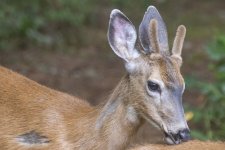
An even smaller buck, one of last year's fawns I suppose = T-ball level, has the tiniest spike antlers showing (no pictures yet). He was traveling alone.
Steve
The bigger of the two has quite long spikes.
The smaller spike buck has been through some stuff as he has scars/bare areas above his tail and on his "shoulder".
An even smaller buck, one of last year's fawns I suppose = T-ball level, has the tiniest spike antlers showing (no pictures yet). He was traveling alone.
Steve