

cascadian
Steelhead
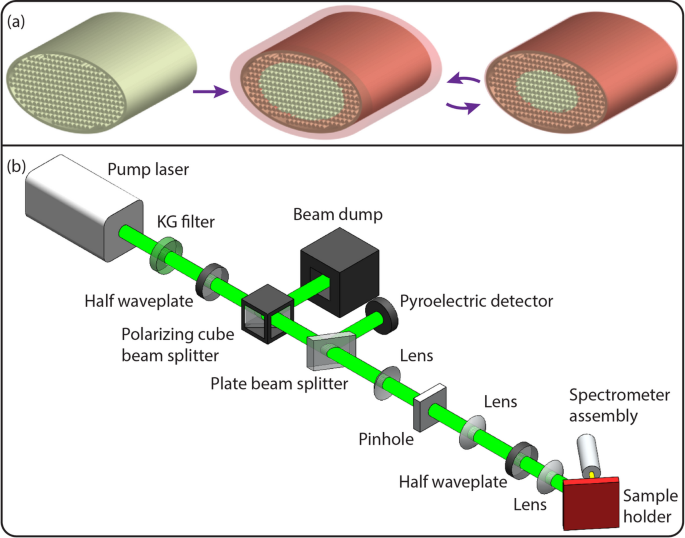
Peacocks have a secret hidden in their brightly colored tail feathers: tiny reflective structures that can amplify light into a laser beam. After dyeing the feathers and energizing them with an external light source, researchers discovered they emitted narrow beams of yellow-green laser light. They say the study, published this month in Scientific Reports, offers the first example of a laser cavity in the animal kingdom.
Scientists have long known that peacock feathers also exhibit "structural color" -- nature's pigment-free way to create dazzling hues. Ordered microstructures within the feathers reflect light at specific frequencies, leading to their vivid blues and greens and iridescence. But Florida Polytechnic University physicist Nathan Dawson and his colleagues wanted to go a step further and see whether those microstructures could also function as a laser cavity. After staining the feathers with a common dye and pumping them with soft pulses of light, they used laboratory instruments to detect beams of yellow-green laser light that were too faint to see with the naked eye. They emerged from the feathers' eyespots, at two distinct wavelengths. Surprisingly, differently colored parts of the eyespots emitted the same wavelengths of laser light, even though each region would presumably vary in its microstructure.
 www.nature.com
Scientists have long known that peacock feathers also exhibit "structural color" -- nature's pigment-free way to create dazzling hues. Ordered microstructures within the feathers reflect light at specific frequencies, leading to their vivid blues and greens and iridescence. But Florida Polytechnic University physicist Nathan Dawson and his colleagues wanted to go a step further and see whether those microstructures could also function as a laser cavity. After staining the feathers with a common dye and pumping them with soft pulses of light, they used laboratory instruments to detect beams of yellow-green laser light that were too faint to see with the naked eye. They emerged from the feathers' eyespots, at two distinct wavelengths. Surprisingly, differently colored parts of the eyespots emitted the same wavelengths of laser light, even though each region would presumably vary in its microstructure.
Spectral fingerprint of laser emission from rhodamine 6g infused male Indian Peafowl tail feathers - Scientific Reports
The light-emissive properties of dye-infused barbules from Indian Peafowl (Pavo cristatus) tail feathers is investigated at high intensities pumped at $$532\,$$ nm. The dye-infused barbules were prepared by repeatedly wetting the eyespot with dye solution and allowing it to dry. While wet, and...
www.nature.com

