
Navigation
Install the app
How to install the app on iOS
Follow along with the video below to see how to install our site as a web app on your home screen.
Note: This feature may not be available in some browsers.
More options
Style variation
You are using an out of date browser. It may not display this or other websites correctly.
You should upgrade or use an alternative browser.
You should upgrade or use an alternative browser.
Beautiful, but closed river
- Thread starter skyriver
- Start date

Yep. Just because it's closed doesn't mean people aren't going to fish it. Both accidentally and on purpose.The sad part is I regularly (every month or so) see people fishing in closed rivers. I don't bother calling the WDFW enforcement line anymore, particularly given their management policies and, if I recall correctly, recent budget cuts have also reduced enforcement staff.
I would love to see the WDFW enforcement strategy. Do they give closed rivers any priority?
I'm assuming, based on 45 years of fishing Washington, that enforcement concentrates on the typical busy spots. You could probably fish a closed river like the Chiwawa for DAYS without being noticed or checked. In fact, I'm assuming the only way you would get busted is if a concerned citizen called it in.
Maybe not, maybe their eyes are on the ball more than we know. I have my doubts.

Fourbtgait
Life of the Party
Enforcement depends on availability and numbers. Exactly how many officers available per region, how big a region?Yep. Just because it's closed doesn't mean people aren't going to fish it. Both accidentally and on purpose.
I would love to see the WDFW enforcement strategy. Do they give closed rivers any priority?
I'm assuming, based on 45 years of fishing Washington, that enforcement concentrates on the typical busy spots. You could probably fish a closed river like the Chiwawa for DAYS without being noticed or checked. In fact, I'm assuming the only way you would get busted is if a concerned citizen called it in.
Maybe not, maybe their eyes are on the ball more than we know. I have my doubts.
Driving back from Missoula, car passes us high rate of speed, slows down. Swerves from line to line. No way I’m passing. Call 911. Only one officer on duty for a Sunday afternoon. He covered from Missoula to border, forget how far north. Said they would try.
Saw him miles up the road pulled over, so grateful the officer wasn’t a hundred miles away.
That’s the situation i understand for the Methow River. One single enforcement officer covering a very large area, making it nearly impossible to enforce the boundary areas well.Enforcement depends on availability and numbers. Exactly how many officers available per region, how big a region?
Driving back from Missoula, car passes us high rate of speed, slows down. Swerves from line to line. No way I’m passing. Call 911. Only one officer on duty for a Sunday afternoon. He covered from Missoula to border, forget how far north. Said they would try.
Saw him miles up the road pulled over, so grateful the officer wasn’t a hundred miles away.

WDFW enforcement strategy is NOT based on conservation goals. It is based on agent contacts. So naturally they go where there are lots of people. An unwritten maxim of our legal and justice system is that "most of the people obey most of the laws most of the time." Therefore, patrolling closed water yields few contacts by the agents because most people are not fishing closed waters. An exception might be for a lake or river that was open but is now closed by emergency regulation. So an agent may patrol to notify any anglers who weren't aware of the regulation change. A good example of how enforcement does not work for conservation goals is this: the Suiattle River spring Chinook spawning tributaries are closed to salmon fishing, which is logical, so no one fishes there except for a few determined salmon poachers. And WDFW agents don't bother with regular patrols because the odds of making a "contact" are so low. However, over on the lower Samish River below old Hwy 99, they patrol regularly in late August and September and use up their ticket books because so many people are snagging hatchery Chinook salmon. Now conservation purpose is served however, because there is always an over-abundance of hatchery salmon stacked up there. It's not like there is any chance that the hatchery will not make its escapement needs.Yep. Just because it's closed doesn't mean people aren't going to fish it. Both accidentally and on purpose.
I would love to see the WDFW enforcement strategy. Do they give closed rivers any priority?
I'm assuming, based on 45 years of fishing Washington, that enforcement concentrates on the typical busy spots. You could probably fish a closed river like the Chiwawa for DAYS without being noticed or checked. In fact, I'm assuming the only way you would get busted is if a concerned citizen called it in.
Maybe not, maybe their eyes are on the ball more than we know. I have my doubts.
The Department will not say or agree that this is their enforcement strategy, but it's hard to ignore the observations and the fact that human nature is in play here. Why spend time driving hundreds of miles on patrol where the likelihood of making a contact is nearly zero? Concerned citizen calls are absolutely how areas with few people get an LE response.
A little math to expand on the enforcement presence on our waters. According to WDFW's web site enforcement has 165 commissioned personnel who make 225,000 contacts annually.
That equates to the commissioned personnel on the average contact 1,364 folks (225,000/165) annually. 260 working days (52 weeks times 5 days/week) annually would be available for each of those personnel. Allowing 100 non-field days a year (for leave, training, court, etc.) there are a potential of 160 days in the field. To achieve that average of 1,364 contacts commissioned personnel would have to average just 8.5 contacts/day.
That doesn't seem like a heavy lift to me.
That equates to the commissioned personnel on the average contact 1,364 folks (225,000/165) annually. 260 working days (52 weeks times 5 days/week) annually would be available for each of those personnel. Allowing 100 non-field days a year (for leave, training, court, etc.) there are a potential of 160 days in the field. To achieve that average of 1,364 contacts commissioned personnel would have to average just 8.5 contacts/day.
That doesn't seem like a heavy lift to me.
Fourbtgait
Life of the Party
Maybe a better way to think would be the number of agents per region. This would include land and waterways. We can’t just divide 165 agents into the 6 regions. 4, 5 and 6 each are hundreds of square miles. Basically there is about 71,303 square miles of land and water statewide. Thats like 432 square miles per agent on average.
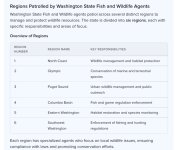
The one single time I was checked in over the past twenty years (including several years in which I fished 50-100 days) was at a WDFW access site (takeout on the Snoqualmie when the Snoqualmie still had a decent winter season).This isn't making me more confident someone will check the Chiwawa this weekend...

I hear you, and in recent years, sadly, I too have taken on this attitude and lack of action. Last spring two incidents spurred me into taking action again. WDFW's app has a way to report poachers (I could care less about a reward), I used it.The sad part is I regularly (every month or so) see people fishing in closed rivers. I don't bother calling the WDFW enforcement line anymore, particularly given their management policies and, if I recall correctly, recent budget cuts have also reduced enforcement staff.
I suggest to all naysayers - report illegal fishing. Okay, maybe enforcement can't (or won't) check it out but I believe that sometimes reporting will result in a contact between the illegal party and enforcement. (And maybe even an arrest.)

This river is behind the Thousand Trails Leavenworth. Boy I've often wished we could fish. One day there were so many sockeye(?) in there I swear I could have ran across.
I've called on poachers a time or two or three. Usually on officer isn't available, but they will take a report. The Columbia County sheriff will show up rather quickly.
I've called on poachers a time or two or three. Usually on officer isn't available, but they will take a report. The Columbia County sheriff will show up rather quickly.
I still on fishing violations when I see poaching type action (fishing salmon closed season etc.). I try to provide as much information as possible, location, time of day, vehicle (including lic. #) and angler descriptions. My hope is to provide the kind of information that allows those agents that are so inclined to work as efficiently as possible.
I know that at least occasionally this approach works as I have gotten feed back about cases made (including a couple pretty good ones). If we are willing to try to make a difference can we really expect officers to go that extra mile.
I know that at least occasionally this approach works as I have gotten feed back about cases made (including a couple pretty good ones). If we are willing to try to make a difference can we really expect officers to go that extra mile.