Bamboo and wild rainbows.

Dave Westburg

Fish the classics
Forum Supporter
54F7C331-2016-4E84-AC72-21025998E6E1_1_105_c.jpeg
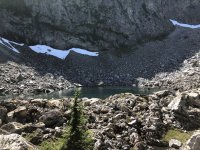
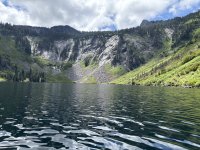
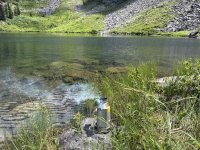
This lake is about the limit for me for a day hike. 4.7 miles each way, 88 switchbacks and 1,500 feet elevation gain in the last two miles. But a self-sustaining population of wild rainbows was the draw. I didn't find many fish till I reached the rock shallows at the far end of the lake.
E2667D14-764A-43B4-92A4-9029B2FDB5EC_1_105_c.jpeg

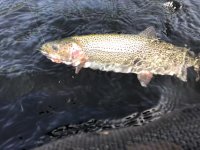
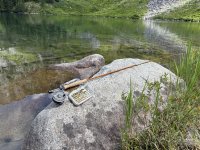
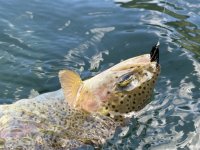
A phillipson 8'6" 5 weight fly rod, a cortland camo intermediate line and a size 12 black or brown or self bodied carey did the trick. The fish were 11-12 inches but well conditioned. I had a fish break me off on a rock. Many strikes came as the flies were sinking before I'd started a retreive.
F23F2695-3D2A-424B-A9BC-560B5F7AA583_1_105_c.jpeg

Time to brew up afternoon coffee before the long float tube ride back down the lake.
321C98D6-8233-4950-BC3B-BD8D04804656_1_105_c.jpeg
 
Wow beautiful lake but quite a challenge of a hike with float tube, waders, fins, woodstove and fishing gear, 10 essential and who knows what else. How heavy was your pack? I am impressed.
Lighter than you think. The wilderness lite float tube weighs 3.5 pounds. Opti-pack fins 16 oz. Simms waders 40 oz. Aluminum Kelly Kettle 19 oz. That's about 11 pounds. Add clothes, lunch, 40 oz of water, fire starting kit and medical kit and fishing gear and I'm in the 20-25 lbs range.
 
Lighter than you think. The wilderness lite float tube weighs 3.5 pounds. Opti-pack fins 16 oz. Simms waders 40 oz. Aluminum Kelly Kettle 19 oz. That's about 11 pounds. Add clothes, lunch, 40 oz of water, fire starting kit and medical kit and fishing gear and I'm in the 20-25 lbs range.
Do you have the "Trekker" or the "Scout" sized Kelly Kettle? I'm thinking of getting one and would appreciate any insights from a long-time user like your good self!
 
Do you have the "Trekker" or the "Scout" sized Kelly Kettle? I'm thinking of getting one and would appreciate any insights from a long-time user like your good self!
Because it was a solo trip I took the 20 fl oz capacity Aluminum Trekker which weighs 19 oz. 20 fluid ounces is plenty of water for coffee or oatmeal or dehydrated dinner for one. When I'm on a group trip I bring the 41 fl oz capacity Aluminum Scout which weighs 25 oz.

Two options. Aluminum or Stainless steel. Aluminum is about 20-30% lighter than stainless and weight matters for me backpacking so that's what I use. Aluminum is supposed to be less strong and more prone to denting than stainless but I haven't noticed it.

Make sure your kelly kettle comes with a green whistle stopper and a cork (the older models only have a cork). The whistle stopper is nice because it whistles when the water is boiling.

The Kelly Kettle is a great option when you are flying in to a cabin via float plane and the pilot won't let you bring flammable fuels. I use the kelly kettle whenever I'm hiking and there's no burn ban in order to avoid running out of fuel and messing with fuel cannisters. Because there's an open flame you prob couldn't use your kelly kettle at times when there's a burn ban.
 
Last edited:
Because it was a solo trip I took the 20 fl oz capacity Aluminum Trekker which weighs 19 oz. 20 fluid ounces is plenty of water for coffee or oatmeal or dehydrated dinner for one. When I'm on a group trip I bring the 41 fl oz capacity Aluminum Scout which weighs 25 oz.

Two options. Aluminum or Stainless steel. Aluminum is about 20-30% lighter than stainless and weight matters for me backpacking so that's what I use. Aluminum is supposed to be less strong and more prone to denting than stainless but I haven't noticed it.

Make sure your kelly kettle comes with a green whistle stopper and a cork (the older models only have a cork). The whistle stopper is nice because it whistles when the water is boiling.

The Kelly Kettle is a great option when you are flying in to a cabin via float plane and the pilot won't let you bring flammable fuels. I use the kelly kettle whenever I'm hiking and there's no burn ban in order to avoid running out of fuel and messing with fuel cannisters. Because there's an open flame you prob couldn't use your kelly ketter at times when there's a burn ban.
Thank you!
 
Impressive stuff, do you always look for lakes with self sustaining populations? That would give you the possibility of a catch of a larger fish mixed with smaller I guess
 
I like fishing alpine lakes with self-sustaining populations. Enjoy knowing the fish are wild and that I won't be skunked by a winterkill or by happening on the lake in the year when all the old fish have died out and the new fish haven't yet been stocked. And when the wild lake is an abundant fish lake it's fun to keep a fish or two for the grill. Nothing is worse than to spend a few hours of ferocious work off trail to get to a lake and see an incredible mayfly hatch like this but no rises because there are no fish. Ask Phil K who was on a couple of those hikes...

IMG_1701.JPG

I still fish stocked alpine lakes however. Some of them are in beautiful country like this...

IMG_1730.jpeg

And the biggest trout I've caught in alpine lakes have come from alpine lakes which are stocked.

IMG_0619.jpeg

The key is the hit them in the 4th year after stocking while the fish are in prime condition...
 
Last edited:
Wonderful report Dave!

The debate of fishing lakes with "wild" populations or those sustained by stocking is an interesting one. Some of the Alpine lakes can be in creditably productive with the ability to grow some very respectable size trout.

Old reports from Whatcom County were that brook trout planted in barren lakes in the 1930s where the initial fish grew to 5#s or more with some fish reaching at least 8#. In the mid 1970s surveyed 2 of those lakes. A large lake with limited spawning area was still producing some brookies to 14 inches or so. Another nearby lake in spite being fished heavily did not have a single fish greater than 9 inches (more than 10 years old) with most of the fish beginning to spawn at less than 6 inches. In that lake the ability of the trout to reproduce outstripped the lake's food resources support larger fish. Surprising the fishing (catch/hour) was significantly better on the lake with the larger fish.

My point is that the ability of a given lake to produce large trout is complex. It is certainly possible a rare lake with a "wild:" population to produce a large trout, the recruitment of the young fish needs to be low enough that they do not deplete the food resources to a point the growth rates are severely affected. In this case the various trout species are not equal. Both the brook trout and cutthroat (especially the Westslopes) often establish self-sustaining populations while rainbows rarely do so. In short species of trout in the lake and their ability to reproduce strongly influence the potential fishing one is likely to find. That reproductive potential is largely determined by that state of any inlet streams.

Typically, if one is looking for a fishery with relatively good fishing (Alpine lakes fisheries are known to be temperamental) with some decent size fish (14 inches and better) looking for lakes off well-traveled trails, and either low recruitment rates is a "wild population or a stocked lake. On stocked lakes those planted at low densities every 3 or 5 years would be a good place to begin one's explorations. If looking for a shot at a large fish, then lakes with very limited wild reproduction or stocked lakes with a longer stocking frequency (maybe once every 7 years or so) at low densities (lakes that are allowed to be fishless for a year or two allow insects etc. populations to rebound).

How large can one find in western Cascades? The largest I personally caught in a "wild" lake was about 5#s but that is the only such lake where I found fish in excess of 20 inches. In stocked lakes the chances of finding larger trout are possible with some lakes producing fish in up to maybe 8# but again that is rare. The largest trout I know of from a lake that I personally planted was Westslope cutthroat that weighted an astounding 13# and no I did not catch it!

Tight lines
Curt
 
Last edited:
Another nearby lake in spite being fished heavily did have a single fish greater than 9 inches (more than 10 years old) with most of the fish beginning to spawn at less than 6 inches.

Tight lines
Curt
Always learn something when you post Curt. Someone should collect all your posts and title it "The Wisdom of Salma." I've done that with everything you've posted on bull trout.

What's your sense as to how long a typical alpine lakes fish lives and does it vary by type of trout (brook, cutt, rainbow, golden). Interesting to hear you identified a 10 year old brookie. I thought most high lakes trout only live 4-5 years.
 
Dave -
I thought that brook trout was 13 years old but was sure that it was at least 10 years old. I would have need better equipment to sure. Know that a brook trout out of a north California high lake was aged at 23 years old. That large cutthroat was caught 10 years after I planted the lake so assume it was that age though only saw the picture. Have seen rainbows in a local "S" river that were also 10 years old (had spawn 6 times). I would not be surprised to hear of an older fish.

In my experience by year 6 after planting a lake's population typically is at near zero though much of that mortality would be angler related. A remote lake with little angler pressure/harvest would be a candidate for one of those older fish though those waters are rarely sampled.

Curt
 
The largest trout I've personally landed in an alpine lake was Slide lake in Skagit County, I didn't measure it but I'd guess that cutthroat was 26-28" and 4-5 lbs. I released it as we had plenty of food and we're moving to lakes farther off the beaten path


c/22
 
The largest trout I've personally landed in an alpine lake was Slide lake in Skagit County, I didn't measure it but I'd guess that cutthroat was 26-28" and 4-5 lbs. I released it as we had plenty of food and we're moving to lakes farther off the beaten path


c/22
Wow that's huge for that lake! Mellow hike but that road has seen better days. That lake is all natural reproduction with mainly coastal cutthroat but there's definitely some mixed Westslope/Yellowstone cutthroat genetics. It was stocked in 1970 with Westslopes from Twin Lakes and Yellowstone Cutthroat in 1930.
 
Wow that's huge for that lake! Mellow hike but that road has seen better days. That lake is all natural reproduction with mainly coastal cutthroat but there's definitely some mixed Westslope/Yellowstone cutthroat genetics. It was stocked in 1970 with Westslopes from Twin Lakes and Yellowstone Cutthroat in 1930.
Yes I believe my hard back book Lakes of Washington noted it was planted with Montana Black Spot, or MBS as they abbreviate it. These I believe are a variety of Cutthroat.

This was back in the day when I would fish from shore using Pautzke salmon eggs just laying on the bottom. Fortunately it was hooked in the mouth not down it's throat.

 
My two biggest alpine fish were 3-5 pounds. Both cutts. One from an eastslope cascades lake above 5,000 feet with an easy 1 mile hike. One from a west slope cascades lake which you can almost drive to.
 
Last edited:
View attachment 159107
This lake is about the limit for me for a day hike. 4.7 miles each way, 88 switchbacks and 1,500 feet elevation gain in the last two miles. But a self-sustaining population of wild rainbows was the draw. I didn't find many fish till I reached the rock shallows at the far end of the lake.

View attachment 159108

A phillipson 8'6" 5 weight fly rod, a cortland camo intermediate line and a size 12 black or brown or self bodied carey did the trick. The fish were 11-12 inches but well conditioned. I had a fish break me off on a rock. Many strikes came as the flies were sinking before I'd started a retreive.

View attachment 159109

Time to brew up afternoon coffee before the long float tube ride back down the lake.

View attachment 159110
Beautiful lake! You should take me next time. Just be prepared to carry me out. Don’t worry I only weigh 195 pounds 😳😂
 
Old thread, but one worth bumping even for my silly question.


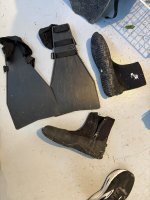
@Dave Westburg what do you wear with those fins? Boots? Just wader stocking feet?
I use the wilderness lite fins and caddis neoprene booties. The biggest advantage of the wilderness light fins is that they are completely flat in my pack. Might be able to shave some weight by using lower cut booties but I'm not that obsessive. I wore waders without boots for a while but the shorelines of alpine lakes are too tough on the neoprene (sharp rocks, sticks in mud) so I added booties.

IMG_4179.JPG
 
Back
Top