Navigation
Install the app
How to install the app on iOS
Follow along with the video below to see how to install our site as a web app on your home screen.
Note: This feature may not be available in some browsers.
More options
Style variation
You are using an out of date browser. It may not display this or other websites correctly.
You should upgrade or use an alternative browser.
You should upgrade or use an alternative browser.
Got Shrooms?
- Thread starter Salmon123
- Start date
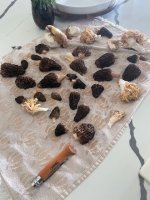
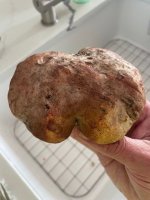
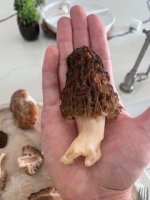
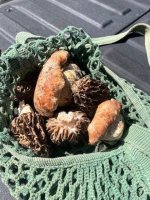

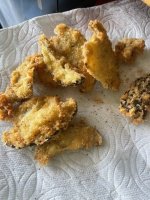
I dabble. I encountered several clusters of oyster mushrooms on my walk. I got to them before they were too infested with insects.
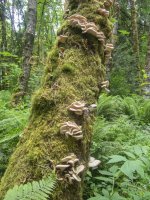
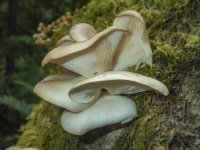
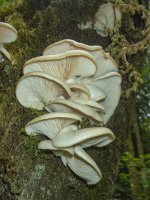
I sliced off a few clusters and sautéed them as a side for last night's dinner of butter-basted NY strip steak, baked potato, and steamed corn - very summery.
Steve
I sliced off a few clusters and sautéed them as a side for last night's dinner of butter-basted NY strip steak, baked potato, and steamed corn - very summery.
Steve

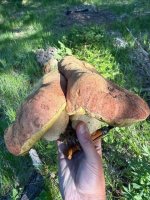
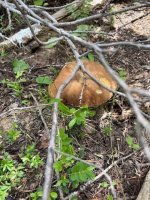
Good for you! Nothing better than fresh Morels sautéed in butter.Any mushroomers out there? Seems like the morels are fading quick this year, Got 2 bonus boletus
Loved it in northeast Oregon where I could go out and cut a couple pounds of morels for our dinner. So nice. Nothing better. Not a mushroom identifying guy but I do know morels.

JimTravers¤£a!!Travers
Life of the Party
The 18th time I turned my brain to mush I figured ahh what the hell

Salmon123
Steelhead
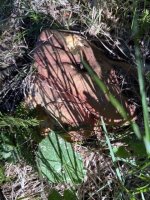
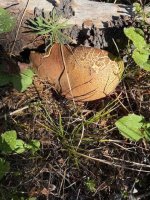
Went up high scouting for morels since we got a little rain up high last weekend, struck out on morels but found some boletus
Attachments
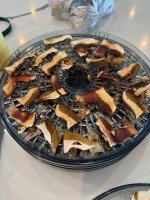
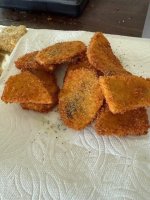
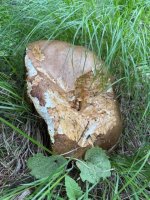
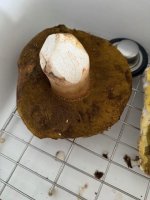
As a naturalist with wide-interests, I keep a keen eye out for anything out of the ordinary. [For. example, yesterday as I was walking back from my mailbox I caught the last act of a gruesome predator-prey drama. An adult female wasp dragged a large paralyzed spider into a burrow that she had dug in the dirt at the edge of my lawn (too fast for pictures, unfortunately). The wasp also likely laid an egg on the spider or in the burrow. The larval wasp will eat the living spider, saving the spider’s vital organs for last. The larva will then pupate and emerge as a flying, reproductive adult. This is a “parasitoid” life cycle – think Alien.]
And this story of a slime mold, actually a mushroom-relative to be more precise is equally interesting. Mushrooms are the nearest evolutionary cousins to slime molds. After a recent rain, I noticed several red-orange “BBs” on the surface of a decaying log.
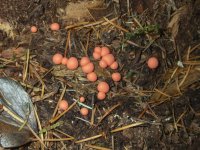
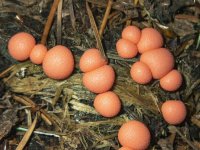
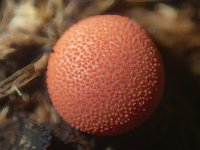
Superficially, the “BBs” looked like small puffballs. They are the fruiting bodies of the Wolf’s milk slime mold, Lycogala epidendrum (non-edible). This is a plasmodial slime mold. For most of its life, it exists as a large multinucleate amoeba (a plasmodium) that feed on microorganisms within the rotting log. In the related species Physarum polycephalum, all the diploid nuclei within the plasmodial mass duplicate and divide synchronously (but without dividing the cytoplasm = no cytokinesis) as the plasmodium grows. But when food becomes scarce, individual amoeba fuse to form a multicellular slug. This slug crawls onto the surface to produce a fruiting body, the red-orange “BBs” that I noticed. Some diploid amoeba will develop under meiosis into gray haploid microscopic spores as the fruiting body dries out. The haploid spores are carried on the wind to colonize new sites. If a haploid amoeba encounters another amoeba of a compatible mating type (not two sexes…), the two cells fuse their cytoplasm and nuclei to become a diploid zygote and develop into another multinucleate plasmodium.
Steve
And this story of a slime mold, actually a mushroom-relative to be more precise is equally interesting. Mushrooms are the nearest evolutionary cousins to slime molds. After a recent rain, I noticed several red-orange “BBs” on the surface of a decaying log.
Superficially, the “BBs” looked like small puffballs. They are the fruiting bodies of the Wolf’s milk slime mold, Lycogala epidendrum (non-edible). This is a plasmodial slime mold. For most of its life, it exists as a large multinucleate amoeba (a plasmodium) that feed on microorganisms within the rotting log. In the related species Physarum polycephalum, all the diploid nuclei within the plasmodial mass duplicate and divide synchronously (but without dividing the cytoplasm = no cytokinesis) as the plasmodium grows. But when food becomes scarce, individual amoeba fuse to form a multicellular slug. This slug crawls onto the surface to produce a fruiting body, the red-orange “BBs” that I noticed. Some diploid amoeba will develop under meiosis into gray haploid microscopic spores as the fruiting body dries out. The haploid spores are carried on the wind to colonize new sites. If a haploid amoeba encounters another amoeba of a compatible mating type (not two sexes…), the two cells fuse their cytoplasm and nuclei to become a diploid zygote and develop into another multinucleate plasmodium.
Steve

Thanks, Cabezon, for reminding me why I got degrees in geology.
McLane Creek Natural Area. Early November 2025. Cryptic biology.
If there is any group that thrives in the fall, it is fungi (and “fungi-adjacent” organisms). We will start with the more traditional mushrooms and branch out into some of more unusual forms/species. [Note: some identifications are tentative as I did not harvest the mushrooms to perform things like spore-prints that are often necessary for accurate identification.]
We encountered clusters of sulfur tuft mushrooms.
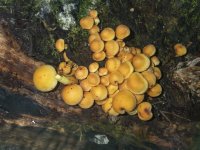
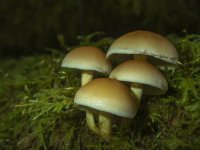
This species prefers to grow on the trunks of dead deciduous trees. It is bitter tasting and poisonous. It can be used as a dye, producing a light lemony-yellow color.
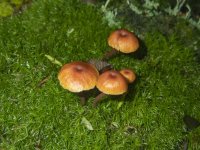
Another distinctive mushroom is the orange moss navel mushroom. The common name is quite descriptive. The cap is orange with a central depression (the navel). This species prefers to grow amidst clumps of moss; it has been proposed that the mushroom has a symbiotic relationship with the moss, though the details are not well understood.
On several dead alders, pockets of crimped gill mushrooms have emerged.
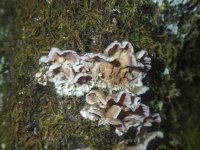
This species is not toxic, but it is reported to be quite bitter.
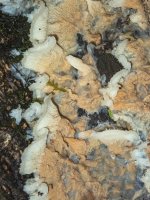
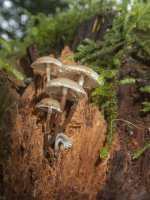
I don’t know what these two are, but the pictures came out well. [Any assistance appreciated.]
The next two are atypical fungi, and very cool. A highlight of a recent walk was encountering several large patches of jelly finger fungus (Calocera cornea) on decaying tree trunks, especially hardwoods like alders.
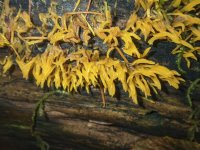
These yellow fingers have a jelly-like texture. These are the basidiocarps, the fruiting bodies of the underground mycelium (the microscopic network that digests the wood). Structures in the basidiocarps form spores that are released from the surface.
Another treat was encountering several clumps of candlesnuff fungus (Xylaria hypoxylon) growing out of downed hardwoods. These are finger-shaped fungi, often with forked tips. The base is black and the tip is light gray.
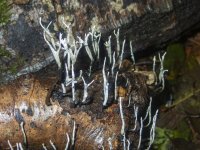
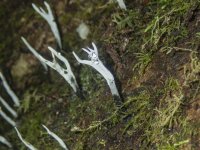
The common name is derived from their similarity to a black candle with a snuffed-out wick. These structures are the ascocarps (again, fruiting bodies that produce spores). They maybe bioluminescent, but not dramatically so.
On several downed logs, I noted several yellow or pink slimes on the surface, Physarum polycephalum, an acellular slime mold. A common name for this organism is “the blob”. Formerly included within the fungi, they are now included with the amoeboid protists, a catch-all term for single-celled eukaryotes. For part of their life cycle, they exist as amoeba with a single haploid nucleus. But the amoeba can fuse to become a multinucleated plasmodium, a mass of cytoplasm and diploid nuclei that moves like a massive single-celled amoeba.
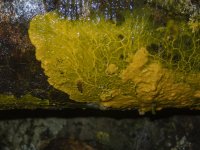
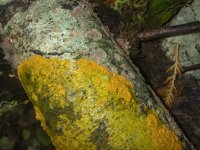
Both the amoebae and plasmodia consume bacteria that are digesting the wood. Under the right conditions (drought or starvation, perhaps just seasonally), the plasmodium streams onto the surface and form spore-producing structures.
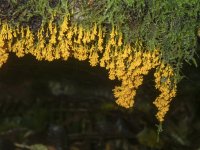
They transition from a yellow color to a pink color as they mature.
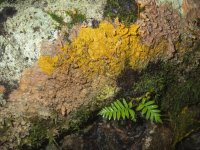
When the spores are released and germinated they will become individual amoeba cells.
I was first introduced to this cool species as a graduate student at U.C.S.B. I was a teaching assistant for several years in an introductory biology course that focused on the diversity of life. One of the three professors (yes, three professors in a single quarter) was a mycologist and used Physarum as a model organism. In the plasmodium form, all the thousands of nuclei divide simultaneously, but stay within the same cytoplasm. This process is synchronized by chemical signals that are distributed by cytoplasmic streaming. Cytoplasmic streaming is a process by which the physical state of the cytoplasm shifts between a gel and a fluid and drives the movement of organelles, nutrients, waste materials, and gases through the plasmodium.
Lichens may be one of the most extreme examples of symbiosis, two different types of organisms that live cooperatively. One partner is photosynthetic, either a green alga or a blue-green algae. Another partner is a filament-forming fungus. In some cases, a third partner may be a nitrogen-fixing cyanobacterium, a yeast (a single-celled fungus) or a bacterium. Each has a specific role in supporting the lichen as a whole. The collective may form one of several growth forms, such as an adherent crust, a small leaf-like scales (squamulose), leaf-like lobes (foliose) or fine filaments.
Continuing with evocative common names, a common crustose lichen at McLane Creek is called the fairy barf lichen (aka “fairy puke lichen” or “candy lichen”). For most of the year, it exists as a mint-green crust painted on tree trunks. What caught my attention were the white globes (apothecia) on their surface.
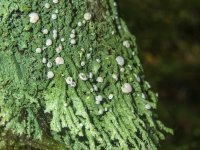
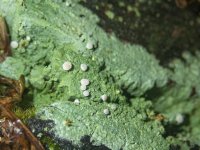
These structures produce reproductive spores.
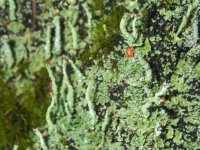
A favorite lichen type is the Cladonia lichens. These typically have small, leaf-like vegetative scales (the thalus). Their reproductive structures (podetium) may form trumpet-shaped cups or fingers, sometimes with red caps (apothecia = fruiting bodies).
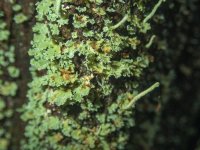
An example of a foliose lichen is the frog-pelt lichen. This lichen is found on dead trees, mossy rocks, or even on the ground. The body (thallus) is rubbery with lobes an inch or two long.
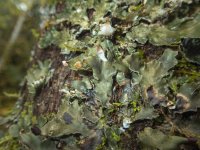
This lichen includes a nitrogen-fixing symbiotic cyanobacterium. Nitrogen is a critical element in many biological molecules, such as DNA and proteins. It is also quite abundant; 78% of the molecules in the atmosphere are N2, nitrogen gas. But there are very few organisms that can use this form of nitrogen. Nitrogen-fixing bacteria convert N2 into forms that other species can use, such as ammonia, nitrate, and nitrite’. These biochemical reactions, occurring in the absence of oxygen, supply available nitrogen to the bacteria’s partners and when the lichen dies, this fixed nitrogen is available to other organism as the lichen decomposes.
Steve
If there is any group that thrives in the fall, it is fungi (and “fungi-adjacent” organisms). We will start with the more traditional mushrooms and branch out into some of more unusual forms/species. [Note: some identifications are tentative as I did not harvest the mushrooms to perform things like spore-prints that are often necessary for accurate identification.]
We encountered clusters of sulfur tuft mushrooms.
This species prefers to grow on the trunks of dead deciduous trees. It is bitter tasting and poisonous. It can be used as a dye, producing a light lemony-yellow color.
Another distinctive mushroom is the orange moss navel mushroom. The common name is quite descriptive. The cap is orange with a central depression (the navel). This species prefers to grow amidst clumps of moss; it has been proposed that the mushroom has a symbiotic relationship with the moss, though the details are not well understood.
On several dead alders, pockets of crimped gill mushrooms have emerged.
This species is not toxic, but it is reported to be quite bitter.
I don’t know what these two are, but the pictures came out well. [Any assistance appreciated.]
The next two are atypical fungi, and very cool. A highlight of a recent walk was encountering several large patches of jelly finger fungus (Calocera cornea) on decaying tree trunks, especially hardwoods like alders.
These yellow fingers have a jelly-like texture. These are the basidiocarps, the fruiting bodies of the underground mycelium (the microscopic network that digests the wood). Structures in the basidiocarps form spores that are released from the surface.
Another treat was encountering several clumps of candlesnuff fungus (Xylaria hypoxylon) growing out of downed hardwoods. These are finger-shaped fungi, often with forked tips. The base is black and the tip is light gray.
The common name is derived from their similarity to a black candle with a snuffed-out wick. These structures are the ascocarps (again, fruiting bodies that produce spores). They maybe bioluminescent, but not dramatically so.
On several downed logs, I noted several yellow or pink slimes on the surface, Physarum polycephalum, an acellular slime mold. A common name for this organism is “the blob”. Formerly included within the fungi, they are now included with the amoeboid protists, a catch-all term for single-celled eukaryotes. For part of their life cycle, they exist as amoeba with a single haploid nucleus. But the amoeba can fuse to become a multinucleated plasmodium, a mass of cytoplasm and diploid nuclei that moves like a massive single-celled amoeba.
Both the amoebae and plasmodia consume bacteria that are digesting the wood. Under the right conditions (drought or starvation, perhaps just seasonally), the plasmodium streams onto the surface and form spore-producing structures.
They transition from a yellow color to a pink color as they mature.
When the spores are released and germinated they will become individual amoeba cells.
I was first introduced to this cool species as a graduate student at U.C.S.B. I was a teaching assistant for several years in an introductory biology course that focused on the diversity of life. One of the three professors (yes, three professors in a single quarter) was a mycologist and used Physarum as a model organism. In the plasmodium form, all the thousands of nuclei divide simultaneously, but stay within the same cytoplasm. This process is synchronized by chemical signals that are distributed by cytoplasmic streaming. Cytoplasmic streaming is a process by which the physical state of the cytoplasm shifts between a gel and a fluid and drives the movement of organelles, nutrients, waste materials, and gases through the plasmodium.
Lichens may be one of the most extreme examples of symbiosis, two different types of organisms that live cooperatively. One partner is photosynthetic, either a green alga or a blue-green algae. Another partner is a filament-forming fungus. In some cases, a third partner may be a nitrogen-fixing cyanobacterium, a yeast (a single-celled fungus) or a bacterium. Each has a specific role in supporting the lichen as a whole. The collective may form one of several growth forms, such as an adherent crust, a small leaf-like scales (squamulose), leaf-like lobes (foliose) or fine filaments.
Continuing with evocative common names, a common crustose lichen at McLane Creek is called the fairy barf lichen (aka “fairy puke lichen” or “candy lichen”). For most of the year, it exists as a mint-green crust painted on tree trunks. What caught my attention were the white globes (apothecia) on their surface.
These structures produce reproductive spores.
A favorite lichen type is the Cladonia lichens. These typically have small, leaf-like vegetative scales (the thalus). Their reproductive structures (podetium) may form trumpet-shaped cups or fingers, sometimes with red caps (apothecia = fruiting bodies).
An example of a foliose lichen is the frog-pelt lichen. This lichen is found on dead trees, mossy rocks, or even on the ground. The body (thallus) is rubbery with lobes an inch or two long.
This lichen includes a nitrogen-fixing symbiotic cyanobacterium. Nitrogen is a critical element in many biological molecules, such as DNA and proteins. It is also quite abundant; 78% of the molecules in the atmosphere are N2, nitrogen gas. But there are very few organisms that can use this form of nitrogen. Nitrogen-fixing bacteria convert N2 into forms that other species can use, such as ammonia, nitrate, and nitrite’. These biochemical reactions, occurring in the absence of oxygen, supply available nitrogen to the bacteria’s partners and when the lichen dies, this fixed nitrogen is available to other organism as the lichen decomposes.
Steve
Attachments
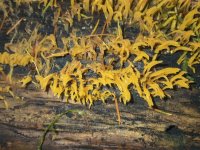
San Juan Island, Xmas 2025. Unusual fungi, lichens, and mosses. My wife and I hiked down the trail to Jakle’s Lagoon in the American Camp section of San Juan Island Historical Park. It is a great walk through a Douglas fir / cedar forest to this brackish-water lagoon. With high tide and winds from the east, salt water from Griffin Bay was pouring into the lagoon.
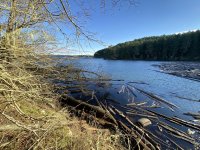
Under storm conditions, massive logs are driven into the lagoon and become trapped there.
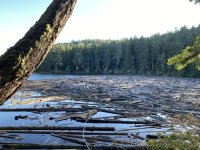
The lagoon is a great breeding area for three-spiked sticklebacks which feed on the abundant calanoid copepods that populate the lake.
On a hike like this, I act like an overactive springer spaniel. My eyes are scanning continuously for anything atypical along the trail and my ear are fine-tuned on any bird sounds in the area (but I don’t have much of a nose…). Most of what we heard were elusive winter wrens who weren’t very cooperative. As you would expect during such a wet time of year, we encountered several species of classic mushrooms along the trail. From a distance, one clump superficially appeared to be simply mushrooms emerging from mosses, but the overall shape of the mushrooms was not quite right - not really symmetrical.
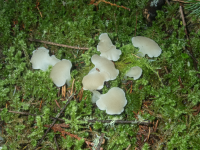
Upon closer examination, it was clear that these were not mushrooms. They lacked the typical narrow stem, bell-like cap, and gills underneath. Instead, these were very jelly-like and had soft “teeth” underneath the fruit bodies.
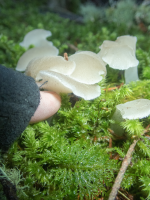
In fact, these were cat’s tongue fungus, Pseudohydnum gelatinosum (aka toothed jelly fungus), a first for me. Each fruiting body was over an inch long.
The cat’s tongue fungus is related to the more common witches’ butter (also known as yellow brain), another jelly fungus. These look like golden globs of jello emerging from a rotten log.
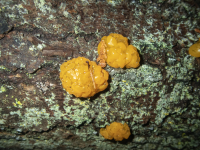
Jelly fungi are not known to be poisonous, but neither they are known for their culinary qualities either.
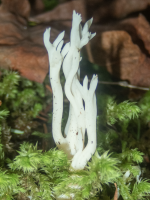
On a hike at the English Camp section of San Juan Island Historical Park, we encountered a clump of another unusual fungus, white coral fungus.
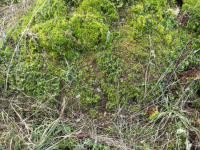
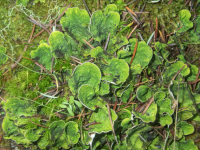
Lichens are fungus-adjacent, a symbiosis of a photosynthetic blue-green or green alga, a network-forming fungus, and often a yeast and/or nitrogen-fixing bacteria. During a walk in the Zylstra Lake, we encountered a patch of freckle-pelt lichen. These form leaf-like bodies on the ground. The dark spots contain the nitrogen-fixing symbionts.
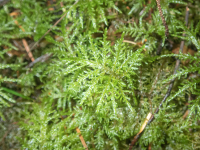
Finally, the stairstep moss (aka glittering wood moss) is common on San Juan under the forest canopy. This is an unusual moss because the next growth season’s feathery-frond emerges from the frond from the previous year. This potentially allows the moss plant to be aged by counting the connected fronds.
Steve
Under storm conditions, massive logs are driven into the lagoon and become trapped there.
The lagoon is a great breeding area for three-spiked sticklebacks which feed on the abundant calanoid copepods that populate the lake.
On a hike like this, I act like an overactive springer spaniel. My eyes are scanning continuously for anything atypical along the trail and my ear are fine-tuned on any bird sounds in the area (but I don’t have much of a nose…). Most of what we heard were elusive winter wrens who weren’t very cooperative. As you would expect during such a wet time of year, we encountered several species of classic mushrooms along the trail. From a distance, one clump superficially appeared to be simply mushrooms emerging from mosses, but the overall shape of the mushrooms was not quite right - not really symmetrical.
Upon closer examination, it was clear that these were not mushrooms. They lacked the typical narrow stem, bell-like cap, and gills underneath. Instead, these were very jelly-like and had soft “teeth” underneath the fruit bodies.
In fact, these were cat’s tongue fungus, Pseudohydnum gelatinosum (aka toothed jelly fungus), a first for me. Each fruiting body was over an inch long.
The cat’s tongue fungus is related to the more common witches’ butter (also known as yellow brain), another jelly fungus. These look like golden globs of jello emerging from a rotten log.
Jelly fungi are not known to be poisonous, but neither they are known for their culinary qualities either.
On a hike at the English Camp section of San Juan Island Historical Park, we encountered a clump of another unusual fungus, white coral fungus.
Lichens are fungus-adjacent, a symbiosis of a photosynthetic blue-green or green alga, a network-forming fungus, and often a yeast and/or nitrogen-fixing bacteria. During a walk in the Zylstra Lake, we encountered a patch of freckle-pelt lichen. These form leaf-like bodies on the ground. The dark spots contain the nitrogen-fixing symbionts.
Finally, the stairstep moss (aka glittering wood moss) is common on San Juan under the forest canopy. This is an unusual moss because the next growth season’s feathery-frond emerges from the frond from the previous year. This potentially allows the moss plant to be aged by counting the connected fronds.
Steve

Cool report Steve! Some people candy the jelly tooth and make a sugared gummy-like treat with them. I haven’t tried it and probably never will but I sure like finding them. They’re fun to look at and touchSan Juan Island, Xmas 2025. Unusual fungi, lichens, and mosses. My wife and I hiked down the trail to Jakle’s Lagoon in the American Camp section of San Juan Island Historical Park. It is a great walk through a Douglas fir / cedar forest to this brackish-water lagoon. With high tide and winds from the east, salt water from Griffin Bay was pouring into the lagoon.
View attachment 175981
Under storm conditions, massive logs are driven into the lagoon and become trapped there.
View attachment 175982
The lagoon is a great breeding area for three-spiked sticklebacks which feed on the abundant calanoid copepods that populate the lake.
On a hike like this, I act like an overactive springer spaniel. My eyes are scanning continuously for anything atypical along the trail and my ear are fine-tuned on any bird sounds in the area (but I don’t have much of a nose…). Most of what we heard were elusive winter wrens who weren’t very cooperative. As you would expect during such a wet time of year, we encountered several species of classic mushrooms along the trail. From a distance, one clump superficially appeared to be simply mushrooms emerging from mosses, but the overall shape of the mushrooms was not quite right - not really symmetrical.
View attachment 175983
Upon closer examination, it was clear that these were not mushrooms. They lacked the typical narrow stem, bell-like cap, and gills underneath. Instead, these were very jelly-like and had soft “teeth” underneath the fruit bodies.
View attachment 175984
In fact, these were cat’s tongue fungus, Pseudohydnum gelatinosum (aka toothed jelly fungus), a first for me. Each fruiting body was over an inch long.
The cat’s tongue fungus is related to the more common witches’ butter (also known as yellow brain), another jelly fungus. These look like golden globs of jello emerging from a rotten log.
View attachment 175985
Jelly fungi are not known to be poisonous, but neither they are known for their culinary qualities either.
On a hike at the English Camp section of San Juan Island Historical Park, we encountered a clump of another unusual fungus, white coral fungus.
View attachment 175986
Lichens are fungus-adjacent, a symbiosis of a photosynthetic blue-green or green alga, a network-forming fungus, and often a yeast and/or nitrogen-fixing bacteria. During a walk in the Zylstra Lake, we encountered a patch of freckle-pelt lichen. These form leaf-like bodies on the ground. The dark spots contain the nitrogen-fixing symbionts.
View attachment 175987
View attachment 175988
Finally, the stairstep moss (aka glittering wood moss) is common on San Juan under the forest canopy. This is an unusual moss because the next growth season’s feathery-frond emerges from the frond from the previous year. This potentially allows the moss plant to be aged by counting the connected fronds.
View attachment 175989
Steve


Coach Potter
Legend
Steve, if you and I were to hike together we wouldn’t make it very far! I too am fascinated by all the same stuff. The major difference between you and I is that I have absolutely no idea what any of it is .
.
My wife gifted me a macro les for my camera so I can finally take good photos of the stuff I find. I love your pictures and explanations behind what you’re showing us.
Thanks!
. My wife gifted me a macro les for my camera so I can finally take good photos of the stuff I find. I love your pictures and explanations behind what you’re showing us.
Thanks!
When I was in gradual school at U.C.S.B., several friends / roommates / biology graduate students and I decided to hike to a local waterfall in a county park to celebrate a birthday. On a gorgeous spring day, it took us over two hours to hike a mile from the parking lot to the waterfall where we shared a birthday cake. Among the group, we had experts on plants, insects, herps, fungi, and birds. Everything was popping off in the spring. It was such a blast (except for the poison oak).Steve, if you and I were to hike together we wouldn’t make it very far! I too am fascinated by all the same stuff. The major difference between you and I is that I have absolutely no idea what any of it is
My wife gifted me a macro les for my camera so I can finally take good photos of the stuff I find. I love your pictures and explanations behind what you’re showing us.
Thanks!
Steve
Coach Potter
Legend
That sounds like a good time!When I was in gradual school at U.C.S.B., several friends / roommates / biology graduate students and I decided to hike to a local waterfall in a county park to celebrate a birthday. On a gorgeous spring day, it took us over two hours to hike a mile from the parking lot to the waterfall where we shared a birthday cake. Among the group, we had experts on plants, insects, herps, fungi, and birds. Everything was popping off in the spring. It was such a blast (except for the poison oak).
Steve
Cabezon - love your pictures and the facts that you pass along to the rest of us. It actually makes my brain hurt!
Keep it up. Looking forward to the next lesson!
Keep it up. Looking forward to the next lesson!
There will be reports at the end of January / early February that will be EPIC... The White Continent...Cabezon - love your pictures and the facts that you pass along to the rest of us. It actually makes my brain hurt!
Keep it up. Looking forward to the next lesson!
Steve

On a side note, if bacteria, fungi and algae showed up at a party, could you guess that they might take a Lichen to each otherThere will be reports at the end of January / early February that will be EPIC... The White Continent...
Steve
JimTravers¤£a!!Travers
Life of the Party
Way ha woah. The fourth time I turned my brain the MUSH in 2021 I walked into a tree. I walked in to the tree because I had turned my brain to MUSH.
These days you're seeing more and more guys turning to MUSH.
These days you're seeing more and more guys turning to MUSH.