

“Icewater” Lake, 6 May 2025. After abandoning a previous visit to this lake due to high winds from the northeast, a friend and I were determined to make our first visit of the year to “Icewater” Lake. The forecast for this day favorable: sunny skies and winds under 10mph. But I began to have some concerns about the forecast’s accuracy when our view of the mountain itself was obscured as we drove around a corner and it came into view.
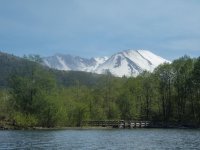
The winds were kicking up dust from the pumice plain. When we reached the launch at the lake, gusty winds from the northeast were again blowing down the lake.
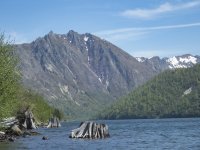
Shit… Fortunately, there were fewer whitecaps than the previous week and we decided to give it a try anyway. The one silver lining of a northeast east wind is that the wind would blow us in our pontoon boats back toward the launch if we decided to shorten our trip.
I rigged three rods as I typically do for fishing “Icewater” Lake. On a Sage 5 wt. rod with a full sinking line, I tied two streamers, a seal brown leach and a brown bead-head crystal bugger (later replaced by a green damsel nymph pattern).
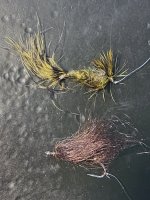
On a Reddington 4 wt. rod with a floating line, I tied on three chironomids: a bead-head silver-ribbed black chironomid on a size 14 hook, a bead-head red-ribbed black chironomid on a size 14 hook, and a red flashabou-ribbed black chironomid on a size 16 hook.
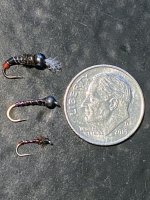
On another 4 wt. Reddington rod with a floating line, I tied on a double Dutch bug with a peacock dubbing underbody as a dry fly. This fly is a version of a foam hopper fly. It has an underbody of peacock dubbing topped by white and black foam, a moose hair wing, a florescent orange overwing for added visibility, and black and white striped legs.
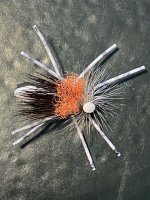
It has a very buggy appearance and is a perfect generic surface attractor for an oligotrophic lake like this one where the trout are very focused on terrestrial insect opportunities.
The winds were quite gusty as I finned my way from the launch toward the island. I was beginning to have second thoughts about our decision to head out. At times, I was finning as hard as I could, but I could barely make any forward progress against the gusts. Finally, I made it to the shallows between the island and the shore. My friend was already there anchored up in the lee of the island and was fishing chironomids under a float.
My plan was to join him anchored up and to start fishing chironomids. I hadn’t had a single hit while trolling my streamers the whole way out. But as I was bringing in the streamers to switch to my chironomid rod, a 10” rainbow attacked the point fly not more than 20 feet from my pontoon boat. The fish in this lake are known for being a) acrobatic and b) strong. But I soon slipped it into the net, took a few pictures, and set it on its way.
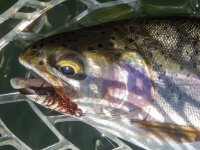
Based on this minor success, I decided to keep trolling these streamers for a bit longer. I normally troll/fin my way across to the southeast shore across the deepest part of the sunken valley to fish the edge of a wide shallow flat. But today that side was totally exposed to the wind and waves. Instead, I continued to troll my streamers into the protected bay between the island and the southwest shore. And I kept picking up fish regularly.
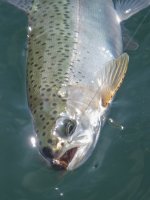
Often, I would feel the strike, set the hook, and instantly have the fish jump out of the water at the end of my full sinking fly line. With the wind gusts dropping, I risked continuing around the corner of the bay into the main basin. My aim was to position my troll path just offshore of what I could see as the bottom in the clear water. And it worked well. Every few minutes, I had another strike. Most fish weren’t huge, in the 9-12” range, but a few pushed 13” and most were quite frisky.
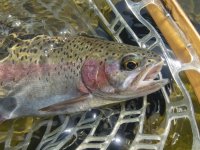
Most were rainbows, but this next fish appears to be a cuttbow trout. It had a light red slash under its throat and a long mandible, a bright red gill cover and wide lateral stripe, and limited spotting.
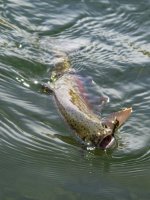
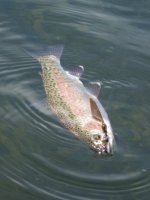
As morning transitioned to early afternoon, I decided that it was time to reverse direction and to change tactics. With the wind gusts subsiding, I could see a light midge hatch happening and the swirls of the occasional small fish rising in the shallows. So, I pulled out my dry fly rod and cast out the double-Dutch bug that I had purchased for last year’s Patagonia trip. It didn’t take long for a rainbow to rocket up off the bottom to smack the fly. Game on.
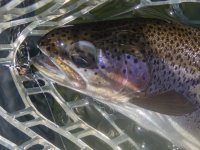
Conveniently, the occasional wind gusts pushed my pontoon boat back along the shore toward the launch in the distance. Every few casts, a trout would grab the fly off the surface.
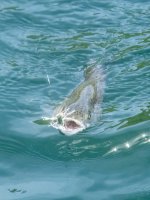
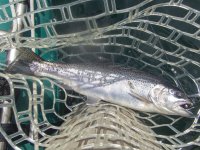
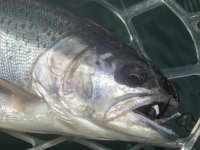
A few times, either the fish wasn’t hooked on the take or I was distracted and missed the strike. But my reflexes were on today and I didn’t miss many.
The largest fish, a 13” cuttbow (I think…), displayed a trick that I have seen here before from experienced fish.
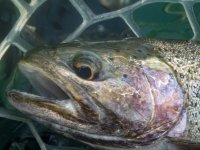
It first nosed the fly as if to drown it, and then it struck.
And one fish was a clear cutthroat.
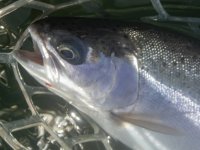
All in all, a very pleasant, very successful day. I will be back.
Steve
The winds were kicking up dust from the pumice plain. When we reached the launch at the lake, gusty winds from the northeast were again blowing down the lake.
Shit… Fortunately, there were fewer whitecaps than the previous week and we decided to give it a try anyway. The one silver lining of a northeast east wind is that the wind would blow us in our pontoon boats back toward the launch if we decided to shorten our trip.
I rigged three rods as I typically do for fishing “Icewater” Lake. On a Sage 5 wt. rod with a full sinking line, I tied two streamers, a seal brown leach and a brown bead-head crystal bugger (later replaced by a green damsel nymph pattern).
On a Reddington 4 wt. rod with a floating line, I tied on three chironomids: a bead-head silver-ribbed black chironomid on a size 14 hook, a bead-head red-ribbed black chironomid on a size 14 hook, and a red flashabou-ribbed black chironomid on a size 16 hook.
On another 4 wt. Reddington rod with a floating line, I tied on a double Dutch bug with a peacock dubbing underbody as a dry fly. This fly is a version of a foam hopper fly. It has an underbody of peacock dubbing topped by white and black foam, a moose hair wing, a florescent orange overwing for added visibility, and black and white striped legs.
It has a very buggy appearance and is a perfect generic surface attractor for an oligotrophic lake like this one where the trout are very focused on terrestrial insect opportunities.
The winds were quite gusty as I finned my way from the launch toward the island. I was beginning to have second thoughts about our decision to head out. At times, I was finning as hard as I could, but I could barely make any forward progress against the gusts. Finally, I made it to the shallows between the island and the shore. My friend was already there anchored up in the lee of the island and was fishing chironomids under a float.
My plan was to join him anchored up and to start fishing chironomids. I hadn’t had a single hit while trolling my streamers the whole way out. But as I was bringing in the streamers to switch to my chironomid rod, a 10” rainbow attacked the point fly not more than 20 feet from my pontoon boat. The fish in this lake are known for being a) acrobatic and b) strong. But I soon slipped it into the net, took a few pictures, and set it on its way.
Based on this minor success, I decided to keep trolling these streamers for a bit longer. I normally troll/fin my way across to the southeast shore across the deepest part of the sunken valley to fish the edge of a wide shallow flat. But today that side was totally exposed to the wind and waves. Instead, I continued to troll my streamers into the protected bay between the island and the southwest shore. And I kept picking up fish regularly.
Often, I would feel the strike, set the hook, and instantly have the fish jump out of the water at the end of my full sinking fly line. With the wind gusts dropping, I risked continuing around the corner of the bay into the main basin. My aim was to position my troll path just offshore of what I could see as the bottom in the clear water. And it worked well. Every few minutes, I had another strike. Most fish weren’t huge, in the 9-12” range, but a few pushed 13” and most were quite frisky.
Most were rainbows, but this next fish appears to be a cuttbow trout. It had a light red slash under its throat and a long mandible, a bright red gill cover and wide lateral stripe, and limited spotting.
As morning transitioned to early afternoon, I decided that it was time to reverse direction and to change tactics. With the wind gusts subsiding, I could see a light midge hatch happening and the swirls of the occasional small fish rising in the shallows. So, I pulled out my dry fly rod and cast out the double-Dutch bug that I had purchased for last year’s Patagonia trip. It didn’t take long for a rainbow to rocket up off the bottom to smack the fly. Game on.
Conveniently, the occasional wind gusts pushed my pontoon boat back along the shore toward the launch in the distance. Every few casts, a trout would grab the fly off the surface.
A few times, either the fish wasn’t hooked on the take or I was distracted and missed the strike. But my reflexes were on today and I didn’t miss many.
The largest fish, a 13” cuttbow (I think…), displayed a trick that I have seen here before from experienced fish.
It first nosed the fly as if to drown it, and then it struck.
And one fish was a clear cutthroat.
All in all, a very pleasant, very successful day. I will be back.
Steve

 .
.
 Thanks for sharing your time out on the water