

Navigation
Install the app
How to install the app on iOS
Follow along with the video below to see how to install our site as a web app on your home screen.
Note: This feature may not be available in some browsers.
More options
Style variation
You are using an out of date browser. It may not display this or other websites correctly.
You should upgrade or use an alternative browser.
You should upgrade or use an alternative browser.
Got any bird pics?
- Thread starter Wadin' Boot
- Start date

Steve, you are LEGEND!
Thanks much for sharing,
Kenneth
Thanks much for sharing,
Kenneth

Has me wishing ...All those neat birds?!? Reptiles? Wow..

Looks like someone's doing a "Big Year"!Arizona, late March 2025. Part 6 of Many: Mixed insectivores. We will start with the flycatchers (family Tyrannidae). We saw both large and small members of this family. Among the smaller flycatchers (size of a medium-size sparrow), we saw black phoebes at many sites, especially those sites with streams or ponds from which they could hawk emerging insects. The white breast of a black phoebe contrasts with the black plumage elsewhere.
View attachment 150085
We also encountered several Say’s phoebes. This species prefers drier locations than black phoebes.
Flamboyant vermillion flycatchers are common in Southern Arizona and we saw them at several sites. The males are very distinctive with a bright red crest, neck, and breast contrasting with a dark gray back, tail, and wings.
View attachment 150086
View attachment 150087
Per usual, a female is more subdued with a gray crest and mantle, white throat, and peach breast.
View attachment 150088
You will typically find them perched on an outside branch from which they can intercept passing insects. At Sweetwater Regional Park, we were fortunate to find a female on a nest.
View attachment 150089
We also saw two species of larger flycatchers: Cassin’s kingbird and Western kingbird. Each is larger than a sparrow but smaller than a robin. At Ron Morriss County Park, individuals of both species were hawking insects that were being blown off a freshwater march; we had a great opportunity to compare the two species. An adult Western kingbird has a light gray cap and mantle, a very light gray / white throat and breast, and a light yellow breast. They are also notable for the presence of white outer tail feathers.
View attachment 150090
Western kingbirds breed across the Western U.S. through the western Canadian provinces. Cassin’s kingbirds are similar to Western kingbirds. Their head, mantle, and throat are much darker gray than a Western kingbird and contrast with their white throat. The yellow on the breast is more intense.
View attachment 150091
View attachment 150092
Cassin’s kingbird prefers drier habitats than a Western kingbird; this species ranges from Mexico into the Southwest U.S.
In more forested areas, we encountered a diverse collection of smaller insectivorous birds. These included white-breasted nuthatches,
View attachment 150093
View attachment 150094
bridled titmice (a favorite of my wife),
View attachment 150095
View attachment 150096
bushtits,
View attachment 150097
and ruby-crowned kinglets.
View attachment 150098
In more open areas dominated by shrubs, we encountered cute verdins,
View attachment 150099
View attachment 150101
cactus wrens,
View attachment 150102
View attachment 150103
blue-gray gnatcatchers,
View attachment 150104
and several swallows, like this rough-winged swallow.
View attachment 150105
Steve


Arizona, late March 2025. Part 7 of Many: Woodpeckers. You might not expect to find many woodpeckers and woodpecker species in such a dry, relatively-treeless environment. But there the woodpecker fauna is rich due to the convergence of east and west and Mexican/Central American species.
Acorn woodpeckers are quite distinctive in many ways. Their plumage has elements of a clown’s make-up with white, black, and red patches on its head.
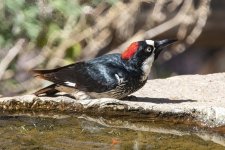
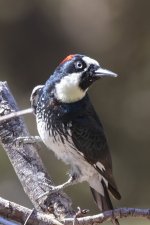
They live in groups of up to fifteen individuals. These groups consisting a pair or more of breeding adults and their nonbreeding offspring. As their name implies, they are heavily dependent on acorns, supplemented with insects, sap, and fruit. Behaviorally, they are also known for caching acorns in small holes in a tree within their territory (a “granary tree”). Their call was supposed to be used as a model of the cartoon character Woody Woodpecker. This species ranges along the West Coast from California through Oregon and from the mountains of Southern Arizona through the Sierra Madre of Mexico into Central America and into northern South America.
We encountered pairs of ladder-backed woodpeckers at many locations. The “ladder-back” of the name refers to the alternating white and black stripes along its back, like the rungs of a ladder. Like many woodpeckers, the males have a red crown on his head with white and black stripes on its cheek.
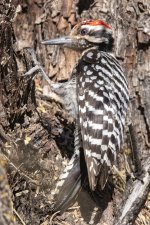
Females are similar but without the red crown.
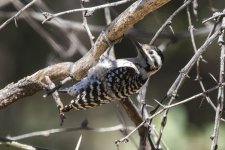
This species ranges from Texas and the desert Southwest through Mexico and into parts of Central America.
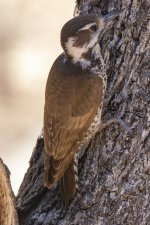
While most woodpecker species have plumages that are dominated by black and white patterns, in Arizona woodpeckers, the black is replaced by brown. Like other woodpeckers, the males have a flash of red on their heads.
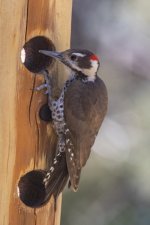
Females are similar but lack the red crown.
Probably the most common woodpecker that we encountered was the gila woodpecker. They are real habitat generalists and VERY vocal. Gila woodpeckers have a similar alternating white and black stripes down their back. The head, neck, and breast are tan. Males also have a red crest.
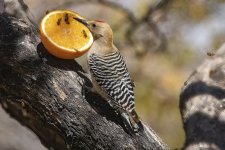
Females lack the red crest.
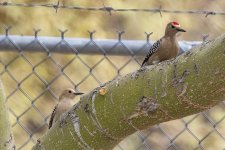
Gila woodpeckers range from Southern Arizona into Mexico. We heard/saw them in the saguaro deserts, riparian woodlands, mountain canyons, and urbanized areas. They are one of the few woodpeckers that nest in the desert. The birds excavate nesting cavities in saguaro cactus.
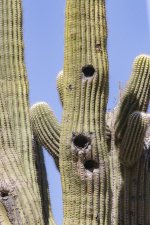
When a pair has moved to a new nesting site, their old cavities are used by other birds (e.g., owls, cactus wrens, and flycatchers) as nest sites.
Southern Arizona (and Northern Mexico) is an area of overlap for Northern flickers and gilded flickers. The status of these have fluctuated in recent years. When I was first starting to learn birds 45 years ago, there were three flicker species: the western “red-shafted” flicker, the eastern “yellow-shafted” flicker, and the southern-western / Mexican “gilded flickers”. Later, all three were combined into a single species, the Northern flicker. All three “forms” do hybridize. The hybrid zone between the “red-shafted” and “yellow-shafted” forms has been expanding and there are various levels of hybrids. That was the rationale for combining the two forms as a single species = lineage with a common evolutionary future, named the Northern flicker. Northern flickers and gilded flickers also form hybrids where their ranges overlap. But later research indicated that both forms are maintaining distinctive differences in their genetics; therefore, the gilded flicker was elevated to the species level.
Among the several woodpecker species that we saw at the San Pedro House east of Sierra Vista, we saw both a Northern flicker and a gilded flicker in the canopy of tall cottonwoods. These identifications were confirmed by Merlin from the birds’ vocalizations. I didn’t capture a picture of a Northern flicker, but I did catch one of a gilded flicker. A male gilded flicker has a tan crown, a gray face, a red mustache, a black oval bib, and spots on its belly. It also has yellow underwings which you can on the tail.
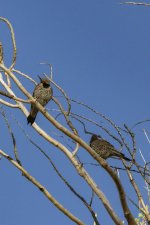
A northern red-shafted flicker would have a similar plumage. But it would have grayer cap (less tan) and its underwings would be red. A northern yellow-shafted flicker would have a grayer cap, a black mustache, and yellow underwings.
Another new species for us was the red-naped sapsucker. Like other sapsuckers, they drill a series of holes in a tree trunk. They then lap up the sap and harvest any insects attracted to the sweet sap. Like the flickers above, there are three forms that used to be lumped into the same species, the yellow-bellied sapsucker. But in 1983, they were separated out into the red-breasted sapsucker on the West Coast, the yellow-bellied sapsucker in the eastern half of the U.S., and the red-naped sapsucker in the Rockies. A male red-naped sapsucker has a vertical white patch on its wing, a red nape, chin, and throat without a black border (yellow-bellied has the border). A black stripe through the eye is bordered with white bars.
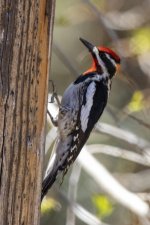
This species breeds in the Rockies and winters in Mexico. Some populations in Nevada, Utah, Arizona, and New Mexico are present year-round.
Steve
Acorn woodpeckers are quite distinctive in many ways. Their plumage has elements of a clown’s make-up with white, black, and red patches on its head.
They live in groups of up to fifteen individuals. These groups consisting a pair or more of breeding adults and their nonbreeding offspring. As their name implies, they are heavily dependent on acorns, supplemented with insects, sap, and fruit. Behaviorally, they are also known for caching acorns in small holes in a tree within their territory (a “granary tree”). Their call was supposed to be used as a model of the cartoon character Woody Woodpecker. This species ranges along the West Coast from California through Oregon and from the mountains of Southern Arizona through the Sierra Madre of Mexico into Central America and into northern South America.
We encountered pairs of ladder-backed woodpeckers at many locations. The “ladder-back” of the name refers to the alternating white and black stripes along its back, like the rungs of a ladder. Like many woodpeckers, the males have a red crown on his head with white and black stripes on its cheek.
Females are similar but without the red crown.
This species ranges from Texas and the desert Southwest through Mexico and into parts of Central America.
While most woodpecker species have plumages that are dominated by black and white patterns, in Arizona woodpeckers, the black is replaced by brown. Like other woodpeckers, the males have a flash of red on their heads.
Females are similar but lack the red crown.
Probably the most common woodpecker that we encountered was the gila woodpecker. They are real habitat generalists and VERY vocal. Gila woodpeckers have a similar alternating white and black stripes down their back. The head, neck, and breast are tan. Males also have a red crest.
Females lack the red crest.
Gila woodpeckers range from Southern Arizona into Mexico. We heard/saw them in the saguaro deserts, riparian woodlands, mountain canyons, and urbanized areas. They are one of the few woodpeckers that nest in the desert. The birds excavate nesting cavities in saguaro cactus.
When a pair has moved to a new nesting site, their old cavities are used by other birds (e.g., owls, cactus wrens, and flycatchers) as nest sites.
Southern Arizona (and Northern Mexico) is an area of overlap for Northern flickers and gilded flickers. The status of these have fluctuated in recent years. When I was first starting to learn birds 45 years ago, there were three flicker species: the western “red-shafted” flicker, the eastern “yellow-shafted” flicker, and the southern-western / Mexican “gilded flickers”. Later, all three were combined into a single species, the Northern flicker. All three “forms” do hybridize. The hybrid zone between the “red-shafted” and “yellow-shafted” forms has been expanding and there are various levels of hybrids. That was the rationale for combining the two forms as a single species = lineage with a common evolutionary future, named the Northern flicker. Northern flickers and gilded flickers also form hybrids where their ranges overlap. But later research indicated that both forms are maintaining distinctive differences in their genetics; therefore, the gilded flicker was elevated to the species level.
Among the several woodpecker species that we saw at the San Pedro House east of Sierra Vista, we saw both a Northern flicker and a gilded flicker in the canopy of tall cottonwoods. These identifications were confirmed by Merlin from the birds’ vocalizations. I didn’t capture a picture of a Northern flicker, but I did catch one of a gilded flicker. A male gilded flicker has a tan crown, a gray face, a red mustache, a black oval bib, and spots on its belly. It also has yellow underwings which you can on the tail.
A northern red-shafted flicker would have a similar plumage. But it would have grayer cap (less tan) and its underwings would be red. A northern yellow-shafted flicker would have a grayer cap, a black mustache, and yellow underwings.
Another new species for us was the red-naped sapsucker. Like other sapsuckers, they drill a series of holes in a tree trunk. They then lap up the sap and harvest any insects attracted to the sweet sap. Like the flickers above, there are three forms that used to be lumped into the same species, the yellow-bellied sapsucker. But in 1983, they were separated out into the red-breasted sapsucker on the West Coast, the yellow-bellied sapsucker in the eastern half of the U.S., and the red-naped sapsucker in the Rockies. A male red-naped sapsucker has a vertical white patch on its wing, a red nape, chin, and throat without a black border (yellow-bellied has the border). A black stripe through the eye is bordered with white bars.
This species breeds in the Rockies and winters in Mexico. Some populations in Nevada, Utah, Arizona, and New Mexico are present year-round.
Steve

Arizona, late March 2025. Part 8 of Many: Diverse larger birds. The family Icteridae includes many recognizable species. such as blackbirds, orioles, grackles, cowbirds, bobolinks, and meadowlarks. The raucous songs of male red-winged blackbirds ring across the marsh, a sure sign of spring. When they are singing, they will fluff up their red epaulets (shoulder patches) to show off.
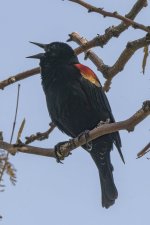
Red-winged blackbirds are polygynous, a single territorial male with many females. Apparently, females choose a nesting site in the marsh based on its resources. Therefore, more than one female (up to 15 females) may establish nests in the territory of male with a particularly productive territory. But not all the eggs/offspring that the females raise (and that a male defends from predators) are the offspring of the territorial male. Females may also mate with nearby males in addition to the territory holder.
Great-tailed grackles are blackbirds on steroids, all black with extra long tails.
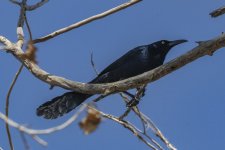
They were often in the same locations as red-winged blackbirds, but perhaps less water-dependent. Males can produce a wide range of sounds, including a very loud “rusty hinge” call or a high-pitched whistle.
We don’t see many orioles in Western Washington. So, it is always a delight to see them on our travels south. We saw three oriole species: Bullock’s oriole,
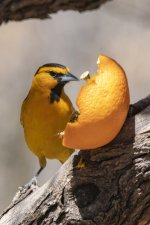
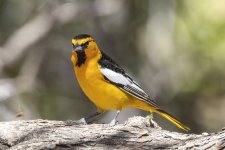 hooded oriole,
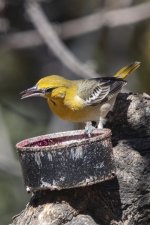
and Scott’s oriole.
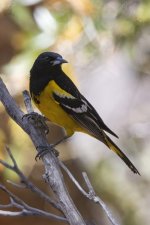
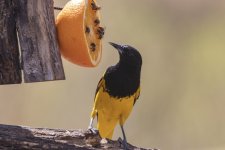
On our last full day, we spent the late morning and afternoon at Ash Canyon Bed and Breakfast, a well-known birding site ($10 "donation" per person). They have transformed the property into a bird sanctuary. There are a variety of bird feeders scattered around the property: hummingbird feeders, mixed seeds, peanut butter logs, jelly tins, and orange halves. The last two were a major draw for the sweet tooth of the orioles. The team at Ash Canyon has attached metal tins to branches and filled them with grape jelly which the orioles loved.
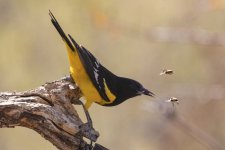
And they had also hammered nails into some branches to which they attached orange halves. Honeybees were also attracted to both. In one case, we watched a male oriole pick of a series honeybees from an orange that he wanted to eat.
Birds in the family Mimidae are well-known songsters and mimics. These include the Northern mockingbird, the gray catbird, and the thrashers. The diverse songs and calls of the Northern mockingbird fooled the Merlin bird I.D. app several times. Mockingbirds have a light gray back and head, a white throat and breast, and two white wing bars.
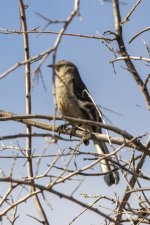
Northern mockingbirds are found throughout the U.S. (but not in coastal Washington, at least not yet), Mexico, and the Caribbean islands.
While Southern Arizona is home to several thrasher species, the only species that we encountered (but many times) was the curve-billed thrasher. A curve-billed thrasher is about the size of an American robin, with a long curved bill, a gray head, mantle, and back and a spotted belly. Their eyes are bright yellow.
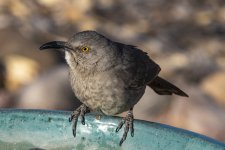
We encountered males singing multiple times.
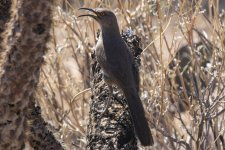 Thrashers forage in a similar fashion to thrushes and towhees, using that long curved bill to dig in the leaf litter for insects, fruits, and seeds, including the fruits of cacti. This is another species whose range extends north into Texas, New Mexico, and Arizona from its core in Mexico.
We saw both northern ravens and Chihuahuan ravens at several sites (no pictures of either this trip), both members of the family Corvidae along with jays and magpies. We encountered Mexican jays at several sites, including oak-pine canyons and feeding sites like Ash Canyon and the Santa Rita Lodge in Madera Canyon. Mexican jays most resemble scrub jays. Their heads and backs are blue with a hint of gray on their mantle; the throat and breast are white to light gray.
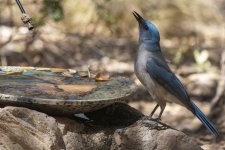
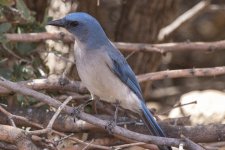
The mantle of a scrub jay is darker, scrub jays have white eyebrow stripes, and they have a blue breast band.
Mexican jays travel in multi-individual groups. While only the dominant pair actually breeds, other members of the group help raise and protect the young. This species prefers oak-pine-juniper woodlands where they feed in acorns, pine nuts, and insects.
Finally, one of the more unique birds that we encountered was the phainopepla. They are members of the small family Ptilogonatidae, the silky flycatchers of Central America and Mexico. Males are glossy black, with red eyes, and black crests.
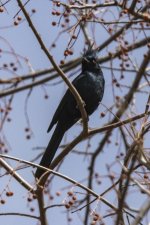
In flight, they reveal white wing patches. The females are similar but with dark gray plumage.
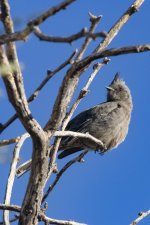
Phainopepla feed on fruits, especially of mistletoe, and insects that they hawk from perches or glean from vegetation. The mistletoe seeds survive the trip through the bird’s digestive tract and are excreted with a mucus-like material (viscin) that glues the seeds to the branches where the phainopepla defecates. The seeds then germinate and begin the process of parasitizing the tree / shrub to which it is attached.
Phainopepla are a species of the desert primarily, especially washes and canyons. We had seen this species in Anza Borrego and Joshua Tree, California the previous year. We saw several in the eastern section of Saguaro National Park and other sites. Their range extends into the desert Southwest and south into Mexico.
Steve
Red-winged blackbirds are polygynous, a single territorial male with many females. Apparently, females choose a nesting site in the marsh based on its resources. Therefore, more than one female (up to 15 females) may establish nests in the territory of male with a particularly productive territory. But not all the eggs/offspring that the females raise (and that a male defends from predators) are the offspring of the territorial male. Females may also mate with nearby males in addition to the territory holder.
Great-tailed grackles are blackbirds on steroids, all black with extra long tails.
They were often in the same locations as red-winged blackbirds, but perhaps less water-dependent. Males can produce a wide range of sounds, including a very loud “rusty hinge” call or a high-pitched whistle.
We don’t see many orioles in Western Washington. So, it is always a delight to see them on our travels south. We saw three oriole species: Bullock’s oriole,
hooded oriole,and Scott’s oriole.
On our last full day, we spent the late morning and afternoon at Ash Canyon Bed and Breakfast, a well-known birding site ($10 "donation" per person). They have transformed the property into a bird sanctuary. There are a variety of bird feeders scattered around the property: hummingbird feeders, mixed seeds, peanut butter logs, jelly tins, and orange halves. The last two were a major draw for the sweet tooth of the orioles. The team at Ash Canyon has attached metal tins to branches and filled them with grape jelly which the orioles loved.
And they had also hammered nails into some branches to which they attached orange halves. Honeybees were also attracted to both. In one case, we watched a male oriole pick of a series honeybees from an orange that he wanted to eat.
Birds in the family Mimidae are well-known songsters and mimics. These include the Northern mockingbird, the gray catbird, and the thrashers. The diverse songs and calls of the Northern mockingbird fooled the Merlin bird I.D. app several times. Mockingbirds have a light gray back and head, a white throat and breast, and two white wing bars.
Northern mockingbirds are found throughout the U.S. (but not in coastal Washington, at least not yet), Mexico, and the Caribbean islands.
While Southern Arizona is home to several thrasher species, the only species that we encountered (but many times) was the curve-billed thrasher. A curve-billed thrasher is about the size of an American robin, with a long curved bill, a gray head, mantle, and back and a spotted belly. Their eyes are bright yellow.
We encountered males singing multiple times.
Thrashers forage in a similar fashion to thrushes and towhees, using that long curved bill to dig in the leaf litter for insects, fruits, and seeds, including the fruits of cacti. This is another species whose range extends north into Texas, New Mexico, and Arizona from its core in Mexico.We saw both northern ravens and Chihuahuan ravens at several sites (no pictures of either this trip), both members of the family Corvidae along with jays and magpies. We encountered Mexican jays at several sites, including oak-pine canyons and feeding sites like Ash Canyon and the Santa Rita Lodge in Madera Canyon. Mexican jays most resemble scrub jays. Their heads and backs are blue with a hint of gray on their mantle; the throat and breast are white to light gray.
The mantle of a scrub jay is darker, scrub jays have white eyebrow stripes, and they have a blue breast band.
Mexican jays travel in multi-individual groups. While only the dominant pair actually breeds, other members of the group help raise and protect the young. This species prefers oak-pine-juniper woodlands where they feed in acorns, pine nuts, and insects.
Finally, one of the more unique birds that we encountered was the phainopepla. They are members of the small family Ptilogonatidae, the silky flycatchers of Central America and Mexico. Males are glossy black, with red eyes, and black crests.
In flight, they reveal white wing patches. The females are similar but with dark gray plumage.
Phainopepla feed on fruits, especially of mistletoe, and insects that they hawk from perches or glean from vegetation. The mistletoe seeds survive the trip through the bird’s digestive tract and are excreted with a mucus-like material (viscin) that glues the seeds to the branches where the phainopepla defecates. The seeds then germinate and begin the process of parasitizing the tree / shrub to which it is attached.
Phainopepla are a species of the desert primarily, especially washes and canyons. We had seen this species in Anza Borrego and Joshua Tree, California the previous year. We saw several in the eastern section of Saguaro National Park and other sites. Their range extends into the desert Southwest and south into Mexico.
Steve

Thanks for the AZ posts Steve. I lived in Phoenix from '99 to '02 before moving to OR. I spent a decent amount of time birding. One trip in particular we went to the SE corner of the state with the hope of finding an elegant trogon. I can't remember exactly where we went, but I think it was near Bisbee. We went on a hike and heard one. We followed the call and my wife was the first to spot him. She isn't a birder, but was very excited that we achieved the goal! My last outing before my son was born was another trip south. I spent the night sleeping in the back of my rig on a forest service road in the middle of nowhere. Have no idea where is was. Woke to a strange call. I looked out the window and was nearly face to face with a Montezuma Quail. Those are the two most memorable birds from AZ.
I am sure the couple has passed by now, but there used to be an old couple that opened their backyard to the public. There was a donation box by the gate to support the sugar fund. Their yard had at least 50 hummingbird feeders. The morning I visited there were 100s of birds actively feeding. I am guessing I read about it in "Arizona Highways." The article said the old man had lost his sight, but could identify the birds from the perch they left and the feeder they used!
Loved living in AZ, but hated living in Phoenix!
I am sure the couple has passed by now, but there used to be an old couple that opened their backyard to the public. There was a donation box by the gate to support the sugar fund. Their yard had at least 50 hummingbird feeders. The morning I visited there were 100s of birds actively feeding. I am guessing I read about it in "Arizona Highways." The article said the old man had lost his sight, but could identify the birds from the perch they left and the feeder they used!
Loved living in AZ, but hated living in Phoenix!
Very cool. While this year has been far too dry, we had a shot at an elegant trogon when we visited in 2023. Our guide shows us the trogon nest, but the birds had moved on.Thanks for the AZ posts Steve. I lived in Phoenix from '99 to '02 before moving to OR. I spent a decent amount of time birding. One trip in particular we went to the SE corner of the state with the hope of finding an elegant trogon. I can't remember exactly where we went, but I think it was near Bisbee. We went on a hike and heard one. We followed the call and my wife was the first to spot him. She isn't a birder, but was very excited that we achieved the goal! My last outing before my son was born was another trip south. I spent the night sleeping in the back of my rig on a forest service road in the middle of nowhere. Have no idea where is was. Woke to a strange call. I looked out the window and was nearly face to face with a Montezuma Quail. Those are the two most memorable birds from AZ.
I am sure the couple has passed by now, but there used to be an old couple that opened their backyard to the public. There was a donation box by the gate to support the sugar fund. Their yard had at least 50 hummingbird feeders. The morning I visited there were 100s of birds actively feeding. I am guessing I read about it in "Arizona Highways." The article said the old man had lost his sight, but could identify the birds from the perch they left and the feeder they used!
Loved living in AZ, but hated living in Phoenix!
The Sky Island area around Tuscan is so interesting because of the range of altitudes and habitats and the overlap of Eastern, Western, and Mexican species. We have just scratched the surface. It would be interesting to visit during the monsoon season, but I think that my PNW wife and I would just melt...
Steve
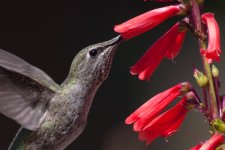
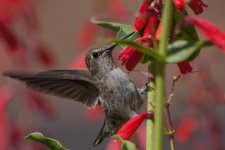
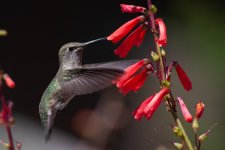
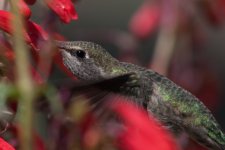
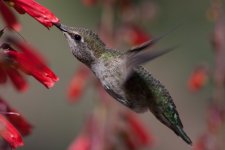
A "bird" search found another folder. Doesn't happen very often, but one day a few years ago I put down the fly rod and dug out the camera and chased birds around the lake. Back in the day I had a film camera with a niceish long lens and I really enjoyed bird photography. Need to stop buying fly gear and upgrade my camera gear.



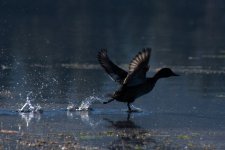



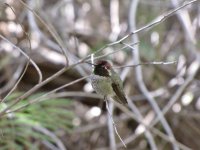
While we are birding Arizona can anyone offer an identification of this hummer? I took the photo at Superior, Az, on a 22 degree March morning during a historic cold snap in 2013. Merlin says Anna's, but given the combination of red cap and green gorget….I question that. I've seen lots of Anna's, but never a green throat like this. Hybrid maybe?

Your Arizona series is just outstanding Steve - thanks so much for sharing. Returning to the Galliforms, your wild turkey image appears to be a Gould's which is a mostly Mexican subspecies except for a bit of its range which is in southern Arizona. I'm wondering if you encountered any scaled or Montezuma quail? I have seen scaled quail in West Texas but am still waiting to add Montezuma quail to my list.We encountered skittish coveys of Gambel’s quail scurrying through the brush several times in our trip.
I think that the green that appears on the left edge of the gorget may be a red herring... These iridescent colors occur when light interacts with layers of melanin in melanosomes and keratin (see here and here and here). The layers act like a prism to split the light into its various wavelengths (=colors). Therefore, the color that you see depends on the angle between the sun, the feathers, and the observer.While we are birding Arizona can anyone offer an identification of this hummer? I took the photo at Superior, Az, on a 22 degree March morning during a historic cold snap in 2013. Merlin says Anna's, but given the combination of red cap and green gorget….I question that. I've seen lots of Anna's, but never a green throat like this. Hybrid maybe?
View attachment 150402
I agree with you that this is a fluffed-up male Anna's hummingbird. The rich red iridescent feathers on the crown extend behind the eye. There is very little white in the transition between the gorget and the green belly feathers. And the bill is relatively short and straight.
Steve
Last edited:
Thank you for the information on the turkey subspecies. That makes sense in light of the location. It appears that Arizona Fish and Game, the Wild Turkey Federation, and other partners have worked diligently to raise and release Gould turkeys back into the areas where it lived originally.Your Arizona series is just outstanding Steve - thanks so much for sharing. Returning to the Galliforms, your wild turkey image appears to be a Gould's which is a mostly Mexican subspecies except for a bit of its range which is in southern Arizona. I'm wondering if you encountered any scaled or Montezuma quail? I have seen scaled quail in West Texas but am still waiting to add Montezuma quail to my list.
No luck on either quail species where we were, although according to eBird records we could have encountered either in the area.
Steve
Last edited:
Just fantastic!
Yes you would. We bought a spec home and I did the backyard landscaping myself. I would get up really early and work in the yard for a couple hours in the morning cause it was usually unbearable by 7:00 AM. The low at night was about 85 if I remember right. Not a "dry heat" during monsoons either - dew point usually in the mid 60s. Like I said - I hated living in Phoenix.Very cool. While this year has been far too dry, we had a shot at an elegant trogon when we visited in 2023. Our guide shows us the trogon nest, but the birds had moved on.
The Sky Island area around Tuscan is so interesting because of the range of altitudes and habitats and the overlap of Eastern, Western, and Mexican species. We have just scratched the surface. It would be interesting to visit during the monsoon season, but I think that my PNW wife and I would just melt...
Steve
Arizona, late March 2025. Part 9 of Many: Cardinals (Cardinalidae), finches (Fringillidae), and one Old World Sparrow (Passeridae).
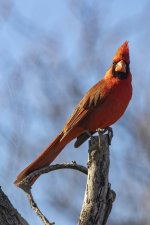
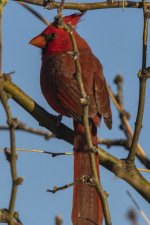
The family Cardinalidae includes cardinals, grosbeaks, and buntings. There were lots of Northern cardinals where I grew up in Boston. On this trip, we saw Northern cardinals at several sites and frequently heard the males’ piercing whistles. Male cardinals are a brilliant red with a red crest, a large red bill, and a black mask and throat.
Females have the same red bill and a hint of red in the crest, wings, and tail.
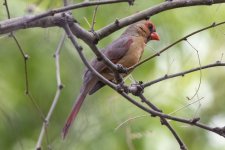
Unusual for a song bird, female cardinals will also sing to maintain cohesion between partners. The massive bill of a cardinal makes short work of most seeds and fruits. They also include insects in their diet as well. Northern cardinals are common in the eastern half of the U.S. but also range into the Southwest and coastal Mexico. On our Southern Arizona trip, we saw them in desert washes in Saguaro National Park, at feeders, in cottonwood groves, and in the pine-oak-sycamore canyons.
We also encountered the pyrrhuloxia or desert cardinal. The strange name “pyrrhuloxia” refers to its plumage (reddish to orange as seen in the bullfinch) and the shape of its bill (crossed bill or crooked bill). They are similar in size to a Northern cardinal and have a similar tall crest and a massive bill. But in the pyrrhuloxia, the bill is yellow. In males, the overall body is gray with red found in the crest, on the face, on the throat and breast, and in the tail and wings.
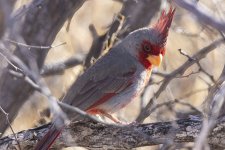
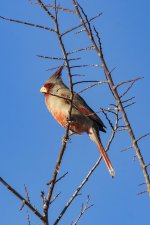
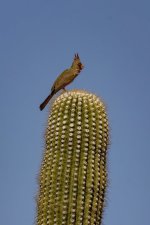
A female pyrrhuloxia is grayish with a hint of red in her crest wing and tail.
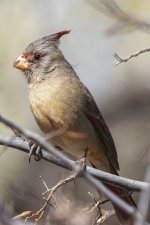
They consume less fruit than do Northern cardinals. They also consume more small seeds and even consume the nectar and pollen of saguaro cacti. Their range from Central/Northern Mexico into Southern Texas, New Mexico, and Arizona.
At the Patton Center for Hummingbirds in Patagonia, Arizona, we encountered several lazuli buntings. Much smaller than the prior two members of the cardinal family, the males are quite colorful. Male painted buntings have bright blue head and neck. The breast transitions from orange to white.
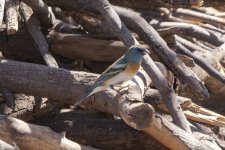
Females are much more subdued with a grayish brown head, mantle, and back and with a tan breast. Lazuli buntings are omnivores, consuming berries and seeds and a variety of insects that they harvest from the understory. They prefer areas near streams and brushy hillsides. They winter along the Pacific Coast of Mexico (with a finger into Southern Arizona). They breed in western half of the U.S., except they are absent west of the Cascades of Oregon and Washington. My wife and I have encountered them when hiking up Umtanum Creek, a tributary of the Yakima River.
We encountered three members of the finch family (Fringillidae). These are generally small, musical, seed specialists. Pine siskins were thick at the Ash Canyon feeders and were easily spooked by imagined or real threats (e.g., Cooper’s hawk blasting through). Pine siskins have small pointed bill, a streaky back and breast, and yellow edging on its wings and tail.
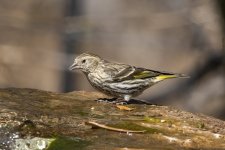
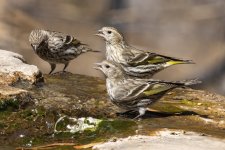
We often hear pine siskins at the top of the Douglas firs around our house throughout the year. This fall, I saw dense flocks of them harvesting seeds from alder cones at Nisqually NRW, for example. This species breeds from Alaska through to Atlantic Canada, down the West Coast, along the Rockies, and into the mountains of Mexico.
Male lesser goldfinches are hard to confuse with anything else. The males have dark black caps, a green mantle, and a yellow throat and breast. They also have white patches in the wings.
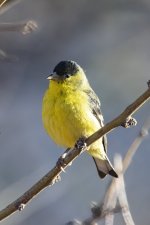
Females have olive backs, gray-yellow throat and breasts, and two white wing bars.
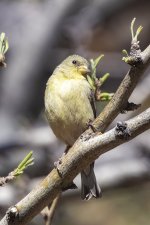
They are not picky about habitat. They are primarily seed eaters, often perching on a seed head to extract the seeds. Lesser goldfinches range through the western half of the country into Mexico and Central America into Northern South America.
While originally confined to the Western U.S., house finches are now widespread, except for a north-south band in the center of the U.S. Males have rosy-red heads and throats with some red on the breast. The lower part of the breast includes brown streaks.
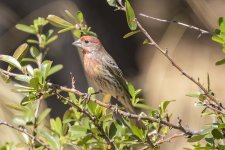
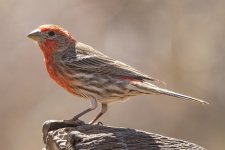
The intensity of the red color depends on the diet of the male. The red pigment is derived from carotenoid pigments in their plant diet. Females prefer males with brighter red plumage = female sexual selection. It has been hypothesized coloration may indicate to a female the genetic quality of potential mates. Very intensely red males can be confused with male purple finches or male Cassin’s finch. Female house finches are brown overall with streaks down the breast. This species feeds on seeds, buds, and fruits. It is common at bird feeders.
House sparrows are so common that one might think that they are a native species. Males have a gray forehead, a chestnut crest and neck, white cheeks, brown and black back feathers, a black bib, and a white-gray breast.
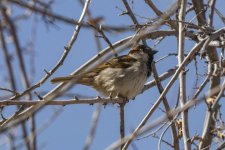
Females are brown overall with a light gray-brown breast. House sparrows primarily eat seeds, but part of their success is their flexibility to include insects, spiders, and other invertebrates depending on food supply.
This Old-World sparrow was originally a European species, but it has now been introduced throughout the world (along with starlings and the rock pigeon). In the U.S., they were deliberately introduced in New York City in 1852 to control the linden moth. They adapt well to urban environments; about the only place where they are not found is deep forests or tundra. They may be the most common bird species on the planet.
Steve
The family Cardinalidae includes cardinals, grosbeaks, and buntings. There were lots of Northern cardinals where I grew up in Boston. On this trip, we saw Northern cardinals at several sites and frequently heard the males’ piercing whistles. Male cardinals are a brilliant red with a red crest, a large red bill, and a black mask and throat.
Females have the same red bill and a hint of red in the crest, wings, and tail.
Unusual for a song bird, female cardinals will also sing to maintain cohesion between partners. The massive bill of a cardinal makes short work of most seeds and fruits. They also include insects in their diet as well. Northern cardinals are common in the eastern half of the U.S. but also range into the Southwest and coastal Mexico. On our Southern Arizona trip, we saw them in desert washes in Saguaro National Park, at feeders, in cottonwood groves, and in the pine-oak-sycamore canyons.
We also encountered the pyrrhuloxia or desert cardinal. The strange name “pyrrhuloxia” refers to its plumage (reddish to orange as seen in the bullfinch) and the shape of its bill (crossed bill or crooked bill). They are similar in size to a Northern cardinal and have a similar tall crest and a massive bill. But in the pyrrhuloxia, the bill is yellow. In males, the overall body is gray with red found in the crest, on the face, on the throat and breast, and in the tail and wings.
A female pyrrhuloxia is grayish with a hint of red in her crest wing and tail.
They consume less fruit than do Northern cardinals. They also consume more small seeds and even consume the nectar and pollen of saguaro cacti. Their range from Central/Northern Mexico into Southern Texas, New Mexico, and Arizona.
At the Patton Center for Hummingbirds in Patagonia, Arizona, we encountered several lazuli buntings. Much smaller than the prior two members of the cardinal family, the males are quite colorful. Male painted buntings have bright blue head and neck. The breast transitions from orange to white.
Females are much more subdued with a grayish brown head, mantle, and back and with a tan breast. Lazuli buntings are omnivores, consuming berries and seeds and a variety of insects that they harvest from the understory. They prefer areas near streams and brushy hillsides. They winter along the Pacific Coast of Mexico (with a finger into Southern Arizona). They breed in western half of the U.S., except they are absent west of the Cascades of Oregon and Washington. My wife and I have encountered them when hiking up Umtanum Creek, a tributary of the Yakima River.
We encountered three members of the finch family (Fringillidae). These are generally small, musical, seed specialists. Pine siskins were thick at the Ash Canyon feeders and were easily spooked by imagined or real threats (e.g., Cooper’s hawk blasting through). Pine siskins have small pointed bill, a streaky back and breast, and yellow edging on its wings and tail.
We often hear pine siskins at the top of the Douglas firs around our house throughout the year. This fall, I saw dense flocks of them harvesting seeds from alder cones at Nisqually NRW, for example. This species breeds from Alaska through to Atlantic Canada, down the West Coast, along the Rockies, and into the mountains of Mexico.
Male lesser goldfinches are hard to confuse with anything else. The males have dark black caps, a green mantle, and a yellow throat and breast. They also have white patches in the wings.
Females have olive backs, gray-yellow throat and breasts, and two white wing bars.
They are not picky about habitat. They are primarily seed eaters, often perching on a seed head to extract the seeds. Lesser goldfinches range through the western half of the country into Mexico and Central America into Northern South America.
While originally confined to the Western U.S., house finches are now widespread, except for a north-south band in the center of the U.S. Males have rosy-red heads and throats with some red on the breast. The lower part of the breast includes brown streaks.
The intensity of the red color depends on the diet of the male. The red pigment is derived from carotenoid pigments in their plant diet. Females prefer males with brighter red plumage = female sexual selection. It has been hypothesized coloration may indicate to a female the genetic quality of potential mates. Very intensely red males can be confused with male purple finches or male Cassin’s finch. Female house finches are brown overall with streaks down the breast. This species feeds on seeds, buds, and fruits. It is common at bird feeders.
House sparrows are so common that one might think that they are a native species. Males have a gray forehead, a chestnut crest and neck, white cheeks, brown and black back feathers, a black bib, and a white-gray breast.
Females are brown overall with a light gray-brown breast. House sparrows primarily eat seeds, but part of their success is their flexibility to include insects, spiders, and other invertebrates depending on food supply.
This Old-World sparrow was originally a European species, but it has now been introduced throughout the world (along with starlings and the rock pigeon). In the U.S., they were deliberately introduced in New York City in 1852 to control the linden moth. They adapt well to urban environments; about the only place where they are not found is deep forests or tundra. They may be the most common bird species on the planet.
Steve
Arizona, late March 2025. Part 10 of Many: New World Sparrows (family Passerellidae), part A. These birds are native to the New World. Most are seed-eating birds with conical bills. The New World Sparrows are a very diverse family with 140 species including various buntings, towhees, juncos, and sparrows. We saw 15 species in this family.
We saw three of the six species of towhees found in the U.S. These sparrows are half the size of a robin. The most common species that we encountered was Abert’s towhee. They are brown-gray overall with reddish-brown under the tail. A ring of dark feathers lies between the light bill and the eye.
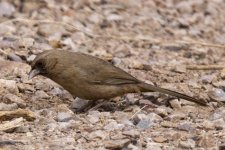
The core habitat for this species is cottonwood-willow riparian forests. This species is found primarily in Arizona with some populations extending into Nevada and Utah, New Mexico, and California. They kick their feet through leaf litter or soil to find insects (primary diet item) and seeds.
Near the end of our trip, we saw birds that looked like Abert’s towhees but the birds lack the dark feathers around the base of the bill. A volunteer at the Ash Canyon Bird Sanctuary suggested that we were seeing canyon towhees, apparently common at that site. And we hadn’t walked more than 20 feet when one popped clearly into view. Unlike the dark feathers at the base of the bill, canyon towhees have a white eye ring, a brownish crown, and a lighter brown streaked throat patch.
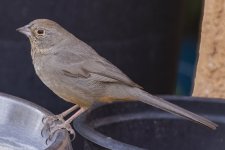
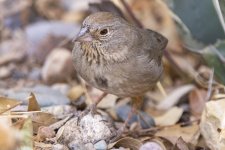
The range of this species extends from parts of Colorado, through Arizona, New Mexico, and Western Texas through most of Mexico. Within this range, they prefer desert grasslands and shrubby areas, and pine-juniper-oak forest. They feed on seeds, berries, and insects that they scratch out of the leaf litter and soil.
The third towhee species, the green towhee is VERY distinctive. Like our local spotted towhees, these birds can be elusive, until they aren’t. On an overall gray body, these birds have a bright reddish brown cap, a white throat, olive wings and tail.
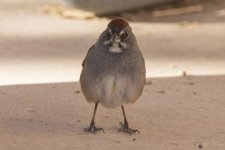
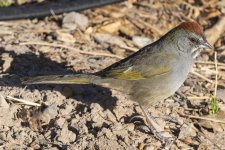
These birds overwinter in southern Western states and into Mexico. They migrate north into Oregon, Idaho, Montana, Wyoming, Colorado, Utah, and Nevada. They prefer shrub habitats and sagebrush areas. Their diets are similar to other towhees.
Dark-eyed juncos are quite common in the Pacific Northwest. We encountered them in pine-oak woodlands of Madera Canyon, but they looked quite different from the PNW birds. The plumages found in this species are very variable with 15 described races. Some of these were considered to be separate species. But recent genetic research indicates significant interbreeding among the color morphs where they overlap. They may represent a single species in the process of fractioning into several new species (like the pink-eyed junco which is considered a separate species. All dark-eyed juncos have white outer tail feathers, pink bills, and pink legs. Our local PNW dark-eyed juncos are the Oregon form with a black head, brown mantle, and brown sides. Most of the birds in Southern Arizona were the red-backed form (dominant form in the Southwest) with an overall gray body, a black line from the bill through the eye, and a reddish-brown mantle.
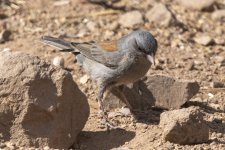
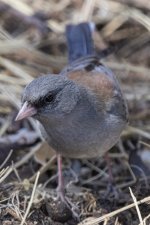
We also saw one pink-sided form with a dull brown mantle and brown sides. This species overwinter across the U.S., in Northern Mexico, and the southern regions of the western Canadian provinces. They breed in the Appalachians, across the western U.S., and into northern Canada and Alaska. They feed primarily on seeds, augmented by insects especially in the breeding season (more protein).
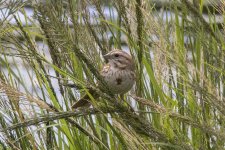
We encountered another old friend, the song sparrow, at multiple locations, basically anywhere that had a nearby water source. But even though they behave like our PNW birds, these Southwest song sparrows were a warm brown in color, in contrast to the dark-brown/gray plumage that we see in the PNW birds. In song sparrows, brown/gray streaks extend from the white throat to central spot in the breast. The crown has two brown streaks, there is brown stripe through the eye, and there is a brown mustache (malar) stripe.
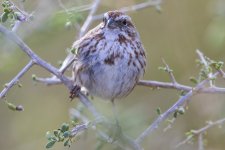
Another old friend that we encountered at several locations (especially with feeders) was the white-crowned sparrow. A white-crowned sparrow will have pale legs, a pale bill, a gray mantle and breast, a white chin, and a black or brown stripes on the otherwise white or gray crown, and two white wing bars.
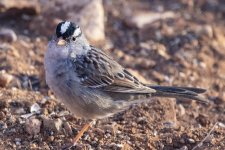
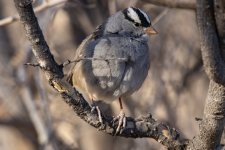
Mature birds have the white crown stripes and immatures have the brown crown stripes. Individuals with bolder crown colors (generally adult males) are more dominant in winter foraging flocks. Interestingly, if you manipulate / paint the crowns of subdominant individuals to be brighter, these modified birds are more likely to win encounters with other birds.
This species ranges across North America from Mexico (wintering only) to the Arctic shores (breeding season only). In the winter, many birds migrate south to the lower half of the U.S. and Mexico. Year-round populations are found along the West Coast, the Sierra Nevada Mountains, and the Rockies. Most of their diet consists of seeds with the addition of seasonal fruit and insects in the summer.
Steve
We saw three of the six species of towhees found in the U.S. These sparrows are half the size of a robin. The most common species that we encountered was Abert’s towhee. They are brown-gray overall with reddish-brown under the tail. A ring of dark feathers lies between the light bill and the eye.
The core habitat for this species is cottonwood-willow riparian forests. This species is found primarily in Arizona with some populations extending into Nevada and Utah, New Mexico, and California. They kick their feet through leaf litter or soil to find insects (primary diet item) and seeds.
Near the end of our trip, we saw birds that looked like Abert’s towhees but the birds lack the dark feathers around the base of the bill. A volunteer at the Ash Canyon Bird Sanctuary suggested that we were seeing canyon towhees, apparently common at that site. And we hadn’t walked more than 20 feet when one popped clearly into view. Unlike the dark feathers at the base of the bill, canyon towhees have a white eye ring, a brownish crown, and a lighter brown streaked throat patch.
The range of this species extends from parts of Colorado, through Arizona, New Mexico, and Western Texas through most of Mexico. Within this range, they prefer desert grasslands and shrubby areas, and pine-juniper-oak forest. They feed on seeds, berries, and insects that they scratch out of the leaf litter and soil.
The third towhee species, the green towhee is VERY distinctive. Like our local spotted towhees, these birds can be elusive, until they aren’t. On an overall gray body, these birds have a bright reddish brown cap, a white throat, olive wings and tail.
These birds overwinter in southern Western states and into Mexico. They migrate north into Oregon, Idaho, Montana, Wyoming, Colorado, Utah, and Nevada. They prefer shrub habitats and sagebrush areas. Their diets are similar to other towhees.
Dark-eyed juncos are quite common in the Pacific Northwest. We encountered them in pine-oak woodlands of Madera Canyon, but they looked quite different from the PNW birds. The plumages found in this species are very variable with 15 described races. Some of these were considered to be separate species. But recent genetic research indicates significant interbreeding among the color morphs where they overlap. They may represent a single species in the process of fractioning into several new species (like the pink-eyed junco which is considered a separate species. All dark-eyed juncos have white outer tail feathers, pink bills, and pink legs. Our local PNW dark-eyed juncos are the Oregon form with a black head, brown mantle, and brown sides. Most of the birds in Southern Arizona were the red-backed form (dominant form in the Southwest) with an overall gray body, a black line from the bill through the eye, and a reddish-brown mantle.
We also saw one pink-sided form with a dull brown mantle and brown sides. This species overwinter across the U.S., in Northern Mexico, and the southern regions of the western Canadian provinces. They breed in the Appalachians, across the western U.S., and into northern Canada and Alaska. They feed primarily on seeds, augmented by insects especially in the breeding season (more protein).
We encountered another old friend, the song sparrow, at multiple locations, basically anywhere that had a nearby water source. But even though they behave like our PNW birds, these Southwest song sparrows were a warm brown in color, in contrast to the dark-brown/gray plumage that we see in the PNW birds. In song sparrows, brown/gray streaks extend from the white throat to central spot in the breast. The crown has two brown streaks, there is brown stripe through the eye, and there is a brown mustache (malar) stripe.
Another old friend that we encountered at several locations (especially with feeders) was the white-crowned sparrow. A white-crowned sparrow will have pale legs, a pale bill, a gray mantle and breast, a white chin, and a black or brown stripes on the otherwise white or gray crown, and two white wing bars.
Mature birds have the white crown stripes and immatures have the brown crown stripes. Individuals with bolder crown colors (generally adult males) are more dominant in winter foraging flocks. Interestingly, if you manipulate / paint the crowns of subdominant individuals to be brighter, these modified birds are more likely to win encounters with other birds.
This species ranges across North America from Mexico (wintering only) to the Arctic shores (breeding season only). In the winter, many birds migrate south to the lower half of the U.S. and Mexico. Year-round populations are found along the West Coast, the Sierra Nevada Mountains, and the Rockies. Most of their diet consists of seeds with the addition of seasonal fruit and insects in the summer.
Steve