Bamboo and the Black Spider.

Dave Westburg

Fish the classics
Forum Supporter
IMG_1944.JPG

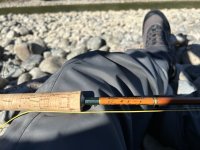
Took my 8'3" Sharpes Wilson International out to swing soft hackles on a stream on the east slope of the cascades. The Wilson International is finished with green thread tipped with gold and has impregnated staggered ferrule bamboo blanks which are the color of a Mac N Jacks amber ale..
IMG_1947.JPG
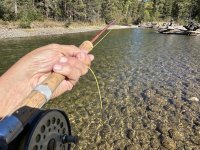
We walked 5.5 miles during the day but the best fishing was in the first riffle.
IMG_1942.JPG

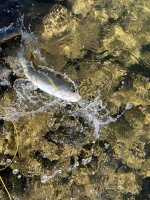
The cutts fought hard.

IMG_1940.JPG

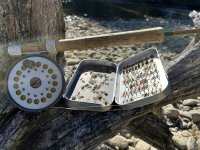
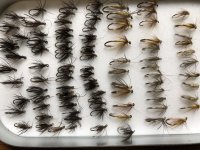
My best fly was a size 12-14 Black Spider which was originated in the 1850's by the scotsman W.C.Stewart. See four rows of flies on left below. Simple to tie. Pearsals Brown silk thread for a body with a Starling hackle wound at the shoulder. You tie the Starling hackle in at the head of the fly and wind it down the body and then work your thread up through the starling to protect the fragile feather from the trout's teeth. Old flies are good flies!
IMG_1878.jpg
 
Last edited:
The Black Spider is one of if not my favorite North Country fly I always have a few rows of them in black, brown and red bodies. One of the reasons I like it besides how effective it is , is that a well tied black spider is incredibly buggy looking. It's just a mess with legs sticking out all over the place. I like to tie them in the traditional manner as described by Stewart.

Stewart popularized the fly but did not originate them. In his own book , The Practical Angler published in 1857 he states, "We were first shown it by James Baillie, and have never been without one on our line ever since."
Also in John Kirkbride's book, The Northern Angler published in 1837. he mentions the "Starling-Hackle fly", which is half-palmered with a starling hackle. This precedes Stewarts published dressing by twenty years.

I understand that this is information that no one asked for but I'm a strong believer in credit where credit is due.
 
The Black Spider is one of if not my favorite North Country fly I always have a few rows of them in black, brown and red bodies. One of the reasons I like it besides how effective it is , is that a well tied black spider is incredibly buggy looking. It's just a mess with legs sticking out all over the place. I like to tie them in the traditional manner as described by Stewart.

Stewart popularized the fly but did not originate them. In his own book , The Practical Angler published in 1857 he states, "We were first shown it by James Baillie, and have never been without one on our line ever since."
Also in John Kirkbride's book, The Northern Angler published in 1837. he mentions the "Starling-Hackle fly", which is half-palmered with a starling hackle. This precedes Stewarts published dressing by twenty years.

I understand that this is information that no one asked for but I'm a strong believer in credit where credit is due.
So tim do you twist the starling feather around the thread and wind the two forward together. I see to remember that’s what stewart advised.
 
So tim do you twist the starling feather around the thread and wind the two forward together. I see to remember that’s what stewart advised.
It is a dandy fly.
I leave the silk back, palmer the starling, then wind the silk through the hackle as you bring it forward. I think I got that from Dave Hughes Wet Flies and it makes for a durable fly with a delicate feather. I like the scarlet gossamer.
 
Last edited:
It is a dandy fly.
I leave the silk back, palmer the starling, then wind the silk through the hackle as you bring it forward. I think I got that from Dave Hughes Wet Flies and it makes for a durable fly with a delicate feather. I like the scarlet gossamer.
I do the same thing tom.
 
So tim do you twist the starling feather around the thread and wind the two forward together. I see to remember that’s what stewart advised.
Yes you lay thread along the feather shaft on the concave side of the feather and twist the two together and palmer forward.
Oliver Edwards has a good U Tube video about it.
 
Last edited:
Back
Top