Tons of chases/looks, but no bites

This is specifically about an experience in some alpine lakes but probably would apply to any lake.

What do you do when you are fish (with a thin tippet) and you can see multiple fish repeatedly slowly following your fly or coming to look, but never taking a bite? This can one maddening and was happening to me all day recently despite trying so many types of fly patterns, having the fly down at their level, etc.

There were a few periodic rises going on, but I got no action on dries and they didn't seem to want to swim up and view my dries. With nymphs and streamers they'd chase them and look consistently.

Thanks
 
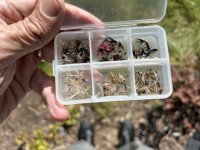
When I have alpine lake follows and refusals I usually drop to 2 lb test floro tippet and a size 16 black gnat or greenwells glory fished off an intermediate line. I always tuck a box of size 16-18 wets and midge dries in my high lakes vest for use when the fish are especially finicky...
IMG_0596.jpeg
 
Last edited:
The first thing I would do is go to a much smaller fly. Yesterday morning with the sun low and lots of clouds, fish hit a big fly eagerly but by afternoon the clouds had cleared and the sun was high-no more interest in the normal flies. I changed over to a 5x tippet with size 14 and 16 soft hackles on a Type 3 line and was immediately back in business. Soft hackles have been a big business for me this fall and have seemed to work everywhere. It seems counterintuitive to put a fly you can hardly see on your line and drop it into the enormity of a lake but amazingly fish can find it quickly.
 
Yep, smaller and slower is usually the way. Unless it’s not and they want something huge and flashy stripped really really fast. Or they’re on snails and want something round and black and static. Or the problem is leader flash and you need to use the right sort of mud to make your monofilament less shiny. Or you used the wrong type of head cement and they can smell it. Or they’re just bastards, and there’s nothing you can do :ROFLMAO:
 
Yep, smaller and slower is usually the way. Unless it’s not and they want something huge and flashy stripped really really fast. Or they’re on snails and want something round and black and static. Or the problem is leader flash and you need to use the right sort of mud to make your monofilament less shiny. Or you used the wrong type of head cement and they can smell it. Or they’re just bastards, and there’s nothing you can do :ROFLMAO:
That clears it up!

In this particular instance (yesterday) I was using a mid size bead head black woolly bugger with a small (16? 18?) nymph dropper. So I had on big and small.

Then had a foam hopper with a small nymph dropper.

Then ditched the bigger fly all together and just deeply sunk a bead head nymph.

Lots of fun (for my family) aquarium viewing as the rainbows lazily swam around near the fly. Lots of frustration for me as they never bit.
 
A couple things I would try
First -is a switch of an intermediate sink line with a fluorocarbon leader with a light tipper and smallish unweighted nymph or soft hackle (for decades a size 14 or 14 dark olive soft hackle has been my go-to alpine lake fly) fished slowly. A much different presentation than with weighted.
The second would be find a relatively clean lake bottom and cast your fly of choice and let it settle to the bottom. Once on the bottom do not move the fly. Instead until a cruising fish nears the area of the fly and then impart just the slightest movement of the fly. In the clear water in many of our lakes it amazing whole effect this method can be though it can test your patience. I recall a golden trout lake with 4 anglers were our entire catch for the morning was a single fish. During a lunch break I noted an area where cruise fish were regular visitors. I allowed a small, unweighted nymph sink to the bottom in 5 feet of water and waited. In the next hour before we had to leave 8 casts produced 6 16 to 18 inch goldens. The other 3 anglers drew blanks
 
A couple things I would try
First -is a switch of an intermediate sink line with a fluorocarbon leader with a light tipper and smallish unweighted nymph or soft hackle (for decades a size 14 or 14 dark olive soft hackle has been my go-to alpine lake fly) fished slowly. A much different presentation than with weighted.
The second would be find a relatively clean lake bottom and cast your fly of choice and let it settle to the bottom. Once on the bottom do not move the fly. Instead until a cruising fish nears the area of the fly and then impart just the slightest movement of the fly. In the clear water in many of our lakes it amazing whole effect this method can be though it can test your patience. I recall a golden trout lake with 4 anglers were our entire catch for the morning was a single fish. During a lunch break I noted an area where cruise fish were regular visitors. I allowed a small, unweighted nymph sink to the bottom in 5 feet of water and waited. In the next hour before we had to leave 8 casts produced 6 16 to 18 inch goldens. The other 3 anglers drew blanks
I love this specific actionable idea!
 
From everything described I'd change the when.
Can you be more specific?

If it's about fishing in the lake at a completely different time of day, often that's just not possible if it involves a long hike in and hike out and no overnight. But if it's a "when" question about the presentation and/or action on the fly, I'm curious what the specific is.
 
.
The second would be find a relatively clean lake bottom and cast your fly of choice and let it settle to the bottom. Once on the bottom do not move the fly. Instead until a cruising fish nears the area of the fly and then impart just the slightest movement of the fly. In the clear water in many of our lakes it amazing whole effect this method can be though it can test your patience. I recall a golden trout lake with 4 anglers were our entire catch for the morning was a single fish. During a lunch break I noted an area where cruise fish were regular visitors. I allowed a small, unweighted nymph sink to the bottom in 5 feet of water and waited. In the next hour before we had to leave 8 casts produced 6 16 to 18 inch goldens. The other 3 anglers drew blanks

On highly pressured fish, or in really clear water, that is a fantastic approach. Just make sure that your fly sinks hook up!
 
In these situations, I’ll first change my retrieve until something triggers a reaction. If that doesn’t work, I’m likely scaling down.

On Saturday, I was at a dock in an area West of Lake Union and noticed a bunch of small 8”-12” large mouth swimming around. All I had with me were some saltwater flies but I figured those should work fine to trigger a strike. They did not work regardless of my approach. The fish would look, but not commit. So I kept digging and managed to find a size 12 micro leech. I figured I’d be in business for sure, but they still wouldn’t eat. Very frustrating. Finally I started watching the fish subtly migrate around the dock and I figured I’d try a Rocky Ford scud technique on them. I cast the fly out to an area that I knew they would come back to, waited for them to return, twitch twitch, bam. These fish did not want to see the fly coming to them or moving past them, they wanted to discover it on their own.
 
The stripped retrieve of a streamer should emulate fear-induced motion. Imitating food is one thing. Imitating prey is another.

Go play with your or any cat to see what I'm talking about. This advice is relevant to trout and their ilk, from my experience.
 
Can you be more specific?

If it's about fishing in the lake at a completely different time of day, often that's just not possible if it involves a long hike in and hike out and no overnight. But if it's a "when" question about the presentation and/or action on the fly, I'm curious what the specific is.
Sometimes...ya can't catch a fish with anything short of dynamite! Next day...can't keep them off a fly.
 
Last edited:
Back
Top