
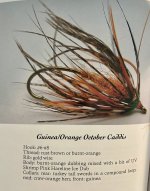
A pattern I’d like to tie calls for a collar of “turkey tail swords in a compound loop.” Googling got me nowhere. Can anyone explain what this means?

Follow along with the video below to see how to install our site as a web app on your home screen.
Note: This feature may not be available in some browsers.

The pattern is “Guinea/Orange October Caddis” from Steven Bird’s Trout Spey and The Art of the Swing.I could use more context. I’m assuming swords could be primary tail feathers but not sure of that. There is a technique we’re you knot individual fibers from feathers using a loop of thread to make a hackle like strand
If you find the answer please share as I would like to know as well and take a stab at tying it in the manner he intended.The pattern is “Guinea/Orange October Caddis” from Steven Bird’s Trout Spey and The Art of the Swing.
I will. I was thinking about sending him an email.If you find the answer please share as I would like to know as well and take a stab at tying it in the manner he intended.

About 8:40 in the first video John shows using a composite loop. Second video he uses it, for a killing tie. I don't use a tool, I just set up my dubbing and hackle on a piece of parchment paper on the bench then move it to the loop with the little bit of wax left on my finger.


May have been two dubbing loops then cut one loop down the middle; dub that loop straight piece of thread; then wedge between the dubbing loop; pinch all three strands with hackle pliers and twist up.That’s an interesting idea. Would you pass the bobbin/verticle dubbed thread through the loop or just rely on its proximity to the loop for it to be captured and twisted in the loop?
I’ll screw around with it tonight.
Steve Bird kindly responded to my email.If you find the answer please share as I would like to know as well and take a stab at tying it in the manner he intended.

Steve Bird kindly responded to my email.
Here is his response:
“Make a thread loop where you want the back of the collar to be located. Cut a section of tail about 2 inches long; strip the swords from one side; place the feather in the loop, barbs extended the length you want. With the swords (barbs) trapped in the loop, use scissors to cut away the feather stem. Wind the loop until the barbs are well trapped, forming a brush. Now wind forward toward the eye, training the collar back as you wind.”

 soft-hacklejournal.blogspot.com
That’s a very similar fly to the one I asked him about:Here's a post by Steve Bird that seems to describe this fly, with a picture. Nice looking fly!:
October Caddis ~ For Swinging
A blog devoted to Trout Spey, swinging flies, tying and fishing soft-hackle flies & flyfishing.
Thanks for the follow up explanation, I'm going to give that a try for sure!Steve Bird kindly responded to my email.
Here is his response:
“Make a thread loop where you want the back of the collar to be located. Cut a section of tail about 2 inches long; strip the swords from one side; place the feather in the loop, barbs extended the length you want. With the swords (barbs) trapped in the loop, use scissors to cut away the feather stem. Wind the loop until the barbs are well trapped, forming a brush. Now wind forward toward the eye, training the collar back as you wind.”
