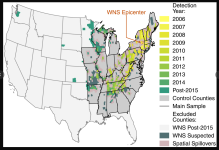
Where I live (New England), White Nose Syndrome has decimated the local bat population. As few as about 20 years ago I would see/hear dozens of bats working my yard. This past summer, I noted only one. I put up a bat house many years ago and usually had bats every year. In the last 10, no residents.
OLYMPIA – White-nose syndrome, an often-fatal disease of hibernating bats, continues to spread in Washington. Washington Department of Fish and Wildlife (WDFW) and research partners documented white-nose syndrome and the fungus that causes white-nose syndrome in eleven new counties in 2024.
wdfw.wa.gov
WDFW actually has a page on their website dedicated to the issue:
Across the United States, bats face many threats that put them at severe risk of population decline. These threats include a devastating disease called white-nose syndrome, wind energy, habitat loss, and climate change.
I'm a mite skeptical about a single author study with a curveball hypothesis... Don't get me wrong, this isn't a debunk, so much as the author fired a shot across the bow, it's eye opening and cool science, but the way science works, the rest of us get to try and replicate and shoot back, even if we don't replicate
A stack of issues here that suck the author brings up - Bat declines, infant mortality increases, insect number declines, crop yield compromises. There are also other issues the author doesn't touch on- way higher rates of later Parkinson's disease in farmers with significant exposures to pesticides, declines in insect eating bird numbers, lots of those locations where bat fungus is most noted overlap with- in the last two decades- with a new emphasis on fracking (ie might changes in groundwater be important here)
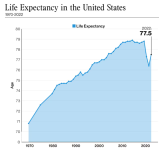
There's another thing troubling about this whole analysis, all Mortality in Covid era was higher. US life expectancy declines were very real.
the author doesn't mention COVID and it isn't entirely clear to me the date ranges studied included COVID era data or not.
A 2021-22 decline was also seen in Infant mortality:
provisional infant mortality rate for the United States in 2022 was 5.60 infant deaths per 1,000live births, 3% higher than the rate in 2021 (5.44). The neonatal mortality rate increased 3% from 3.49 to 3.58, and the post neonatal mortality rate by 4%(from 1.95 to 2.02) from 2021 to 2022. Mortality rates increased significantly among infants of American Indian and Alaska Native non-Hispanic (7.46 to9.06) and White non-Hispanic (4.36 to 4.52) women. From 2021 to 2022, infant mortality rates increased significantly for infants of women ages 25–29, from 5.15 to 5.37. Mortality rates increased significantly for total preterm (less than37 weeks of gestation) and early preterm
Agricultural counties with significant pesticide use are often dozens of not hundreds of miles of neonatal and pediatric ICUs, let alone declines in physician numbers and Obgyn in non urban areas in the USA. This is an ongoing/worsening problem, add to that small hospitals in underserved areas are closing.
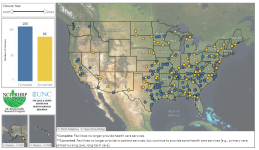
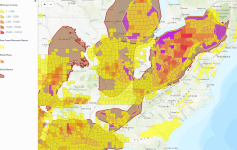
This map pretty much overlaps the map the author puts in for bat declines, it's hospital closures or conversion 2005-2024, conversions meaning no inpatient or critical care emergency services:
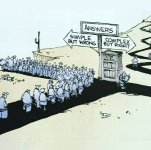
That cartoon is complete backwards.. simple is almost always right complex is almost always wrong and the people who fight for the complex are blowing smoke and telling you are too dumb to understand because they are hiding something usually the fact that they want control but have no clue what to do..
Honestly , simplicity and success go together
Dishonesty, complexity and failure also go together.
Not my fault people don't like it.
Anti- green windmills kill 880,000 bats per year... simple.
Windmills are not environmentally friendly it is that simple making it more complex is lying.
That cartoon is complete backwards.. simple is almost always right complex is almost always wrong and the people who fight for the complex are blowing smoke and telling you are too dumb to understand because they are hiding something usually the fact that they want control but have no clue what to do..
Honestly , simplicity and success go together
Dishonesty, complexity and failure also go together.
Not my fault people don't like it.
Anti- green windmills kill 880,000 bats per year... simple.
Windmills are not environmentally friendly it is that simple making it more complex is lying.
I’m sorry but I couldn’t finish that article, as I was busy manifesting good science by tanning my testicles to max out my T levels. It would be nuts to complicate this simply brilliant junk-bronzing approach. Chestnuts roasting, on an open fire…..
Science aside though, we recently had a bat take up residence just outside our front door, under our covered entry area.
I mean, i celebrate bats for eating bugs, but I’m also married, which means I had to convince the bat to move it along. The idea of getting a bat in her hair, and the reality of little bat poops, was a hard pass. Enter peppermint oil spray, placed up where the ceiling meets the wall. Exit bat. Additionally, I have the positive externality of a very minty-smelling covered porch now. Winning.
Our extended family have stayed out the same campgroung for decades in Montana. One summer our group of extended family noticed a lot of bats around dusk. There were hundreds of bats exiting a side wall of one of our cabins we rented. It was fun to watch but very disconcerting for sure. We notified our 'landlords' the next day. They immdiately took the wall down. Thousands, and I am not joking 1000's of bats, were there. They rebuilt the wall. No more bats.
I like bats. They do a great service of managing insect population. Just not in the walls of our rental cabin.
The 'landlords' built several bat houses nearby to accomodate the displaced bats. They worked well also...
excellent write-up.
Besides the noted impact on OBGYN residents, there is a growing exodus of OB-GYN nurses relocating due to the draconian laws passed in their states, which will certainly impact respective infant mortality going forward.
As to truth, there is the truth which is reached by understanding the complexity of contributing factors, and there is the truth required to rationalize one's perspective.