

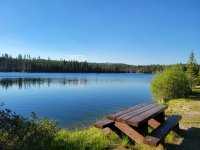
Tried to escape the heat by heading higher in elevation, in this case, to a Thompson-Nicola BC lake around the 4,000 foot elevation range. You'll probably recognize this lake if you've been there. I'd never fished this small lake before, but heard that there were some big fish in it. This was my campsite right on the lakeshore. I was the only fisherman/camper there the entire time, so if you like solitude like I do, maybe this is the place for you. It isn't the easiest lake to find, and the road in has some bad spots. But, I didn't escape the heat, as when I arrived on Tuesday evening, it was still 91 degrees! Fortunately, it cooled at night down to the 52 to 60 degree range, and the following two days were a bit cooler. The water temperature ranged from 66 to 70 degrees, so marginal for rainbow trout survivability, but I didn't have to revive any of the fish as they swam away readily when released.
This lake had quite a few fish in it, but I found nothing larger than 19 inches:
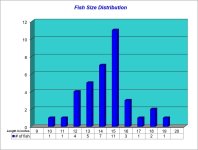
Still, all the fish that were 14 inches and larger fought well and jumped a lot, so it was a fun outing. Most of the fish took my T-Waterboatman pattern. I mainly fished a full sinking line, finding most of the fish about 12 to 14 feet below the water surface in 18 to 20 feet of water on the drop-offs.
Not so fun were all the mosquitoes, No-See-Ums, horse flies and deer flies. Had to use insect repellent and mosquito screens. Also, this small lake had 7 Common Loons, the most I've ever seen together on a small lake. I assume they were all in the same family (2 adults and 5 grown-up youngsters), as they seemed to often hang out together. One or two of the loons would always be shadowing me, and when I hooked a fish they were instantly within a rod length of my pontoon boat or under the boat looking for the fish to be released. I tried to play the fish as quickly as possible, release the fish on the side of the boat opposite of the loons, and splash my fins to distract the loons, but the loons still got 3 of the fish for sure, and probably more. In addition to the Common Loons, I also saw/heard Spotted Sandpipers, Canada Geese, Buffleheads, a Downy Woodpecker, Bald Eagles, an Osprey, Ravens, Crows, Bats, Common Nighthawks, Great Blue Herons, Mallards, Gray Jays, American Robins, Swainson’s Thrushes, Warbling Vireos, Red-breasted Nuthatches, an Olive-sided Flycatcher, Yellow-rumped Warblers, Dark-eyed Juncos, a Swallow (surprised not to see more swallows), and Song Sparrows.
I saw the best callibaetis hatch on this lake I think I've ever seen, medium-brown, large callibaetis. It was taking place over a broad, shallow shoal, but oddly, there wasn't a single fish rising in that area. At other times there were also smaller hatches of smaller, dark-gray callibaetis (both duns and spinners), but again I didn't see any fish rising for those bugs. I tried a callibaetis nymph, but didn't get any hits.
Each day I'd see an occasional Traveling Sedge, but never a good hatch. I had some success using Brian Chan's Still Water Caddis Pupa pattern. On Thursday evening, I was looking for a hatch, but it didn't happen, so well after sunset I finally quit and started packing up my things. Of course, a Traveling Sedge hatch began just before dusk right in front of my campsite, lasted for about 30 minutes and the fish were feeding. I just watched the action and enjoyed the spectacle, but didn't participate. Oh well, at least I know this lake has the potential for a Traveling Sedge hatch, which can be some of the best dry fly action one can find.
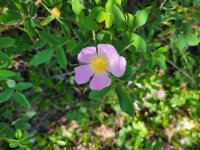
There were lots of these wild roses growing around the lake, and one time I saw a nice deer eating the leaves of the roses. Also saw a couple of beavers swimming across the lake.
Anyway, I always enjoy exploring new lakes, as you never know what you'll find. I'm sure this lake has bigger fish, but I'll just have to find them on the next trip.
Rex


