Steve, great thorough reports we've come to expect and enjoy I think I can say for all. I believe you'd be the very top choice to jump in a time machine and join the Lewis, Cabezon and Clark expedition !!! That is only if you haven't been beamed to the Galapagos first, or Cousteau hasn't pulled rank.
Great stuff ! Question, what fish are in the Salton Sea beyond talapia?
The ichthyofauna of the Salton Sea is a complicated (and interesting question). The Salton Sea prehistorically served as a river delta for the Colorado River into the Gulf of Mexico or as a dry plain that filled and dried out repeatedly over the last 1,300 years (see
here). It lies at the southern edge of the San Andreas Fault, the contact zone = transform fault between the Pacific Plate and the North American Plate after the
Farallon Plate was subducted under the North American Plate [The Juan de Fuca Plate/s off our coast are the northern remnants of the Farallon Plate.] and the
spreading center (East Pacific Rise) that is driving northwestern movements of the Pacific Plate vs. the North American Plate. The Gulf of Mexico separates Baja California from the mainland. The Gulf of Mexico first appeared about 5 to 10 million years ago due to a spreading center extending from the East Pacific Rise; the divergent spreading center extends north up to just south of the Salton Sea at present. There are several
geothermal power plants along the southern shore of the Salton Sea that tap the warm water generated by the new crust forming in this region.
The present incarnation of the Salton Sea as a lake begins in 1906 when an irrigation canal from the Colorado River to the Imperial Valley failed. For two years the entire volume of the Colorado River emptied out of the canal and flowed into the dry depression that had been the pre-historic Salton Sea. This created the largest lake in California (30 miles long). After repair of the canal, the sea was the dumping area for excess irrigation water from expanding agriculture in the Imperial Valley and Coachella/Mecca area. [If you can't dump irrigation water somewhere, salts and heavy metals like selenium build up in the soil.]. The Salton Sea is 200 feet below sea level and the easy dumping area for the farms around it. In the 1950's and 60's, the area became a resort destination. But as the farmers have become more efficient with their use of limited irrigation water, the lake has shrunk and become more saline. The irrigation water carried residual salts (and pesticides and fertilizers) that were present in the soil into the lake where the water then evaporated.
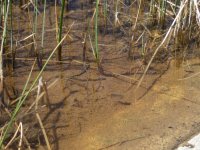
One of the fish species that predates the inundation of the Salton Sea is the desert pupfish,
Cyprinodon macularis. These are killifish (Cyprinodontiformes) that inhabited seeps and spring in the Lower Colorado River in Arizona and California. They are hardy fish that can survive high temperatures and salinities, and low oxygen levels. But they are also critically endangered due to modifications of the springs / seeps that they depend on and the introduction of non-native species.
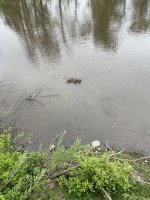
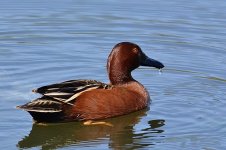
These pictures are from an artificial pond in Anza Borrego State Park near Borrego Springs.
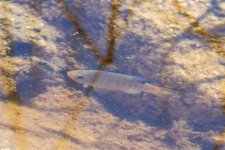 Archeological studies
 of Native American middens around the edge of the lake indicate that the tribes harvested some of the fish characteristic of the Lower Colorado River such as razorback suckers and bonytail chubs.
At present, only
Mozambique tilapia (
Oreochromis mossambicus) survive at the current salinities of the main lake (the pupfish are found in the marshes around the margins). Tilapia is a
cichlid, a member of a freshwater fish family that is found in rivers and lakes in Africa (e.g., mouth-breeding cichlids from the Rift Lakes) and South America (e.g., discus, peacock bass). But if current trends continue, the Salton Sea will become too saline for this species too. [Tilapia have been introduced around the world, including to isolated Pacific atolls. A scientist friend of mine was doing research [DOD disposal of chemical weapons by combustion] at Fanning Atoll (aka Tabuaeran, part of the nation of Kiribati in the Line Islands) told me that missionaries introduced tilapia into the lagoon as a food source. He described seeing tilapia exiting the lagoon through channels to feed on the coral reef, while reef sharks would enter the channels to feed on the tilapia in the lagoon.]. The last big year for tilapia fishing in the Salton Sea was 2007 and the numbers have declined since then largely because of the increased salinity and increased incidences of anoxia.
Several marine species (orange mouth corvina, gulf croaker, and sargo) were introduced to the Salton Sea and became, along with tilapia, a
major recreational fishery (great article). All four species were self-sustaining with the corvina at the top of the food chain. The corvina reached over 20 pounds. In the 1960's, the Salton Sea supported California's most productive fishery. It became a destination fishery and supported a major tourism industry around the Salton Sea. But by the early 90s, the hypoxia created by the high nutrient levels and the increased salinity disrupted the life cycle of all three marine species because their young-of-the-year were especially susceptible to extreme environmental conditions. A wet year would produce a decent recruitment, but these became rarer and rarer. [The tilapia can survive along the wave-washed shorelines.]. But even the tilapia numbers have largely crashed.
A long answer to a simple question. But it is an interesting story.
Steve