Bread Thread

Some questions, in no particular order..

When you want "ripe" starter, how far ahead of time do you feed it? I know temperature plays a big part, but I fed mine about 45 minutes ago and hope it will be perfect in the morning.

For my sourdough loaves, with ripe or not starter, they all are very dense. I use a dutch oven to cook them in and feel like I give them plenty of time to rise, but all have been very dense with a tough crust. Very tasty, just very flat. Should I let them rise longer? Temp's are tough this time of year, but I'll keep the heat up in the house, and turn on the oven and even the gas fireplace. I'm going to try the kettle of water in the oven with the door closed next..

Pizza crust, I love the King Arthur recipe and have even let it ferment up to 3 days in the fridge before using. However saw the Perfect Loaf recipe with cornmeal or porridge. Any preferences? Other recipes I should try.

Starter in general, I'm typically feeding with King Arthur AP. I do add some King Arthur Whole Wheat, but don't keep track of the specific amount. When I do use the whole wheat for a specific feeding, I typically do 25% whole wheat and 75% AP. Should I do this for every feeding? Does it make much of a difference? My starter is healthy and doubles in size most of the time. I have a rubber band on the jar, where it is when I feed it after mixing everything in with a chop stick.. I think Zak mentioned this.

Sorry for all of the questions, I am having fun figuring things out, but need to do more research and trial and error!

Cheers and TIA!!
Bill
 
Last edited:
30 g starter in 500g flour, so 6%? Hydration was 80%.
In that case, maybe underproofed . I do a 20% inoculation and it's usually 5.5 hrs.

One thing that can happen is that the bacteria are way more active then the yeast and produce large amounts of lactic and acetic acid. The acid can cause the gluten proteins to denature and the dough to lose its strength. I understand this from a molecular and conceptual stand but not from a practical time/temp/starter angle.
 
In that case, maybe underproofed . I do a 20% inoculation and it's usually 5.5 hrs.

One thing that can happen is that the bacteria are way more active then the yeast and produce large amounts of lactic and acetic acid. The acid can cause the gluten proteins to denature and the dough to lose its strength. I understand this from a molecular and conceptual stand but not from a practical time/temp/starter angle.

I’m at 25% starter for my loaves.
 
Some questions, in no particular order..

When you want "ripe" starter, how fare ahead of time do you feed it? I know temperature plays a big part, but I fed mine about 45 minutes ago and hope it will be perfect in the morning.

For my sourdough loaves, with ripe or not starter, they all are very dense. I use a dutch oven to cook them in and feel like I give them plenty of time to rise, but all have been very dense with a tough crust. Very tasty, just very flat. Should I let them rise longer? Temp's are tough this time of year, but I'll keep the heat up in the house, and turn on the oven and even the gas fireplace. I'm going to try the kettle of water in the oven with the door closed next..

Pizza crust, I love the King Arthur recipe and have even let it ferment up to 3 days in the fridge before using. However saw the Perfect Loaf recipe with cornmeal or porridge. Any preferences? Other recipes I should try.

Starter in general, I'm typically feeding with King Arthur AP. I do add some King Arthur Whole Wheat, but don't keep track of the specific amount. When I do use the whole wheat for a specific feeding, I typically do 25% whole wheat and 75% AP. Should I do this for every feeding? Does it make much of a difference? My starter is healthy and doubles in size most of the time. I have a rubber band on the jar, where it is when I feed it after mixing everything in with a chop stick.. I think Zak mentioned this.

Sorry for all of the questions, I am having fun figuring things out, but need to do more research and trial and error!

Cheers and TIA!!
Bill
I think starters are generally healthiest with some amount of whole grain. I believe the additional mineral content from the bran helps the microbes I like the flavor profile of rye and that it doesn't build gluten, easier to disperse in a dough mix. I make batches of 1kg "starter flour", 700g bread flour and 300g whole grain rye.

The more whole grain you use, the faster it will ferment because whole grain has a lower % by mass of fermentable starches and sugars.

Each starter is different and each environment is different, get to know your starter's behavior by combining strict measurements and observations. E.G. how long does it take to peak and start falling when fed 1:1:1 at 72 degrees or how long does it take at 1:3:3 at 67 degrees. Mine takes 10 hours at 65 degrees when fed 1:3:3. Which is perfect because I feed Friday night and mix dough Saturday morning.
 
I'm starting an experiment in bringing back starter. I have sadly (and completely) neglected the jar in my fridge for about two months. The dark liquid that collects on top dried and settled into a film on the starter. Scraping that off, the starter underneath is a dense paste the consistency of modeling clay. I left half an inch of that paste in the jar and added 50g each of flour and water. The jar is back in the fridge, because I didn't want to change too many things at once.
 
I'm starting an experiment in bringing back starter. I have sadly (and completely) neglected the jar in my fridge for about two months. The dark liquid that collects on top dried and settled into a film on the starter. Scraping that off, the starter underneath is a dense paste the consistency of modeling clay. I left half an inch of that paste in the jar and added 50g each of flour and water. The jar is back in the fridge, because I didn't want to change too many things at once.
It'll probably come back just fine. I'd recommend room temp, the yeast cells don't reproduce/divide at that low of a temp, but the bacteria can at a slow rate. It can contribute to an imbalance between the 2 and weird starter behavior. Just go to room temp and do 3-4 1:1:1 feeding and see what happens. My money's on it being good to go by then.
 
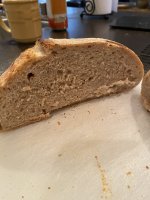
View attachment 97442View attachment 97442I’m thinking underproofed? It still tastes good though though.
My sourdough bread has been like that, tasty but very dense. The crust is is tough and chewy. I let it proof a long time, even when I put it in the Dutch oven I've been using. I'm thinking of just leaving the next loaf in the oven overnight with a hot kettle of water.. the method Gary uses.. then cooking it later in the day..
 
This is what I know:
Even if it's labeled bread flour, the grocery store stuff doesn't have enough protein for an open crumb.
Under bulk proof is way better than over proofed bulk.
A hungry starter is way better than an overfeed starter. I judge this by the viscosity of the starter. If it's got a lot of gluten left in it, it won't yield the best results.
At altitude, I can get an open crumb, with a great ear, but it takes a lot of effort.
Autolyse is the key to a good open crumb. The longer the longer the better to a point. You don't want it to start proofing.
Adding yeast after autolyse is fine, with starter, not so much.
Pre shaping is overrated.
Too warm a temperature is worse than too cool during proofing and fermentation.
After shaping, a warm rise, is key prior to refrigeration.
After oven spring is maxed out at high temperature, the temperature setting affects only the moisture of the inside off the loaf, and the color of the crust.
 
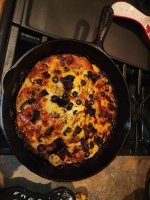
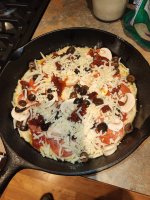
Well this turned out fantastic! One of the best pizzas I've ever had. Recipe from the Perfect Loaf!

The crust was crispy and chewy. Sourdough flavor was there but subtle! I was skeptical about adding a cornmeal porage into the dough but it was fantastic!! Made one pizza and have another for pizza on Tuesday or Wednesday. Topped with peppering, mushrooms, olives and sun dried tomatoes!

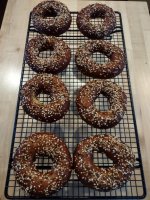
20231231_180211.jpg20231231_173333.jpg

 
Last edited:
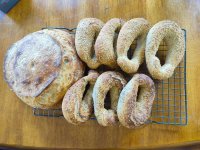
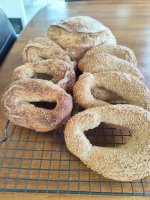
I stumbled across a middle eastern bread called ka'ak while travelling down an internet rabbit hole and got inspired to give it a try. There are several varieties of ka'ak, which are sometimes referred to as Jerusalem bagels. So.e varieties look almost exactly like a new York bagel, others are more pita-like. Sometimes they are sweetened, other times savory.

I roughly followed the recipe found here: https://www.breadexperience.com/sourdough-spelt-kaak-bread/
I used 50% spelt T85 and 50% Edison AP
I followed a more bagel-like shaping method than this recipe called for due to the way the dough was handling. I think the hydration needed to be higher in order to roll and make more flatbread style. I baked them in the challenger at 500 degrees, 7 minutes covered, 4 minutes uncovered.

I brushed them with egg whites and topped with either sesame seeds or homemade za'atar. They are currently cooled propped on on today's boule
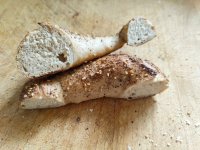
IMG20240114123919.jpgIMG20240114123933.jpgIMG20240114125137.jpg

The process wasn't too difficult, shaping and batch baking being the toughest parts. They taste really good but I'd make a few changes: Increase the hydration, knead more, bulk ferment less, final proof longer.
 
A water related question. Has anyone had difficulty changing from hard water to soft water or vice versa? On the Frozen Tundra I have soft water but down here in Colbert the water is very hard, even difficult to soap up in the shower. Since I got here my baking just hasn't been the same. At first I suspected the oven temp wasn't accurate but the purchase of a good thermometer proved that idea wrong, it seems to be dead on.

Biscuits seem to be just fine since they use buttermilk instead of water but the bread isn't rising as much and the crumb is more dense than before. I just can't get the loaves to pop and be the beauties I make at home. I like to share my bread with friends but so far haven't made anything I am proud of.

Any theories on hard water versus soft water?
 
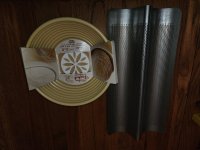
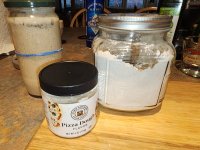
Got a few new things from King Arthur, a pan for French loaves or baguettes and a proofing bowl that you can use to stamp you bread with a design. Plus some pizza dough flavoring..

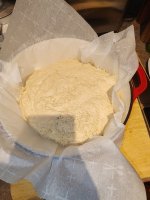
I'm also trying to figure out why my bread in my dutch oven turns out flat despite how long i let it proof. The first picture is a loaf I'm currently let it do its thing. I know its cold and sometimes turn up the gas oven to heat up the kitchen as well as turn the heat up. This loaf was started over 48 hours ago. My bread is tasty, but very dense with a tough crust. It is fun to figure it out, but I guess ive of the mindset that more time is a good thing.. it may not be the case though.

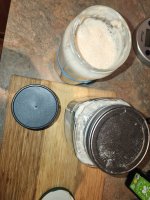
Last I've started to premix my starter flour that I use to feed it. 75% AP and 25% whole wheat flour. Both King Arthur. It's working well as I feed my starter 3 or 4 hours ago and it's close to doubled... time to start something new!! Cheers!!20240114_141829.jpg
20240114_141947.jpg20240114_142217.jpg20240114_142234.jpg
 
Last edited:
Back
Top