U.S. drafts plan to bring grizzly bears back to Washington’s North Cascades (WAPO)

Status
Not open for further replies.
I don't believe they'll be successful there without the ability to seasonably exploit distant food sources - your point

If 3,500 bears once made it until we nearly wiped them out, wouldn't 200 bears have it made?
Well no, no they wouldn't. Because those 3500 bears had access to the lowlands, and salmon, and connected habitats to roam in search of food. Those bears didnt move because they wanted to, they moved because there was no (or limited/poor) food in the hills for months at a time. They wake up in april and actively feed until November/dec.

You can have all of the blueberries for one grizzly, that doesnt mean they're going to be available all summer and fall. If they were, there would probably be more grizzlies there already.
 
Well no, no they wouldn't. Because those 3500 bears had access to the lowlands, and salmon, and connected habitats to roam in search of food. Those bears didnt move because they wanted to, they moved because there was no (or limited/poor) food in the hills for months at a time. They wake up in april and actively feed until November/dec.

You can have all of the blueberries for one grizzly, that doesnt mean they're going to be available all summer and fall. If they were, there would probably be more grizzlies there already.
Seriously, I think you are missing the points made in researched articles and an expert podcast. Inland Grizzly bear are almost entirely vegetarian and don't require salmon to survive. The reasons that there aren't more Grizzly bear there now have also been pointed out. There are simply too few to make it on their own. And no, not all of those 3500+ bears had access to Salmon. As you say, with respect, please read the articles and listen to the podcast from the folks who have put a ton of time into this recovery process. The facts are on their side.
 
Maybe already discussed here, so forgive me if I'm doubling up on a question already asked....
If grizzly bears could/would thrive in the north cascades, why isn't the current range expanding further into the area they already are on the fringe of?

There's a population of some size currently bordering the north cascades, what's stopping them from expanding into that area all on their own? Assuming it's not being limited by diet and/or habitat (as has been pointed out, they eat veg, and there's veg there). So what's stopping the grizz from naturally moving into this area if it's suitable habitat?

If the area they currently inhabit is suitable, and so is the area in the north cascades, one would imagine they'd naturally start to inhabit that area were there is no competition - right?

Maybe they're canadian bears and they're just respecting the border?
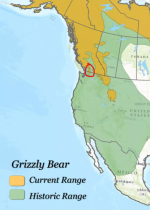
1699399023852.png
 
Not many bears in the BC portion of the North Cascades.

North Cascades (6 bears) - IUCN Critically Endangered
Straddling the Cascade Mountains the North Cascades grizzly bears are transboundary, sharing habitat in BC and Washington State. This highly endangered grizzly bear population, estimated at as few as 6 animals, is separated from BC’s coastal grizzly bear populations by the Fraser Canyon, Highway 1 and two railroads and is bounded on the east by the Similkameen River.

 
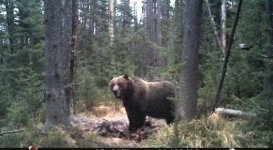
One of those inland berry-eating bears that stay in established Grizzly ranges. Nephew caught this game camera photo several years ago back home. Griz was feeding on a wolf-killed Moose calf. This bear was 2/3 of the way between Butte & Deerlodge.MT Grizzly (1) 9-2019.jpg
 
Last edited:
Go Grizz !!!
:)
 
Maybe already discussed here, so forgive me if I'm doubling up on a question already asked....
If grizzly bears could/would thrive in the north cascades, why isn't the current range expanding further into the area they already are on the fringe of?

There's a population of some size currently bordering the north cascades, what's stopping them from expanding into that area all on their own? Assuming it's not being limited by diet and/or habitat (as has been pointed out, they eat veg, and there's veg there). So what's stopping the grizz from naturally moving into this area if it's suitable habitat?

If the area they currently inhabit is suitable, and so is the area in the north cascades, one would imagine they'd naturally start to inhabit that area were there is no competition - right?

Maybe they're canadian bears and they're just respecting the border?
View attachment 89522
Because we haven't told them yet they will be strict vegetarian bears in this zone...once they make it through the zoom meeting everyone will be on the same page😁
 
Not many bears in the BC portion of the North Cascades.

North Cascades (6 bears) - IUCN Critically Endangered
Straddling the Cascade Mountains the North Cascades grizzly bears are transboundary, sharing habitat in BC and Washington State. This highly endangered grizzly bear population, estimated at as few as 6 animals, is separated from BC’s coastal grizzly bear populations by the Fraser Canyon, Highway 1 and two railroads and is bounded on the east by the Similkameen River.


I did some poking around and it seems there has been some concern about the BC Cascades Griz ppopulationand what they would eat for at least 5 years.

 
I believe you are correct...they ate a bunch of odd stuff, but fats are more difficult to come by.
 
Maybe already discussed here, so forgive me if I'm doubling up on a question already asked....
If grizzly bears could/would thrive in the north cascades, why isn't the current range expanding further into the area they already are on the fringe of?

There's a population of some size currently bordering the north cascades, what's stopping them from expanding into that area all on their own? Assuming it's not being limited by diet and/or habitat (as has been pointed out, they eat veg, and there's veg there). So what's stopping the grizz from naturally moving into this area if it's suitable habitat?

If the area they currently inhabit is suitable, and so is the area in the north cascades, one would imagine they'd naturally start to inhabit that area were there is no competition - right?

Maybe they're canadian bears and they're just respecting the border?
View attachment 89522
Ask any Canadian about the "Canadian Shield"! I asked fellow fly flingers in Alberta why there were no rattlesnakes in the area of Alberta I was fishing when just south of the border in the US there were scores of them. Their reply was, "Canadian Shield, ay".😁
 
Diet varies significantly across grizzly populations. They are opportunistic and will feed on what’s available. Based on very limited reading I have done, the majority of mammals they consume are not ungulates. Unless ungulates are readily available and then, mostly scavenging winter kill or stealing from other predators. I also believe they have not repopulated in the North Cascades because it’s an isolated island. With an isolated population - like most populations in the lower 48 and these are not mice or rabbits. If they get to the goal population, will there be conflicts outside of the recover areas in lower elevations. Of course, you only need to look at neighboring states to see that. We’re humans, IMO we can do a few things to adapt to that reality. Honestly, it’s the least we can do considering. Will that happen though, probably not unfortunately.

That said, we can start by being Johnny on the spot when the Grubhub driver rings your doorbell in bear country….black or brown :).

 
I'm probably going to be advised I'm a Neanderthal in my understanding of intact ecosystems and such but I don't see the point. I mean I actually don't see the point in stocking grizzlies or wolves for that matter. I mean they will occur in the habitat available. I see protecting them and allowing them to survive and even thrive. But I'm always astonished at the fact that the same people adamantly opposed to hatchery fish seem to have little issues with going through multiple mental flaming hoops to introduce big ass predators into an environment. So here I am. I just don't get it. I see the benefits in Yellowstone with wolves. I'm not completely stupid or ignorant on what their presence means to the landscape. Do people seriously think we will yield the same benefits in Washington? I don't see it, I don't get it.
 
I'm probably going to be advised I'm a Neanderthal in my understanding of intact ecosystems and such but I don't see the point. I mean I actually don't see the point in stocking grizzlies or wolves for that matter. I mean they will occur in the habitat available. I see protecting them and allowing them to survive and even thrive. But I'm always astonished at the fact that the same people adamantly opposed to hatchery fish seem to have little issues with going through multiple mental flaming hoops to introduce big ass predators into an environment. So here I am. I just don't get it. I see the benefits in Yellowstone with wolves. I'm not completely stupid or ignorant on what their presence means to the landscape. Do people seriously think we will yield the same benefits in Washington? I don't see it, I don't get it.
Well, that's just step 1, step 3 or 4 involves removing YOU from the environment too.
 
I did some poking around and it seems there has been some concern about the BC Cascades Griz ppopulationand what they would eat for at least 5 years.

Bear type thread drift: I was working on a project on the White River (Lake Wenatchee) when a resident of the lake was mauled by a black bear. If I remember right, the bear was old and the wild berry crop had been poor. The bear was rummaging in garbage cans when the man happened on the bear. We were busting a lot of brush on that project and wondered if there were other hungry bears around....
 
Bear type thread drift: I was working on a project on the White River (Lake Wenatchee) when a resident of the lake was mauled by a black bear. If I remember right, the bear was old and the wild berry crop had been poor. The bear was rummaging in garbage cans when the man happened on the bear. We were busting a lot of brush on that project and wondered if there were other hungry bears around....
I think I remember seeing that on the news, a resident near Lake Wenatchee attacked by a bear. Maybe about 10 years ago or so?
 
I spent a few minutes looking up harvest reports this morning for the area. Game management unit 203 Pasayten has had zero elk harvest last several years and averages 10-15 deer a year for harvest. That is a huge GMU. I am not sure I could find another GMU with worst numbers.

I fully understand Grizzly bears are omnivores but I think it is justified to question placing them in an area without essentially any measurable numbers of ungulates.
 
Status
Not open for further replies.
Back
Top