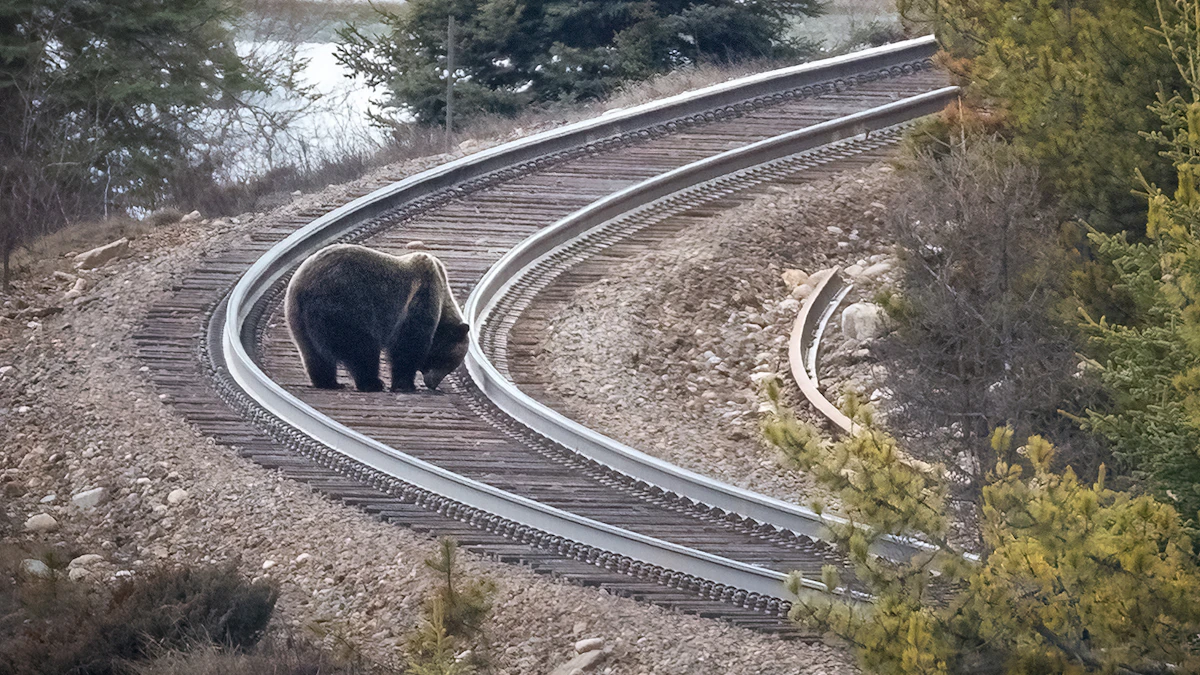
U.S. drafts plan to bring grizzly bears back to Washington’s North Cascades (WAPO)

Status
Not open for further replies.
I'll bite, what are the things that have disallowed them to repopulate, that are likely to change? I ask generally, I'm pretty pro predator in general but I agree with the notion that there isnt a lot to eat in the north cascades for Grizzlies. Salmon runs dont make the high country and even if they did, would it be a viable source of food for bears with runs as they are?

What I know about bears is they are really really good at finding food. If there is food for bears, bears find it. I think the lack of grizzlies in the area says a lot about its ability to support grizzlies.
Good question. https://www.mtpr.org/montana-news/2...-grizzly-bear-recovery-in-the-lower-48-states

The map reminds me of how far Salmon and Steelhead once migrated before dams and overpopulation commenced.
 
Good question. https://www.mtpr.org/montana-news/2...-grizzly-bear-recovery-in-the-lower-48-states

The map reminds me of how far Salmon and Steelhead once migrated before dams and overpopulation commenced.
Respectfully, that appears to be a list of protections, listings and acts designed to protect and repopulate Grizzlies across the west. If anything, that list shows even further that despite having every available protection the North Cascades simply doesnt support grizzlies as it once did, and that is unlikely to change.

Historically, those bears roamed from the high country to the estuaries, depending on food availability. That's the only way they would make it today as well.
 
Respectfully, that appears to be a list of protections, listings and acts designed to protect and repopulate Grizzlies across the west. If anything, that list shows even further that despite having every available protection the North Cascades simply doesnt support grizzlies as it once did, and that is unlikely to change.

Historically, those bears roamed from the high country to the estuaries, depending on food availability. That's the only way they would make it today as well.
Can you imagine if they relocated them to the estuaries?

Of course we all know how well that would go over. Much better to put them in someone else's area....
 
"what are the things that have disallowed them to repopulate, that are likely to change?" This was your question as I read it.

"Facing threats from habitat loss, hunting and conflicts with people and livestock" was what I took from the article.

Grizzly bears are omnivores and opportunists. There is no direct information about the grizzly bear diet in the North Cascades that I am aware of. Based on research elsewhere it is expected their diet consists mostly of vegetation –berries, grasses, leaves, roots, corms and bulbs. They also feed on carrion (dead things), insects, fish, small mammals, and will steal kills from other predators.
 
Plenty of hoary marmot for grizz to eat up there, huckleberry too. White pine nuts, elk calves, dead bison,, and moths though...
 
Last edited:
"Facing threats from habitat loss, hunting and conflicts with people and livestock"
I'm skeptical that many of those factors apply to grizzly bears in the NCE. The NCNP is pristine intact; the NRA is nearly pristine; and the National Forest, while not pristine, is certainly decent. No one's been hunting grizzlys for 50 years in WA, so that's not applicable to the NCE. And in order for conflicts with people and livestock, there has to be a bear in an area containing people and livestock. The human/grizzly overlap has been so extremely slight, with a sighting about once every few years, that I'm hard pressed to consider that a limiting factor. And a conflict with livestock is only likely once a bear wanders downhill far enough to encounter grazing livestock. Once that happens there will be conflict, and yes, that will probably be limiting. But we're a long ways from being there yet.

Until I see some clear, cogent, and convincing evidence indicating otherwise, I still think that if the habitat were truly suitable, the bears would already be there. Since they have been sighted from time to time, I'll go out on a limb and say that grizzly bears currently inhabit the NCE at the level the habitat is capable of supporting, since there's nothing been shown that would stop them from being there.
 
Last edited:
Can you imagine if they relocated them to the estuaries?

Of course we all know how well that would go over.
Lol
It's highly unlikely that would ever be considered to be a good place for successful reintroduction to take place, given the very high likelihood of interactions with humans, the considerable habitat degradation etc. It's not like the Duwamish would be considered, nor the mouth of the Snohomish either. Too many couches, too many Starbucks, too good of cell reception

A more reasoned and serious point of view could bolster an argument for opposing the reintroduction, and while there certainly may be one, this isn't it.
The NCE has much better chances of a successful reintroduction than the Duwamish, and from what I have read, even there the prime grizzly habitat is limited, and marginal grizzly habitat is also not large.
Go Grizzly !!!
:)
 
Lol
It's highly unlikely that would ever be considered to be a good place for successful reintroduction to take place, given the very high likelihood of interactions with humans, the considerable habitat degradation etc. It's not like the Duwamish would be considered, nor the mouth of the Snohomish either. Too many couches, too many Starbucks, too good of cell reception

A more reasoned and serious point of view could bolster an argument for opposing the reintroduction, and while there certainly may be one, this isn't it.
The NCE has much better chances of a successful reintroduction than the Duwamish, and from what I have read, even there the prime grizzly habitat is limited, and marginal grizzly habitat is also not large.
Go Grizzly !!!
:)
I obviously wasn't actually recommending a relocation effort to the coast. If my point about placing them in someone else's backyard is lost then I apologize for the confusion....
 
Whoa! Grizzlies hooked on second-hand meth. Not good!
Yogi sez to Boo-boo "Hold my beer!"


Getting “drunk” on fermented grain has killed dozens of grizzly bears along a treacherous stretch of rail line near Glacier National Park, Montana.

Since 1980, 63 bears have been killed along a stretch of rail line that goes over Marias Pass and the Great Bear Wilderness, according to reports from state and federal wildlife agencies. The worst year on record was 2019, when eight grizzlies were killed by trains, and three have been killed so far this year.

Many of them likely died during a “drunken attempt” to outrun the trains, a Wyoming bear expert said.
 
I had a dream last night that WDFW had a half dozen griz and would plop them into homeless camps that popped up...
I shouldn't stay up so late. It makes me sleep too hard...
 
Yogi sez to Boo-boo "Hold my beer!"


Getting “drunk” on fermented grain has killed dozens of grizzly bears along a treacherous stretch of rail line near Glacier National Park, Montana.


Well, they have that in common with humans I see...
;)
 
I'm skeptical that many of those factors apply to grizzly bears in the NCE. The NCNP is pristine intact; the NRA is nearly pristine; and the National Forest, while not pristine, is certainly decent. No one's been hunting grizzlys for 50 years in WA, so that's not applicable to the NCE. And in order for conflicts with people and livestock, there has to be a bear in an area containing people and livestock. The human/grizzly overlap has been so extremely slight, with a sighting about once every few years, that I'm hard pressed to consider that a limiting factor. And a conflict with livestock is only likely once a bear wanders downhill far enough to encounter grazing livestock. Once that happens there will be conflict, and yes, that will probably be limiting. But we're a long ways from being there yet.

Until I see some clear, cogent, and convincing evidence indicating otherwise, I still think that if the habitat were truly suitable, the bears would already be there. Since they have been sighted from time to time, I'll go out on a limb and say that grizzly bears currently inhabit the NCE at the level the habitat is capable of supporting, since there's nothing been shown that would stop them from being there.
I'm no bear biologist but my assumption is that it's due to a combination of age of maturity (a quick Google says 3-8 years for grizz, 2 years for wolves), lower fecundity compared to wolves (1-4 offspring for grizz, 4-7 for wolves), length of time the offspring stay with mom(grizz 2-3 years, wolves 1-2 years). Plus how far dispersing offspring travel but I can't find a good source or W.A.G. for that.

Looking at the blobs in the map of the Grizzly Bear Recovery Zones and Distribution it also seems to support that grizzly bears aren't super fast recolonizers. But the argument could also be made that they don't want to leave what is currently identified as good habitat in the 6 recovery areas.
 
Rivers are blown, so I'm really grateful for this thread.

Yes, Griz are in the North Cascades. A friend was hiking out of Marblemount on the Pacific Crest Trail several summers ago and showed me his bear pics from the trail after he returned. Taken from about 200yds, you could clearly see the telltale hump of a Griz.. If that bear wanted human snacks there was plenty of opportunity.

I'm sure they're populating the remote areas of the North Cascades where sufficient food is available. It -is- remote, if you look at that area between Marblemount and Stehekin on Google Earth you'll get an idea of just how much is remote. Or the area around Ross Lake.

Quite a bit different that the clusterfuck around I-90 and the Enchantments.

I personally would like to see them stop at 3-5 Griz introduced, then wait 10 years to see how it goes.

Or, as an alternative, fit those Griz with radio transmitting collars and drop a couple off at the Cracker Bar on the Sky. After they clean out a few camps, trank 'em and take them back to the wilderness to sleep off the toxic after effects of their meal.
 
It -is- remote, if you look at that area between Marblemount and Stehekin on Google Earth you'll get an idea of just how much is remote.
I have hiked in and around that area many times. There are some great places up there, and you won't see a lot of people outside of a few well known and heavily used trails.
Once you start on the way trails and game paths is when the fun starts.
 
I'm skeptical that many of those factors apply to grizzly bears in the NCE. The NCNP is pristine intact; the NRA is nearly pristine; and the National Forest, while not pristine, is certainly decent. No one's been hunting grizzlys for 50 years in WA, so that's not applicable to the NCE. And in order for conflicts with people and livestock, there has to be a bear in an area containing people and livestock. The human/grizzly overlap has been so extremely slight, with a sighting about once every few years, that I'm hard pressed to consider that a limiting factor. And a conflict with livestock is only likely once a bear wanders downhill far enough to encounter grazing livestock. Once that happens there will be conflict, and yes, that will probably be limiting. But we're a long ways from being there yet.

Until I see some clear, cogent, and convincing evidence indicating otherwise, I still think that if the habitat were truly suitable, the bears would already be there. Since they have been sighted from time to time, I'll go out on a limb and say that grizzly bears currently inhabit the NCE at the level the habitat is capable of supporting, since there's nothing been shown that would stop them from being there.
The following excerpt comes from the Western Wildlife Outreach history of Grizzly bear and their dramatic decline.

Grizzly Bears in the North Cascades of Washington​

Hudson Bay Company trapping records show that 3,788 grizzly bear hides were shipped from trading posts in the North Cascades area between 1827 and 1859. The decimation of the North Cascades grizzly bear population continued for more than a century with commercial trapping, habitat loss, and unregulated hunting the leading causes of death. The last grizzly bear to be killed in the North Cascades of Washington was in 1967 in Fisher Creek (in what is now North Cascades National Park).

Of North Cascades grizzly bear sightings reported to government agencies between 1950 and 1991, 20 were confirmed and an additional 81 were considered highly probable. Today, the estimated resident population in Washington’s North Cascades is between 5 and 20 bears (the estimated population in British Columbia’s North Cascades is also 5 to 20 bears). Most likely the home ranges of a small number of grizzly bears span the border.

It would seem that there were a hell of lot more Grizz in them there hills at one time.
 
Last edited:
We are told that across the west where ever the bears had access to salmon they did well. The "bonus" food source help support larger and more productive bears and larger populations. I find it hard to imagine a situation in the west side of the north Cascades where many more grizzly bears could exist without taking advantage of the food resources provided by spawning salmon.

Of course, the bears interacting with the salmon with few exceptions will bring them in direct contact with human populations and those associated problems. Something else to consider, if another ESA listed species needs more salmon (remember the orcas) we can expect to see a push for more fish on the salmon grounds. Give societies reluctances to address habitat limiting factors the only immediate source for additional salmon will come from further fishing restrictions.

curt
 
It would seem that there were a hell of lot more Grizz in them there hills at one time.
I think maybe we're "talking past" each other, and I'm not doing all that I can to connect the dots. The details in that bit you posted from Western Wildlife Outreach matter and make a significant difference. Hunting between 1827 and 1859 - and 1859 to 1967 - are not remotely comparable to the hunting, or more accurately, the lack of hunting since 1967, or 1973 when the ESA went into effect. A key point here is that there is no record of grizzly bears being killed by hunting or any other factor since 1967. So everything that happened between 1827 and 1967 is notwithstanding when contrasted to the period since 1967.
So while the bears were relatively abundant historically, it simply cannot be said that hunting is a factor preventing an increase in the grizzly bear population during the recent 56 year period. Doing so is as misplaced and outlandish as blaming historical overfishing of Columbia River salmon in the late 19th and early 20th century for the low populations currently, when the most proximate cause of low populations is habitat destruction and degradation, especially in the form of dams.

This leads to the more likely reason grizzly bears have not increased significantly over the last half century - habitat. Just as deer, elk, and black bears don't spend all 12 months of the year in the alpine high country of the N. Cascades, grizzly bears probably didn't either, for generally the same reason: it's great summer habitat and really lousy winter habitat. If grizzly bears require a habitat mix of high and low elevation territory to do well, then I think we're getting closer to the limiting factor or factors. Low elevation habitat has been significantly modified by anthropomorphic processes, and grizzly bears attempting to occupy such habitat seasonally would inevitably encounter humans. From what I read, grizzly bears are less tolerant of human activity than their black bear cousins. Further, resources such as fish, are only 10 to 20% as abundant as they were historically in the anadromous fish zones. So a modified landscape with vastly more human activity and far less food resource, and someone expects the NCE to support up to 200 grizzly bears? It seems laughable to me. Given the factors in play, I don't see how a biologist or ecologist could conclude anything other than that the NCE is currently at its carrying capacity for grizzly bears.

 
Yogi sez to Boo-boo "Hold my beer!"


Getting “drunk” on fermented grain has killed dozens of grizzly bears along a treacherous stretch of rail line near Glacier National Park, Montana.

Since 1980, 63 bears have been killed along a stretch of rail line that goes over Marias Pass and the Great Bear Wilderness, according to reports from state and federal wildlife agencies. The worst year on record was 2019, when eight grizzlies were killed by trains, and three have been killed so far this year.


Many of them likely died during a “drunken attempt” to outrun the trains, a Wyoming bear expert said.

I live in a rural area with a rail line close by. At any rate they somehow managed to flip a rail car of grain on an essentially straight piece of track. It was an attractive thing for bears and other wildlife. It took a full two to three months to clean up. Basically animals ate it and my area had it's share of unusual wildlife interactions and sightings. This was all at the same time they were trying to get the oil train thing going along the Washington coast. I finally spoke to some of the folks cleaning it up and told them what a shining bit of marketing their performance has made on the possibility of every entrusting them to carry oil. "Oh we'd get right on oil if it spill", said the guy. Oh, I bet, was my thought. Sad part was a couple bears were shot by locals in their yards because there was an attractant that upped the interaction rate.
 
I contacted my friend who is a Game Dept guy and a fellow member of OHA (Okanogan Highlands Alliance) about this topic to see if he could answer some questions presented by this forum. Taking the time to read the EIS and listening to an
I think maybe we're "talking past" each other, and I'm not doing all that I can to connect the dots. The details in that bit you posted from Western Wildlife Outreach matter and make a significant difference. Hunting between 1827 and 1859 - and 1859 to 1967 - are not remotely comparable to the hunting, or more accurately, the lack of hunting since 1967, or 1973 when the ESA went into effect. A key point here is that there is no record of grizzly bears being killed by hunting or any other factor since 1967. So everything that happened between 1827 and 1967 is notwithstanding when contrasted to the period since 1967.
So while the bears were relatively abundant historically, it simply cannot be said that hunting is a factor preventing an increase in the grizzly bear population during the recent 56 year period. Doing so is as misplaced and outlandish as blaming historical overfishing of Columbia River salmon in the late 19th and early 20th century for the low populations currently, when the most proximate cause of low populations is habitat destruction and degradation, especially in the form of dams.

This leads to the more likely reason grizzly bears have not increased significantly over the last half century - habitat. Just as deer, elk, and black bears don't spend all 12 months of the year in the alpine high country of the N. Cascades, grizzly bears probably didn't either, for generally the same reason: it's great summer habitat and really lousy winter habitat. If grizzly bears require a habitat mix of high and low elevation territory to do well, then I think we're getting closer to the limiting factor or factors. Low elevation habitat has been significantly modified by anthropomorphic processes, and grizzly bears attempting to occupy such habitat seasonally would inevitably encounter humans. From what I read, grizzly bears are less tolerant of human activity than their black bear cousins. Further, resources such as fish, are only 10 to 20% as abundant as they were historically in the anadromous fish zones. So a modified landscape with vastly more human activity and far less food resource, and someone expects the NCE to support up to 200 grizzly bears? It seems laughable to me. Given the factors in play, I don't see how a biologist or ecologist could conclude anything other than that the NCE is currently at its carrying capacity for grizzly bears.

expert's podcast are on my agenda. Here are his comments:

The reintroduction EIS is usually the most authoritative document to be familiar with - although I haven't read it yet. Should have lots of food availability references. I always like to know the EIS because no-one else takes the time to read them.
Bill Gaines is a colleague who got his PhD studying grizzlies. His work is very sound! His podcast that is referenced should be informative!
Finally I spent a good chunk of this year (months) in the presence of grizzlies and learned how to change my behavior so I was not feeling risky - including camping in high density areas in Alaska.
I'm supporting reintroduction and ignoring the deluge of misinformation so prevalent these days.

Below is the pod cast hosted by OHA with presenter Bill Gaines. It would seem that the once prominent population of Grizzly Bears in the North Cascades was reduced to a very low group that as Dr. Gaines states "now need our help" to repopulate. Grizz need lots of berries (85% of their diet), lots of room (up to 4500 square miles per male bear), and remote areas. All of which are supplied in the North Cascades. Inland Grizz are built for digging (development of hump muscle) and are "NOT" especially fond of Salmon. The rear teeth are made for grinding and not chewing like Mr. and Mrs. Black Bear. Sounds like you should be more worried about black bears eating the last Salmon. Give the pod cast a listen as it has a lot of interesting info from a guy who has been out there for a bunch of years gathering enough data to convince the Feds to place North Cascades Grizz on the threatened list.

 
Last edited:
Status
Not open for further replies.
Back
Top