NFR Groundwater?

Non-fishing related

Flymph

Life of the Party
X_V5rZRoiJcmhGHQGhReRuB8YvkxTTquLS9pe5h9-IFaTGBNd0tKTUQmPj6viJEQ_mSaSl-_OmkcDRPqBjEP8axZMYLqPEaMWPLmW6-AAvT5dgwlI5-UHtv5lKagH8-5JzWN4HSmI991r97du1njFo5-sL-r2I_2pjvJlVEdRi9XGlbHfYW1=s0-d-e1-ft
A pool of groundwater next to sprawling alfalfa fields in Butler Valley, Ariz.Rebecca Noble for The New York Times​

Dry wells​

The water that lies beneath the earth’s surface — known as groundwater — has been a vital resource for thousands of years. Communities that are far away from lakes and rivers use groundwater to irrigate crops and provide drinking water.​
For most of human history, groundwater has existed in a convenient equilibrium. The pockets of water under the surface need years or decades to replenish as rainwater and other moisture seep into the earth. Fortunately, though, people have used groundwater slowly, allowing replenishment to happen.​
Now that equilibrium is at risk.​
Several of my colleagues — led by Mira Rojanasakul and Christopher Flavelle — have spent months compiling data on groundwater levels across the U.S., based on more than 80,000 monitoring stations. Chris and Mira did so after discovering that no comprehensive database existed. The statistics tended to be local and fragmented, making it difficult to understand national patterns.​
The trends in this new database are alarming. Over the past 40 years, groundwater levels at most of the sites have declined. At 11 percent of the sites, levels last year fell to their lowest level on record.​
The U.S., in other words, is taking water out of the ground more quickly than nature is replenishing it. “There’s almost no way to convey how important it is,” Don Cline, the associate director for water resources at the United States Geological Survey, told The Times.​
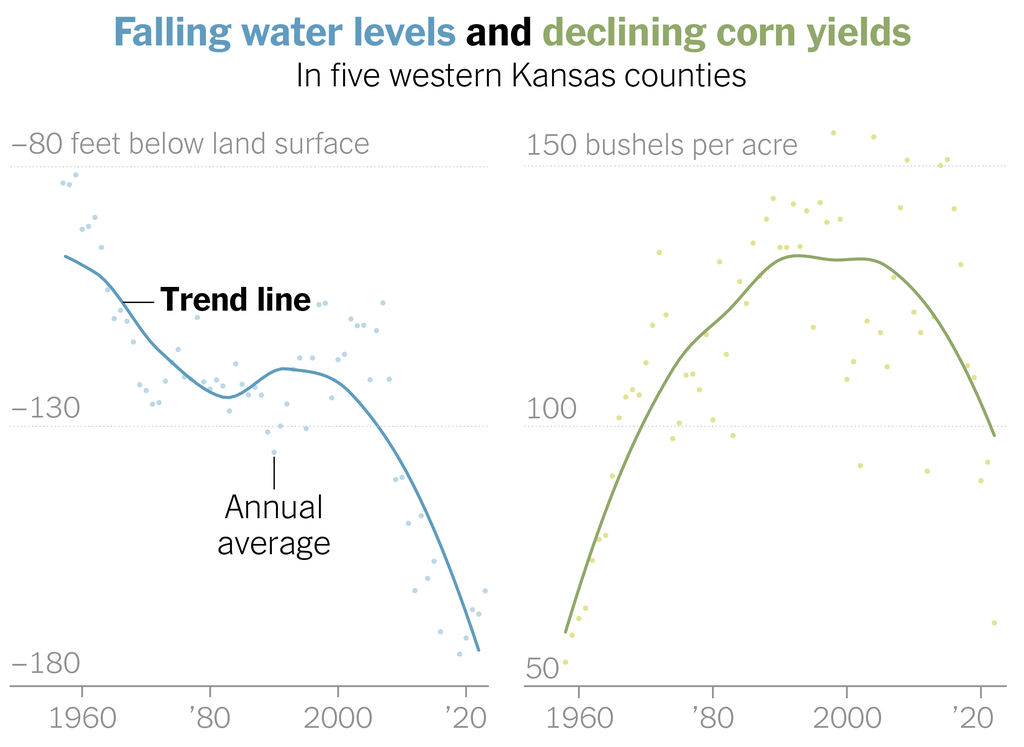
Already, there are consequences. In parts of Kansas, the shortage of water has reduced the amount of corn that an average acre can produce.​
79FUbTpGuztow-1XMgeb0N7LKEErI8FQLHZHJoXsW-oed0Ek7K8zRyZMF1fmNY87akCb0LdGPmnBalteKmyLhvPPWA1AMF_L0PbuPxZVSSgs_hJhzPnsUHTkL2rWD0hLETowGdyJIl1PwhUb9eAiDaXwIv2JqtjiG_t1ZDDU=s0-d-e1-ft
Sources: U.S.D.A., U.S.G.S., Kansas Geological Survey | By The New York Times​
In Norfolk, Va., officials have resorted to pumping treated wastewater into underground rock layers that store groundwater — known as aquifers — to replenish them. On Long Island, the depletion of aquifers has allowed saltwater to seep in and threatened the groundwater that remains.​
“We’ve built whole parts of the country and whole parts of the economy on groundwater, which is fine so long as you have groundwater,” Chris told me. “I don’t think people realize quite how quickly we’re burning through it.”​

Giant wells​

Unlike many other environmental trends, this story is not primarily about climate change, although the warming planet plays an aggravating role. There are three main reasons for the groundwater declines:​
  • Pumping technology has improved, allowing communities to draw water out of the earth much more quickly than in the past. Some wells can pump more than 100,000 gallons a day.
  • Economic growth and urban sprawl have increased the demand for water. Although the U.S. economy has not been growing rapidly in recent decades, American farms help feed other countries where the economy and population have been growing faster.
  • Climate change has reduced the amount of water that comes from alternative sources, like rivers: A warmer planet leads to less rainfall and faster evaporation of the rain that does fall. These declines have led communities to increase groundwater use.
These forces are not unique to the U.S. Other countries are coping with groundwater declines that are sometimes worse. This summer, my colleagues Vivian Yee and Leily Nikounazar reported on the dire shortages in parts of Iran, while Alissa Rubin and Bryan Denton did so in Iraq. The photographs and videos from Iraq are especially jarring.​

Protecting the commons​

Is there any solution?​
Slowing climate change, by reducing carbon emissions, would help in the long term — and the long term is obviously important. More immediately, the answer may need to involve stricter rules on how much water towns, farms and companies can remove from the ground. “In many places,” Chris said, “the rules are weak or nonexistent.”​
The federal government neither tracks the situation nor does much to regulate it. Some state and local governments — in parts of Arizona, for instance, and Texas — also have lax rules.​
It’s a classic tragedy of the commons. The ecologist Garrett Hardin popularized that term in a 1968 essay based on a 19th-century pamphlet by William Forster Lloyd, an English economist. In the pamphlet, Lloyd explained that any individual farmer had an incentive for his cattle to eat as much grass as possible in any field that the community shared. But if all the farmers did so, the field would be ruined. The solution is for the farmers to agree on a set of rules that benefit all of them in the long run.​
 
"A warmer planet leads to less rainfall and faster evaporation of the rain that does fall."

I'm not certain this is correct.....
Agree to an extent.

Warming global temps increase the rate of evaporation worldwide. More evaporation is causing more precipitation, on average. We are already seeing impacts of higher evaporation and precipitation rates, and the impacts are expected to increase over this century as climate warms.

Higher evaporation and precipitation rates are not evenly distributed around the world. Some areas may experience heavier than normal precipitation, and other areas may become prone to droughts, as the traditional locations of rain belts and deserts shift in response to a changing climate. Some climate models predict that coastal regions will become wetter and the middle of continents will become drier. Also, some models forecast more evaporation and rainfall over oceans, but not necessarily over land.

Any way you spin it the Groundwater is declining. This decline could lead to catastrophic issues and needs to be closely monitored.

 
And just when we think things cannot be more utterly corrupt or just wrong, we have this..local farmers watching their land turn into dustbowls while Saudi owned farms pump water freely to grow hay to send to Saudi Arabia to feed to Saud cattle because...Saudi Arabia does not allow their own groundwater to be used to grow hay...

 
Agree to an extent.

Warming global temps increase the rate of evaporation worldwide. More evaporation is causing more precipitation, on average. We are already seeing impacts of higher evaporation and precipitation rates, and the impacts are expected to increase over this century as climate warms.

Higher evaporation and precipitation rates are not evenly distributed around the world. Some areas may experience heavier than normal precipitation, and other areas may become prone to droughts, as the traditional locations of rain belts and deserts shift in response to a changing climate. Some climate models predict that coastal regions will become wetter and the middle of continents will become drier. Also, some models forecast more evaporation and rainfall over oceans, but not necessarily over land.

Any way you spin it the Groundwater is declining. This decline could lead to catastrophic issues and needs to be closely monitored.
They listed that as one of the three major reasons that groundwater is drying up.....
I have a hard time taking an article seriously that is 66% correct....
 
They listed that as one of the three major reasons that groundwater is drying up.....
I have a hard time taking an article seriously that is 66% correct....
 
And just when we think things cannot be more utterly corrupt or just wrong, we have this..local farmers watching their land turn into dustbowls while Saudi owned farms pump water freely to grow hay to send to Saudi Arabia to feed to Saud cattle because...Saudi Arabia does not allow their own groundwater to be used to grow hay...

Why the U.S. so willingly allows itself to be used by others as a third world country - you know, the kind of country where natural resources are exploited and exported to a first world country - continues to flumoxe me. Kind of like cutting our forests to send raw logs overseas for processing and use.
 
Why the U.S. so willingly allows itself to be used by others as a third world country - you know, the kind of country where natural resources are exploited and exported to a first world country - continues to flumoxe me. Kind of like cutting our forests to send raw logs overseas for processing and use.
Capitalism run amok...unregulated on as many levels as it can be seems to be the goal, as making as much money as possible= good, anything other than that= bad. Dismantling the administrative state is the latest catch phrase used to further undo anything that gets between an entity and its profits.

Sell them the rope to hang us with, seems there's an oft misattributed quote to that effect I've heard before...

...and so it goes...
 
Why the U.S. so willingly allows itself to be used by others as a third world country - you know, the kind of country where natural resources are exploited and exported to a first world country - continues to flumoxe me. Kind of like cutting our forests to send raw logs overseas for processing and use.
You mean, why do we let foreign entities buy US land?
 
Don’t blame the foreigners. They just do here what we do….pump until it’s gone, and call for gummint bailouts. Someday someone will tell the true, complete story of the Odessa groundwater subarea in central Washington. There’s plenty published on it already…And it ain’t no Chinese or Saudi overuse… no sir. It’s us rugged individualist ‘mericans.
 
Because greed will always trump patriotism
And because when people create laws that stop everyone who isn't a permanent resident or US citizen from buying land they get called racist and get sued....which happened very recently.

Or if it's within a few miles from a US military base, then it's not racist and it's OK. Which also happened fairly recently.
 
Or if it's within a few miles from a US military base, then it's not racist and it's OK. Which also happened fairly recently.
I heard that the Chinese were stopped from buying land within a few miles of a military base. Who knows what it would lead to....
 
Last edited:
Why the U.S. so willingly allows itself to be used by others as a third world country - you know, the kind of country where natural resources are exploited and exported to a first world country - continues to flumoxe me. Kind of like cutting our forests to send raw logs overseas for processing and use.
You mean, ahhh, like oil?

The United States is the fifth-largest oil exporter. It exported $67.6 billion worth of oil in 2021, comprising 7.11% of global exports. The country significantly increased its oil output between 2011 and 2020. In 2022, the U.S. produced 20.21 million barrels of oil per day, about 20% of the global total, making it the world's largest oil producer.
 
Back
Top