
Last edited:

Follow along with the video below to see how to install our site as a web app on your home screen.
Note: This feature may not be available in some browsers.

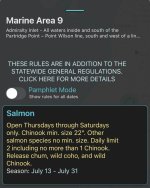
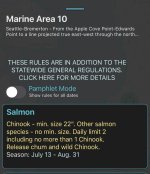
At quick glance the app has various rulings for wild coho in marine areas. From it it looks like you can harvest wild coho in 10 but not 9(?)I have what is likely a silly question but can't seem to find any definitive answer online regarding resident coho. Are hatchery resident clipped adipose and native residents intact adipose? Are there native residents or are all native coho ocean bound? The handful I've netted to date have all been around 3 Lbs or so and all have had intact adipose. I'm assuming if I want to harvest one for a fresh meal it's clipped adipose only on these smaller fish.
Thanks


Interesting. I had sort of baselessly assumed that a much larger percentage were south sound net pen fish.Historically Puget Sound sub-populations of Chinook, coho, and pinks that opted to remain in Puget Sound for their marine rearing. It appears that both hatchery and wild salmon take advantage of that lifestyles. Indications are that those fish with delayed juvenile marine migration are more apt to adopt that resident life history though not iron clad, It is thought that wild Chinook with older juveniles and wild coho from larger lake system (extra time in freshwater rearing) were more prone to reside in the sound. The resident pinks were common into the mid-1950s, recently there have been a few seen in that resident coho fishery.
The resident coho in Puget Sound in a true mixed stock fishery attracting fish from throughout the region. Looking at the coho Code Wire Tag information for the most recent 3 years (2020-2022) collected in MA 10 during June and the first half of July highlights the mixed stock nature of that fishery. From that information1% were from BC hatcheries, 25% from North Sound hatcheries, 9% from Hood Canal hatcheries, 42% from central sound (Green and Puyallup), 16% from South Sound hatcheries and 8% from South Sound net pens.
Curt
Historically Puget Sound sub-populations of Chinook, coho, and pinks that opted to remain in Puget Sound for their marine rearing. It appears that both hatchery and wild salmon take advantage of that lifestyles. Indications are that those fish with delayed juvenile marine migration are more apt to adopt that resident life history though not iron clad, It is thought that wild Chinook with older juveniles and wild coho from larger lake system (extra time in freshwater rearing) were more prone to reside in the sound. The resident pinks were common into the mid-1950s, recently there have been a few seen in that resident coho fishery.
The resident coho in Puget Sound in a true mixed stock fishery attracting fish from throughout the region. Looking at the coho Code Wire Tag information for the most recent 3 years (2020-2022) collected in MA 10 during June and the first half of July highlights the mixed stock nature of that fishery. From that information1% were from BC hatcheries, 25% from North Sound hatcheries, 9% from Hood Canal hatcheries, 42% from central sound (Green and Puyallup), 16% from South Sound hatcheries and 8% from South Sound net pens.
Curt

I've grown up fishing the Puyallup and there are a large amount of smaller coho that run up the river in August. There were a ton of these smaller fish in MA 11 this year and I've just thought of them as those fish that return up the river earlyHistorically Puget Sound sub-populations of Chinook, coho, and pinks that opted to remain in Puget Sound for their marine rearing. It appears that both hatchery and wild salmon take advantage of that lifestyles. Indications are that those fish with delayed juvenile marine migration are more apt to adopt that resident life history though not iron clad, It is thought that wild Chinook with older juveniles and wild coho from larger lake system (extra time in freshwater rearing) were more prone to reside in the sound. The resident pinks were common into the mid-1950s, recently there have been a few seen in that resident coho fishery.
The resident coho in Puget Sound in a true mixed stock fishery attracting fish from throughout the region. Looking at the coho Code Wire Tag information for the most recent 3 years (2020-2022) collected in MA 10 during June and the first half of July highlights the mixed stock nature of that fishery. From that information1% were from BC hatcheries, 25% from North Sound hatcheries, 9% from Hood Canal hatcheries, 42% from central sound (Green and Puyallup), 16% from South Sound hatcheries and 8% from South Sound net pens.
Curt
I saw that 50% (2,142/4,300) of MA9 quota is already gone.
Would reaching the quota early shut down fishing for coho and pinks in July?
I saw that 50% (2,142/4,300) of MA9 quota is already gone.
Would reaching the quota early shut down fishing for coho and pinks in July?
I am much less sure.. WDFW closed MA11 to all salmon fishing at 19% of the quota (one of 3 quotas apparently needed to manage salmon), so I would definitely recommend preparing yourself for a mule kick to the groin when it comes to PS salmon fishing options.I saw that 50% (2,142/4,300) of MA9 quota is already gone.
Would reaching the quota early shut down fishing for coho and pinks in July?